
PaintingProGuide is reader-supported. When you buy through links on this page we may earn an affiliate commission at no extra cost to you.
Texture art lives or dies on the brush. Soft synthetics smooth paint out; a stiff bristle brush for texture art does the opposite, dragging ridges into heavy-body acrylic, flicking broken marks for grass and foliage, and stippling dense dots that read as moss, stone or fur. The stiffness that makes these brushes useful usually comes from natural hog bristle, which has split “flagged” tips and enough spring to push thick paint around without collapsing.
The six sets below cover the main stiff-brush shapes texture painters reach for: splayed texture brushes, hog fans, stencil and stippling brushes, and comb brushes for parallel lines. Each one makes a different kind of mark, so the right choice depends on what you want your surface to look like.
Quick answer: For dedicated texture work, the Fuumuui Texture Paint Brush Set is the strongest starting point: five hollow natural hog split-bristle flats designed to scatter dots, speckles and wispy strokes in one pass. If you mainly paint landscapes in heavy acrylic or oil, the DUGATO Stiff Hog Hair Fan Brush Set gives seven sizes on long handles. For stippled, sponge-like texture on canvas, wood or furniture, the GACDR Stencil Brush Set pairs flat-top and dome-shaped hog brushes at a low price.
Our Top Picks at a Glance
- Fuumuui Texture Paint Brush Set (5 pcs, hollow hog split bristle) — Best overall for scattered texture marks
- DUGATO Stiff Hog Hair Fan Brush Set (7 pcs, long handle) — Best for landscape texture at the easel
- GACDR Fan Brush Set (7 hog bristle fans) — Best budget fan brushes for thick paint
- GACDR Stencil Brush Set (6 pcs, flat and dome) — Best for stippling and pounced texture
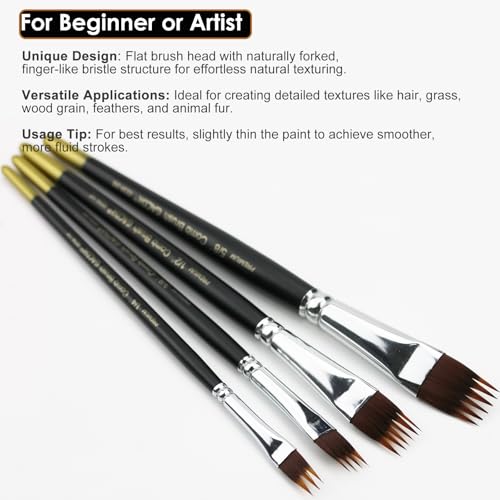
- GACDR Grainer Comb Brush Set (4 pcs) — Best for wood grain, fur and parallel lines
- Penta Angel Wooden Stencil Brushes (6 pcs) — Best inexpensive stipplers in three diameters
| Product | Best For | Key Spec | Key Strength | Price Tier |
|---|---|---|---|---|
| Fuumuui Texture Set | Foliage, moss, speckled texture | 5 flats; hollow hog split bristle | One-pass broken marks | $$ |
| DUGATO Hog Fan Set | Grass, skies, impasto blending | 7 fans #2–#14; 12 in handles | Long handles for easel work | $ |
| GACDR Fan Set | Thick acrylic and oil texture | 7 hog fans #2–#14 | Seven sizes in one budget pack | $ |
| GACDR Stencil Set | Stippling, pouncing, stencils | 3 flat-top + 3 dome hog brushes | Two head shapes in one set | $ |
| GACDR Comb Set | Wood grain, fur, feathers | 4 comb brushes 1/4–5/8 in | Repeatable parallel strokes | $ |
| Penta Angel Stencil Brushes | Small stippled areas | 6 brushes; 6/10/16 mm | Clear size options | $ |
How We Chose
These picks are based on the Amazon listing details and specifications checked in October 2026, how well each brush’s bristle type, head shape and size range fit texture painting, and how widely each product is reviewed by Amazon buyers. We did not paint with these brushes; all product facts come from their listings, and general guidance reflects well-established properties of hog bristle and synthetic fibers.
- Bristle stiffness: natural hog bristle was preferred because it holds its shape under thick paint. Synthetic comb brushes were included only for a mark hog cannot easily make.
- Head shape: each pick produces a distinct texture: splayed, fan, stipple or comb.
- Size range: sets with several sizes scored higher, since texture work scales from small accents to large fields.
- Construction: crimped ferrules and stated anti-shedding design matter when you scrub and pound brushes.
- Medium compatibility: brushes listed for heavy-body acrylic and oil were favored over watercolor-first sets.
Best Stiff Bristle Brushes for Texture Art Reviewed
1. Fuumuui Texture Paint Brush Set — Best for scattered, organic texture

Fuumuui built this set specifically for texture. The five flats use hollow natural hog bristle that is separated, or split, at the tip, so a single press leaves a cluster of dots and wisps instead of a solid stroke. The listing pitches it for tree moss, foliage clusters, wild grass, distant shrubs and terrain, which is exactly where a stiff, broken mark beats careful detail painting.
The bristle is described as stiff and elastic, able to resist bending under heavy pigment and to carry oil, acrylic and even diluted watercolor. Handles are polished wood, and the copper ferrules are double-crimped to keep the hog hair locked in. It is the most specialized set here and sits a tier above the rest.
Best suited for: Landscape and nature painters, texture-focused abstract artists and anyone tired of trying to dab foliage with a regular flat.
Key features:
- Five flat texture brushes
- Hollow, split natural hog bristle
- Works with oil, acrylic, gouache and watercolor
- Polished wood handles
- Double-crimped copper ferrules
Pros:
- Purpose-made for broken texture marks
- Stiff hog holds heavy paint
- Usable across several mediums
Cons and limitations:
- Specialized: not a substitute for standard flats and rounds
- Listing does not specify individual brush sizes
- Higher price tier than the other sets
Buying consideration: Texture brushes work best with paint that is not too wet. Blot the loaded brush once on a paper towel before stippling to keep the dots separate.
2. DUGATO Stiff Hog Hair Fan Brush Set — Best for landscape texture at the easel
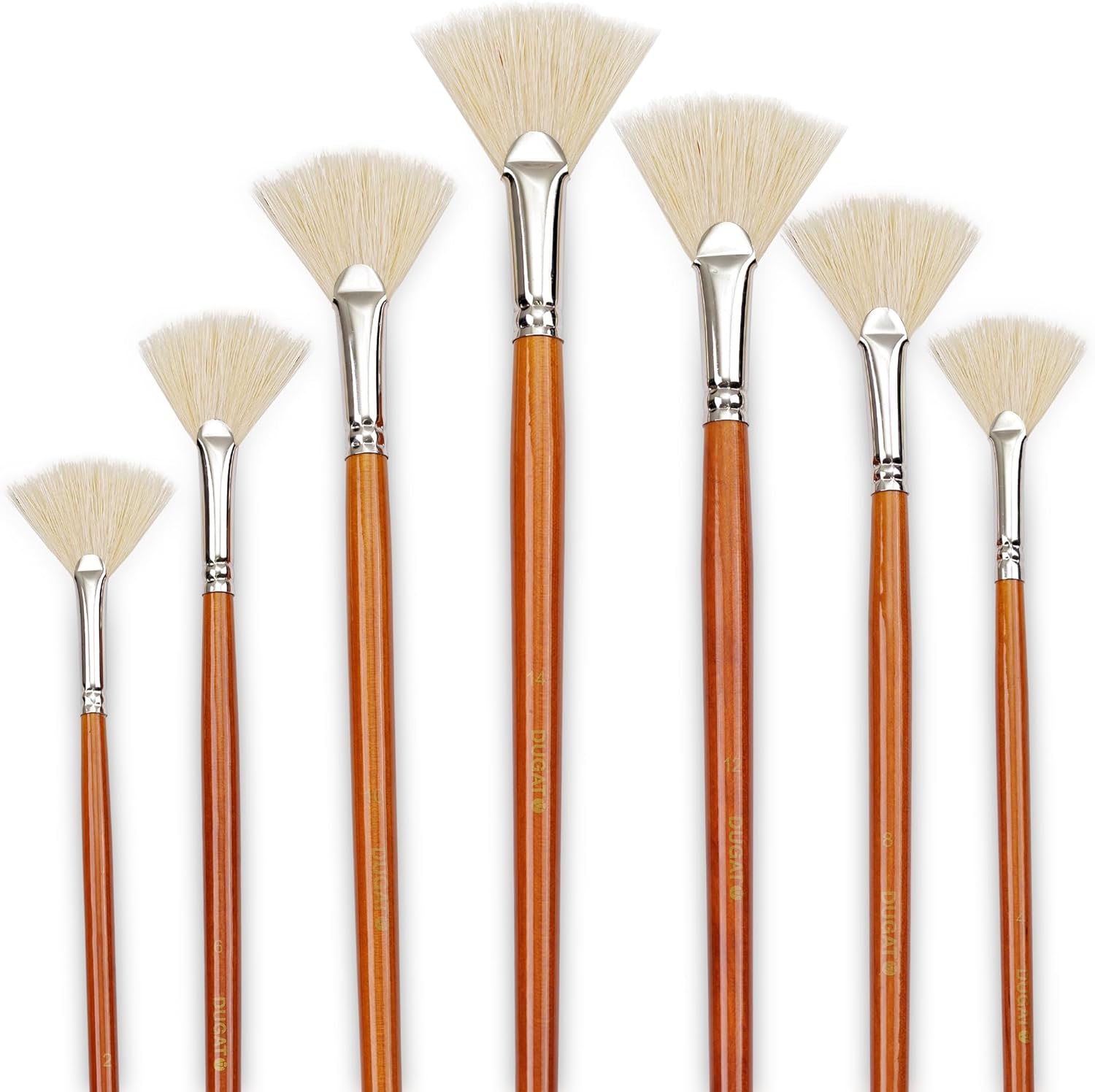
A fan brush is the classic stiff-bristle texture tool, and DUGATO’s set gives you seven of them, sizes #2 through #14. The bristle is white hog hair that the listing describes as stiff yet responsive, with flagged tips that hold heavy-body acrylic and oil and release them for blending, dry brushing and feathered texture.
Two details set it apart from cheaper fan packs. The handles are 12-inch solid birch with a lacquer finish, which lets you work at arm’s length on an easel, and the ferrules are double-crimped aluminum. DUGATO also lists the fans for ceramic glaze and underglaze, a sign the heads hold a lot of material.
Best suited for: Easel painters working on landscapes, grasses, foliage, fur and soft-edged texture in acrylic or oil.
Key features:
- Seven fan brushes #2–#14
- Natural white hog hair with flagged tips
- 12-inch lacquered birch handles
- Double-crimped aluminum ferrules
- Also suited to ceramic glazing
Pros:
- Long handles suit standing work
- Wide size range
- Holds heavy paint well
Cons and limitations:
- Long handles are awkward for small tabletop work
- Fans alone will not cover every texture
- Natural hair needs prompt cleaning
Buying consideration: If you paint seated at a table, the shorter-handled GACDR fan set may feel more natural.
3. GACDR Fan Brush Set — Best for budget fan texture

GACDR’s fan set covers the same seven sizes as the DUGATO, #2 to #14, in hog bristle that the listing says is suited to thick strokes and texture, able to stir up heavy pigment without clumping. Copper crimped ferrules hold the heads in place, and the birch handles are finished in color.
For texture painters on a tight budget, it is an efficient way to try fans in every size. The largest brush is about 2.1 inches wide, wide enough for sweeping grass fields or skies.
Best suited for: Beginners exploring texture in acrylic or oil and painters who want spare fans for rough work.
Key features:
- Seven fan brushes #2–#14
- Hog bristle for thick paint
- Copper crimped ferrules
- Birch wood handles
- Largest brush about 2.1 in wide
Pros:
- Full size run at a low price
- Good for heavy acrylic and oil
- Easy to clean with warm soapy water
Cons and limitations:
- Handle length not specified
- Less detail on bristle grade than DUGATO
- Avoid hot water when cleaning, per listing
Buying consideration: Dedicate one or two sizes to rough texture and keep the rest cleaner for blending; abused fans splay permanently.
4. GACDR Stencil Brush Set — Best for stippling and pounced texture

Stencil brushes are round, dense and cut straight across, which makes them ideal for pouncing paint straight down onto a surface. That vertical tapping action creates a fine, sponge-like texture that softens transitions, builds stone and sand effects and adds tooth to backgrounds.
GACDR’s set includes three flat-topped brushes for crisp edges and three dome-shaped brushes for softer gradients. The listing describes natural hog hair bristle and birch handles, and names chalk paint among compatible paints, so it moves easily between canvas, wood, fabric and furniture.
Best suited for: Mixed-media artists, stencil users and anyone who wants fine stippled texture without a sponge.
Key features:
- Six natural hog bristle brushes
- Three flat-top and three dome heads
- Birch wood handles
- For stencil, oil, acrylic and watercolor
- Works on fabric, paper, wood and walls
Pros:
- Two textures in one set
- Dense heads hold their shape when pounced
- Handles chalk and craft paint
Cons and limitations:
- Not for brushed strokes; stippling only
- Sizes are not specified in the listing
- Dome heads can take time to break in
Buying consideration: Use a very small amount of paint for stippling. Overloaded stencil brushes leave blobs instead of texture.
5. GACDR Grainer Comb Brush Set — Best for wood grain, fur and feathers

A comb brush has gaps between bristle groups, so one stroke lays down a row of fine parallel lines. That makes it efficient for wood grain, fur, hair, feathers and grasses, where painting each line separately would take hours.
This is the one synthetic pick here: the listing describes split Toray synthetic and Korean nylon hair, not hog. It earns its place because the comb shape creates a texture that stiff hog fans only approximate. Sizes are 1/4, 3/8, 1/2 and 5/8 inch, with short black birch handles and seamless silver ferrules.
Best suited for: Wildlife, pet portrait and decorative painters, plus anyone faking wood grain on furniture or crafts.
Key features:
- Four comb brushes: 1/4, 3/8, 1/2, 5/8 in
- Split synthetic nylon hair
- Short birch handles
- Seamless silver ferrules
- For acrylic, watercolor, gouache and oil
Pros:
- Fast, consistent parallel strokes
- Short handles give close control
- Low price for four sizes
Cons and limitations:
- Synthetic: softer than hog with very thick paint
- Narrow range of uses
- Not suited to impasto
Buying consideration: Thin your paint slightly for comb work so each line separates cleanly.
6. Penta Angel Wooden Stencil Brushes — Best for small stippled areas

Penta Angel’s pack is the plainest set here and the most clearly sized: six natural-bristle stencil brushes in three diameters, 6 mm, 10 mm and 16 mm. The small brush handles tight stippled accents; the large one covers a background quickly.
The listing recommends soaking the brush head in warm water before first use, which suggests the bristles are bound tightly and may feel stiff at first. For texture work that stiffness is an advantage.
Best suited for: Budget buyers, kids and adults doing stencil art, and painters who want spare stipplers to dedicate to rough textures.
Key features:
- Six stencil brushes
- Three diameters: 6, 10, 16 mm
- Natural bristle with wood handles
- For oil, watercolor and acrylic
- Suitable for wood, wall and paper
Pros:
- Clear sizing
- Very inexpensive
- Two of each size for different colors
Cons and limitations:
- No dome option
- Listing gives little detail on bristle type
- Best for smooth surfaces
Buying consideration: Keep one brush per color family so you are not washing between every stipple layer.
Buying Guide: How to Choose a Stiff Bristle Brush for Texture Art
“Stiff” describes how a brush behaves, but the mark you get depends just as much on head shape and how you load it. Use these criteria to match a brush to the surface you have in mind.
Natural hog vs. stiff synthetic
Hog bristle is naturally split at the tip and has a springy, slightly coarse feel that grabs thick paint. That is why it dominates oil and heavy-body acrylic texture work. Stiff synthetics are easier to clean and do not mind long soaks in water, but most feel softer with heavy paint. Choose hog for impasto and broken marks; consider synthetic for comb and detail texture.
Match the head shape to the texture
- Split or splayed flats: scattered dots and wisps for moss, foliage and gravel.
- Fans: grass, hair, tree texture and soft blended edges.
- Stencil and dome brushes: pounced, sponge-like stippling.
- Combs: evenly spaced parallel lines for grain and fur.
Size range
Texture should scale with distance: larger marks in the foreground, smaller ones farther back. Sets with several sizes, like the seven-fan packs, let you follow that rule without buying brushes one by one.
Handle length
Long handles, like DUGATO’s 12-inch birch, keep you back from the canvas so you see the overall texture as you build it. Short handles give tighter control for tabletop work, crafts and small canvases.
Ferrule and shedding
Texture techniques are hard on brushes: pouncing, scrubbing and dragging pull at the bristles. Look for crimped or double-crimped ferrules, which every pick here lists. A stray hog hair stuck in wet impasto is hard to remove without leaving a mark.
Medium and paint consistency
Stiff brushes are at their best with heavy-body acrylic, oil and texture pastes. With fluid acrylic or watercolor, stiff bristles tend to splatter. If you plan to use thin paint, a texture set like the Fuumuui, which lists watercolor compatibility, is more forgiving.
Four Ways to Get Texture from a Stiff Brush
The brush is only half the equation. How you move it changes the result just as much as which set you buy.
- Dry brushing. Load a little paint, wipe most of it off, then drag the brush lightly across a dried layer. The paint catches only on the raised weave of the canvas or on earlier ridges, which is ideal for weathered wood, rock and highlights on grass.
- Stippling. Hold a stencil or dome brush vertically and tap straight down. Build up in light layers, letting each one dry, to create gravel, sand, distant foliage or a soft vignette.
- Flicking. With a fan or splayed texture brush, press the heel down and flick upward. Each flick leaves a cluster of blades, the fastest way to paint a field of grass.
- Dragging through wet paint. Lay down a thick layer of heavy-body acrylic or oil, then pull a comb or stiff flat through it to carve lines and ridges. Clean the brush between passes so the grooves stay crisp.
Practice each one on a scrap canvas board before starting a piece. Ten minutes of test marks will tell you more about a new brush than any spec sheet.
Learn the Techniques
Texture brushes pair well with a couple of finer tools. For crisp lines over a textured ground, read how to use a liner brush for detail work. To decide which smaller brushes you need for the finishing details on top of texture, see what size brush to use for detail acrylic work.
Common Mistakes to Avoid
- Overloading the brush. Too much paint fills the gaps between bristles and turns texture into a smear.
- Using wet, runny paint. Stiff brushes need body. Add a texture medium or use heavy-body paint.
- Making every mark the same size. Uniform texture looks like wallpaper. Vary size and pressure.
- Letting acrylic dry in hog bristle. Dried acrylic ruins a natural brush quickly. Rinse often during a session.
- Cleaning with hot water. GACDR specifically warns against it; warm, soapy water and reshaping is safer.
- Expecting one brush to do everything. Texture brushes complement, not replace, your basic flats and rounds.
FAQs
What brush is best for textured painting?
For broken, organic texture, a stiff natural hog bristle brush with split or splayed tips works best, such as the Fuumuui Texture set. For grass and fur, a hog fan is the classic choice, and for stippling, a dome or flat-top stencil brush.
Are hog bristle brushes good for acrylic?
Yes, for heavy-body acrylic and texture work. Hog bristle holds thick paint and leaves visible brushmarks. Rinse it frequently, because dried acrylic is hard to remove from natural hair.
Can I use stiff brushes with watercolor?
You can for dry-brush and splatter effects, but stiff brushes do not hold water the way soft brushes do. The Fuumuui set lists watercolor compatibility for texture effects.
What is the difference between a stencil brush and a stippling brush?
In practice they overlap. Both are round, dense and used with an up-and-down pouncing motion. Flat-top heads give crisper texture; dome heads give softer, more blended stippling.
How do I clean hog bristle brushes after acrylic?
Wipe off excess paint, rinse in warm (not hot) water with mild soap, work the soap into the heel near the ferrule, rinse, reshape and dry flat or bristles down.
Do I need a texture medium as well as stiff brushes?
Not always. Heavy-body acrylic and oil hold brushmarks well on their own. For tall ridges and sculptural effects, a modeling paste or gel gives the brush more to work with.
Final Recommendation
If you want one set dedicated to texture, buy the Fuumuui Texture Paint Brush Set. Its split hog bristle produces broken, natural marks with very little effort. Landscape painters who work standing at an easel will get more from the DUGATO long-handled fans, while the GACDR Fan Set is the budget way to get the same seven sizes.
For stippled and pounced surfaces, choose the GACDR Stencil Set for its flat and dome heads, or the Penta Angel brushes if you want clear sizes for the least money. Add the GACDR Comb Set when your subjects call for grain, hair or feathers.




