PaintingProGuide is reader-supported. When you buy through links on this page we may earn an affiliate commission at no extra cost to you.
Vegan paint for kids means paint made without animal-derived ingredients. That sounds simple, but children’s art supplies are rarely labeled that way, and “non-toxic” or “natural” on a bottle does not tell you whether milk protein, egg, beeswax or other animal products are inside. The best vegan paints for kids are the ones that clearly state a plant-based or vegetable-based formula, list their ingredients plainly, and still wash off easily and perform well on paper.
This guide explains which animal ingredients can appear in paint, how to read labels, and which kids’ paints in the Amazon listings we checked are explicitly plant-based versus simply non-toxic. We are careful to separate the two, because a family choosing vegan products deserves accurate information rather than assumptions.
Quick answer: The only paint in this guide whose listing explicitly says vegan is Lattooland Natural Vegan Finger Paints, a vegetable-based powder you mix with water, suitable from 6 months. Jar Melo Washable Finger Paint Powder is also described as made from pure vegetable powder and food-grade thickeners. For older kids who need regular tempera, Colorations Paraben-Free Simply Washable Tempera is AP certified and paraben-free, but it is not labeled vegan, so confirm ingredients with the maker.
Our Top Picks at a Glance
- Lattooland Natural Vegan Finger Paints — Best explicitly vegan paint for babies and toddlers
- Jar Melo Washable Finger Paints Powder, 6 Colors — Best vegetable-based powder with more colors
- ABEIER Washable Finger Paint, 12 Colors — Best ready-to-use finger paint (vegan status unconfirmed)
- Colorations Paraben-Free Simply Washable Tempera, 8 Pack — Best classroom tempera (vegan status unconfirmed)
- Crayola Washable Kids Paint, 6 Count — Best small starter set (vegan status unconfirmed)
- Crayola Washable Kids Paint, 12 Count with Glitter — Best for variety and sparkle (vegan status unconfirmed)
| Product | Best For | Key Spec | Key Strength | Price Tier |
|---|---|---|---|---|
| Lattooland Vegan Finger Paints | Babies and toddlers | 4 colors, powder, vegetable-based, 6 mo+ | Labeled vegan | $$ |
| Jar Melo Paint Powder | Toddlers, sensory play | 6 colors, vegetable powder, food-grade thickeners | Plant-based ingredients | $$ |
| ABEIER Finger Paint | Toddlers 1-3 | 12 colors, ASTM D-4236 | Ready to use, creamy | $ |
| Colorations Paraben-Free | Classrooms | 8 colors, 16 oz each, AP Seal | Paraben-free, versatile | $$ |
| Crayola Washable 6 Count | Small projects | 6 colors, 2 oz each | Low cost, washable | $ |
| Crayola Washable 12 Count | Variety | 6 classic + 6 glitter colors | Glitter options | $$ |
How We Chose
We have not used these paints ourselves. The selection is based on the Amazon listing details and specifications checked in October 2026, how clearly each listing describes its ingredients and safety, how well each product fits the ages it targets, and how widely each product is reviewed by Amazon buyers. Where a listing does not mention vegan or plant-based ingredients, we say so instead of guessing.
- Explicit plant-based or vegan labeling in the listing.
- Ingredient transparency: descriptions like vegetable powder or food-grade thickeners.
- Safety marks: AP Seal, ASTM D-4236 conformance and non-toxic labeling.
- Washability: clean-up from skin, clothing and surfaces.
- Age fit: taste-safe formulas for babies, regular tempera for older kids.
What Makes a Paint Vegan (or Not)?
Paint is pigment plus a binder that holds the pigment together and sticks it to paper, plus additives for texture, preservation and flow. Several traditional ingredients come from animals:
- Casein: a milk protein used as a binder in some tempera and poster paints, and the basis of casein paint.
- Egg: egg tempera is the historical meaning of “tempera,” though most modern kids’ tempera does not use egg.
- Ox gall: a wetting agent made from cattle bile, sometimes used in watercolors.
- Bone char: the source of some traditional black pigments, such as bone black.
- Carmine: a red pigment made from cochineal insects.
- Shellac and beeswax: found in some varnishes, crayons and specialty paints.
- Gelatin and glue: animal glues appear in some traditional sizing and craft products.
Most modern washable kids’ paints use synthetic binders and pigments, so many are free of animal ingredients in practice. The problem is that few brands state it. “Non-toxic” means a product has been evaluated for toxicity; it says nothing about animal content. Likewise, “natural” is not the same as vegan, since milk and beeswax are natural.
How to check if a kids’ paint is vegan
- Look for explicit vegan or plant-based labeling, like the Lattooland listing.
- Read the ingredient description for vegetable, plant or food-grade plant-derived components.
- Check allergen statements: listings that say free of dairy, casein and egg rule out the most common animal binders.
- Contact the manufacturer if nothing is stated. Many art supply brands will answer ingredient questions.
- Remember that vegan formula and cruelty-free testing are separate questions; ask about both if both matter to you.
Best Vegan Paints for Kids Reviewed
1. Lattooland Natural Vegan Finger Paints for Babies and Toddlers — Best for explicitly vegan paint for babies and toddlers

Lattooland’s listing is the clearest in this guide: it describes natural, vegetable-based, chemical-free ingredients and calls the product vegan and taste-safe. It comes as four paint powders, including pink and yellow, that you mix with water to the consistency you want, which means fresh paint each session and no preservatives sitting in a bottle.
The listing positions it for babies and kids from 6 months up and describes it as washable. The kit includes accessories for mixing and painting.
Best suited for: Parents of babies and young toddlers who want a plainly vegan, taste-safe first paint.
Key features:
- 4 paint powders
- Vegetable-based, labeled vegan
- Mix with water as needed
- Suitable from 6 months per listing
- Washable
Pros:
- Only explicitly vegan listing here
- Taste-safe for mouthing ages
- Mix only what you need
- Mid price tier
Cons and limitations:
- Only four colors
- Vegetable colors are softer than synthetic pigments
- Powder requires mixing before each session
Buying consideration: Mix small batches; fresh vegetable paint does not keep like bottled tempera. Store unused powder sealed and dry.
2. Jar Melo Washable Finger Paints Powder for Babies, 6 Colors — Best for vegetable-based powder with more colors
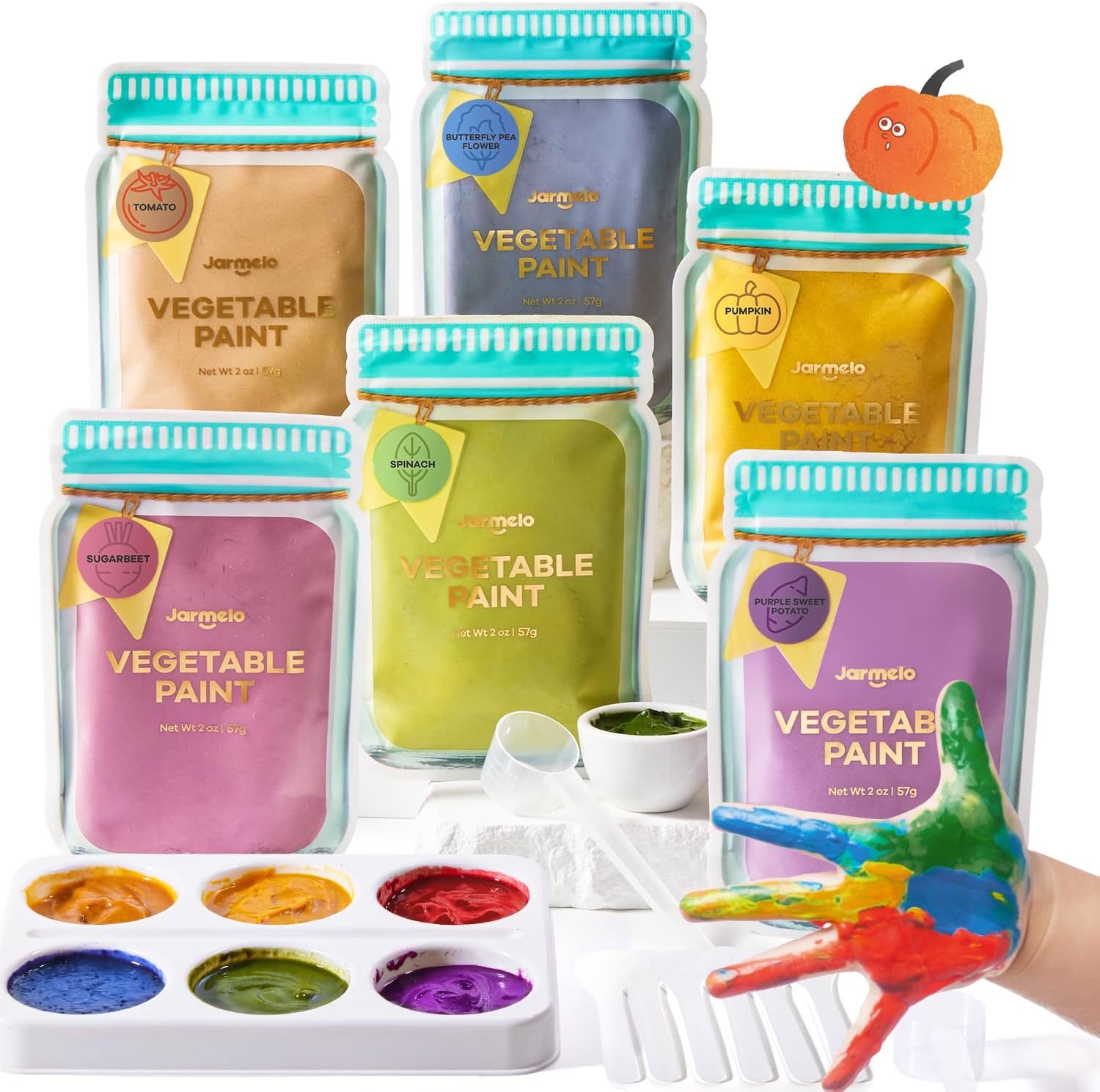
Jar Melo describes its powder as made from pure vegetable powder and food-grade thickeners, with no additives, and says it is safe if accidentally ingested. You mix it with warm water to make a creamy, mousse-like paint. The kit includes a mixing palette, two spoons and six stirring sticks.
The listing does not use the word vegan, but its ingredient description is plant-based. If vegan status is essential to you, confirm the thickener source with the brand. The listing also notes that porous fabrics and wood may absorb the paint.
Best suited for: Toddler families who want plant-based sensory paint with a few more colors.
Key features:
- 6 colors
- Vegetable powder with food-grade thickeners
- Mixing palette, spoons and sticks included
- Washable from skin and most surfaces
Pros:
- Plant-based ingredient description
- More colors than Lattooland
- Creamy texture for sensory play
Cons and limitations:
- Not explicitly labeled vegan
- Can stain porous fabric and wood
- Upper end of the mid price tier
Buying consideration: Lay down a washable mat or paper tablecloth; plant-based colors can still mark porous surfaces.
3. ABEIER Washable Finger Paint for Toddlers, 12 Colors — Best for ready-to-use finger paint

ABEIER offers 12 ready-to-use colors in a thick, silky cream texture, conforming to ASTM D-4236 and described as non-toxic and safe for skin contact. The listing says it washes off skin, fabrics and plastic without stain remover.
Its listing does not mention vegan or plant-based ingredients. It is included here because many families look for a no-mixing option alongside powder paints; if vegan status matters, contact the brand before buying.
Best suited for: Families who want bottled finger paint with more colors and are able to confirm ingredients with the maker.
Key features:
- 12 colors
- ASTM D-4236, non-toxic
- Thick cream texture
- Washable
Pros:
- Ready to use
- Wide color range
- Low-to-mid price tier
Cons and limitations:
- Vegan status not stated
- Not taste-safe for babies who mouth paint
Buying consideration: Ask the seller about binders and preservatives if you need a fully vegan product.
4. Colorations Paraben-Free Simply Washable Tempera Paint, Rainbow Plus 8-Pack — Best for classroom tempera

Colorations’ Rainbow Plus pack includes eight 16 oz bottles, among them red, orange, yellow, green and blue. The listing says the formula is now paraben-free and certified with the AP Seal. It describes paint that will not chip, flake or crack when dry, and works on paper, canvas, wood and cardboard, with brushes, rollers or sponges.
Paraben-free is a preservative claim, not a vegan claim. For families or schools with vegan policies, this is a strong classroom paint to ask the manufacturer about, since it is designed for heavy use and ages beyond toddlerhood.
Best suited for: Preschool and elementary classrooms needing large bottles of dependable tempera.
Key features:
- 8 colors, 16 oz bottles
- Paraben-free
- AP Seal certified
- Works on paper, canvas, wood, cardboard
Pros:
- Large classroom volumes
- Paraben-free formula
- Versatile surfaces
- Indoor and outdoor use
Cons and limitations:
- Vegan status not stated
- Upper price tier for a home purchase
Buying consideration: Schools with dietary or ethical policies can request ingredient documentation before ordering in bulk.
5. Crayola Washable Kids Paint, 6 Count — Best for a small starter set

Crayola’s six-count set includes colors such as yellow, green, red orange, fuchsia, teal and blue violet in 2 oz bottles, and is listed for ages 3 and up. It is washable and low in cost.
The listing does not address vegan ingredients. Crayola is a large brand that publishes product information, so it is a reasonable brand to contact directly if you need confirmation.
Best suited for: Families wanting a cheap, washable set for occasional projects.
Key features:
- 6 colors, 2 oz each
- Washable
- Ages 3+
Pros:
- Lowest price tier
- Washable
- Bright colors
Cons and limitations:
- Vegan status not stated
- Small bottles run out quickly
Buying consideration: Check Crayola’s product safety and ingredient pages for current formula details before buying for a vegan household.
6. Crayola Washable Kids Paint Set, 12 Count with Glitter — Best for variety and sparkle

This Amazon-exclusive Crayola set includes six classic colors and six glitter colors. The listing describes rich, smooth coverage and says the paints wash from skin and most washable clothing.
Like the six-count set, it is not described as vegan. Glitter adds another question for eco-minded families, since most craft glitter is plastic.
Best suited for: Kids who want sparkle and more variety, in families that can verify ingredients.
Key features:
- 12 colors: 6 classic, 6 glitter
- Washable
- Amazon exclusive set
Pros:
- More variety
- Glitter effects
- Washable
Cons and limitations:
- Vegan status not stated
- Glitter may not suit eco-focused households
Buying consideration: If you choose plant-based paint for environmental reasons, the glitter colors may work against that goal.
Buying Guide: How to Choose Vegan Paint for Kids
Look for explicit labeling first
Vegan or plant-based wording in the listing is the strongest signal. Lattooland is the clearest example here. Without it, you are relying on assumptions.
Read the binder and thickener
Vegetable powders with plant thickeners are usually animal-free. Watch for casein, egg, gelatin, shellac or beeswax in ingredient lists.
Match the formula to the age
Babies and young toddlers who mouth everything need taste-safe paint like Lattooland or Jar Melo. Older kids can use standard washable tempera.
Check safety certification separately
AP Seal and ASTM D-4236 tell you about toxicity evaluation and labeling. They do not tell you whether a product is vegan.
Consider powder versus bottled
Powders let you mix fresh paint and avoid preservatives but take a minute to prepare. Bottled paints are convenient but usually contain preservatives to stay fresh.
Think about the whole kit
Brushes may use animal hair, and some crayons and varnishes contain beeswax or shellac. Synthetic brushes are the vegan default.
Choosing Vegan Paint by Age
Babies and young toddlers (6 months to 2 years)
At this age everything ends up in the mouth, so taste-safe matters more than color range. Powder paints made from vegetable ingredients, like Lattooland, are the best fit. Paint on a high chair tray, a large sheet of paper taped to the floor, or inside a zip-top bag with paper for completely mess-free sensory play. Short sessions of ten minutes or so are plenty.
Toddlers and preschoolers (2 to 5 years)
Kids now enjoy mixing colors and making recognizable shapes. Jar Melo’s six colors give more choice, and thicker finger paints let them push color around with hands, sponges and chunky brushes. If you move to bottled paints at this stage, confirm ingredients with the brand and choose clearly washable formulas.
School-age kids (5 years and up)
Older children paint more detailed pictures and want bright, opaque colors that hold up on cardboard, wood and rocks. Standard washable tempera suits these projects. Since few classroom tempera brands state vegan status, this is the age where a quick email to the manufacturer is most useful. Synthetic brushes in a range of sizes complete a vegan-friendly kit.
Making Your Own Simple Vegan Kids’ Paint
If you cannot find a product that fits, homemade paint is easy. A common recipe mixes flour or cornstarch with water, heats it into a smooth paste, then divides it and tints each portion with plant-based food coloring or natural colorants such as turmeric for yellow, beet juice for pink and spirulina for green. It will not keep for long and colors fade, but for toddlers it is fully transparent in ingredients. Always supervise and discard leftovers after a day or two.
Once your child is comfortable painting, try simple projects with their new paints, such as our guides to painting an easy ladybug for kids or making painted rock critters.
Common Mistakes to Avoid
- Assuming non-toxic means vegan: the labels answer different questions.
- Assuming natural means vegan: milk and beeswax are natural.
- Forgetting the brushes: natural-hair brushes are animal products; choose synthetic.
- Storing mixed powder paint too long: fresh vegetable paint can spoil.
- Ignoring stain warnings: plant-based colors can still mark porous fabric and wood.
- Not asking the manufacturer: a short email often answers the question definitively.
FAQs
Is all washable kids’ paint vegan?
Not necessarily. Many modern washable paints use synthetic binders, but few are labeled vegan. Some paints have historically used milk-based casein. Check the label or ask the brand.
Which kids’ paint is labeled vegan?
Among the products in this guide, Lattooland Natural Vegan Finger Paints is the one whose listing explicitly says vegan. Jar Melo describes a vegetable-based formula without using the word vegan.
Is tempera paint vegan?
Traditional egg tempera is not. Modern kids’ tempera usually uses synthetic binders instead, but formulas vary, so check with the manufacturer.
Is vegan paint safe for babies?
Vegan does not automatically mean safe for babies. Look for products described as taste-safe and suitable for the child’s age, like Lattooland, which lists 6 months and up.
Does vegan paint wash out of clothes?
Lattooland and Jar Melo are described as washable, though Jar Melo notes porous fabrics may absorb color. Treat stains quickly with cool water and soap.
Are paraben-free paints vegan?
Paraben-free refers to preservatives, not animal content. Colorations’ paraben-free tempera is a good classroom paint, but its listing does not say vegan.
Final Recommendation
If you need a paint that is clearly labeled vegan, Lattooland Natural Vegan Finger Paints is the pick, especially for babies and toddlers. Jar Melo Finger Paint Powder offers a vegetable-based alternative with more colors; confirm the thickener source if strict vegan status matters.
For older kids and classrooms, Colorations Paraben-Free Tempera, ABEIER Finger Paint and the Crayola sets are practical washable choices, but none is labeled vegan, so ask the manufacturers before buying for a vegan household. Pair any of them with synthetic brushes to keep the whole kit animal-free.