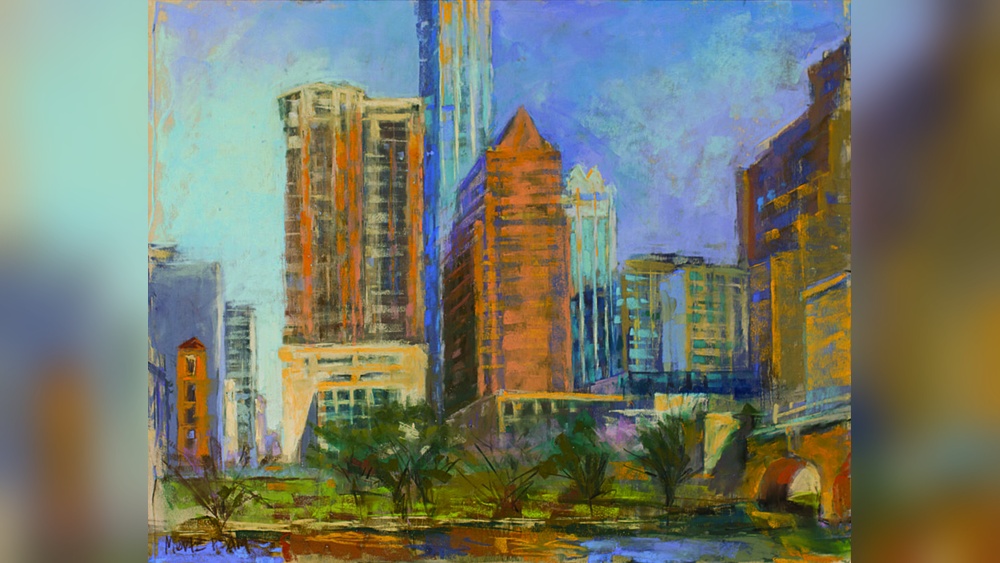
Quick answer: To paint a city in oil painting, simplify the scene into large value shapes, establish one eye level so buildings converge correctly, and block in a lean monochrome underpainting before adding color. Paint distant buildings lighter, cooler and softer, keep the strongest contrast and detail at a single focal point, and suggest windows, cars and people with a few broken strokes instead of drawing every one. Finish with selective highlights such as lit windows, wet reflections or signs.
Cities are full of information: hundreds of windows, wires, signs, cars, people and reflections. The challenge with urban subjects is never finding something to paint. It is deciding what to leave out. Strong city paintings feel detailed but are built from a few large shapes, a clear light direction and a lot of suggestion.
This guide covers how to paint a city in oil painting with practical tips at every stage: choosing and simplifying a view, perspective that does not need a ruler, a step-by-step painting process, color for day, dusk and rain, and the shortcuts urban painters use to imply detail. For broader background on oil methods and styles, the guide to oil painting styles and expert tips pairs well with this one.
Choose a View That Works as a Painting
Not every great street makes a great painting. Look for three things when selecting a city scene:
- A clear light pattern. Low sun raking down a street, or one side in shadow and the other in light, gives the painting structure.
- A lead-in. A street, sidewalk, canal or row of parked cars that pulls the eye into the picture.
- A focal point. A tower, a cafe awning, a figure, a lit shop window. Something that deserves the sharpest edge and strongest contrast.
Crop aggressively. A narrow section of street often makes a stronger painting than a wide skyline. Photograph your reference at several focal lengths, or use a viewfinder card to frame options.
Oil Painting Tips for Beginners: Simplify Before You Paint
The single most important habit in urban painting is reducing the scene to shapes. Before painting, make a three-value thumbnail, only light, mid and dark, about the size of a playing card.
- Group all shadowed building faces into one dark shape, even if they are different colors.
- Group all sunlit surfaces into one light shape.
- Treat the sky as its own value, usually light.
- Ignore windows, signs and people entirely at this stage.
If the thumbnail reads as a convincing street, the painting will too. If it is confusing, no amount of detail later will fix it.
Perspective for City Painting Without Getting Technical
Buildings must line up with the viewer’s eye level, or the painting will look off even to people who cannot say why. You do not need elaborate construction; a few rules handle most scenes.
- Find the eye level. In a street scene, it is roughly where the heads of standing people on level ground appear, because your eye is at about the same height as theirs. Draw a faint line there.
- Roof and window lines converge. Horizontal lines on building faces that recede from you angle toward a point on the eye level. Lines above eye level slope down toward it; lines below slope up.
- Verticals stay vertical. For most street-level paintings, keep building edges vertical. Tilted verticals make buildings look like they are falling.
- Measure with your brush. Hold a brush handle at arm’s length, align it with a roofline, then transfer that angle to the canvas.
Figures help sell the perspective. Heads of people standing on the same level ground stay close to the eye line whether they are near or far; only their bodies shrink with distance.
How to Paint a City in Oil Painting: Step-by-Step
Step 1: Tone the canvas
Wash a thin layer of burnt sienna or a warm gray over the canvas and wipe it back. Warm ground glowing through gaps between strokes makes cool city colors feel more vibrant.
Step 2: Draw the big structure
Using thin paint on a small brush, mark the eye level, the main building masses, the street edges and the focal point. Keep it loose. You are placing shapes, not drawing architecture.
Step 3: Block in a lean monochrome underpainting
Using burnt umber or a mix of ultramarine and burnt sienna thinned with solvent, paint the dark masses identified in your thumbnail. Wipe out lights with a rag. This is where oil underpainting tips matter most: keep it thin and lean so it dries quickly and the color layers can sit on top without turning to mud.
Step 4: Paint the sky
Block the sky in early so building silhouettes can be cut against it. In a city, the sky near the horizon is often hazy and warmer or grayer than the zenith, due to atmosphere and pollution. Carry the sky color slightly behind the buildings.
Step 5: Block in the building planes in color
Paint each large plane in a single mixed color: one for the lit faces, one for shadowed faces, one for the street. Shadow sides of buildings often reflect sky color and can be surprisingly blue or violet. Keep these as big flat shapes.
Step 6: Establish distance
Repaint or adjust distant buildings so they are lighter, cooler and lower in contrast than near ones. Add some sky color into every far mix. The gradual fade is what gives a street its depth.
Step 7: Suggest windows and architectural detail
Use a small flat brush to tap in windows as small rectangles, but only some of them. Group windows in shadow into darker bands, and pick out only a few with clear edges near the focal point. Vary spacing slightly; perfectly regular rows look mechanical.
Step 8: Add cars, people and street furniture
Paint figures as simple carrot shapes with a dot for a head and maybe one leg stroke. Cars become horizontal blocks with a dark underside and a light top. Street lamps and poles are single vertical strokes with a rigger. Keep them in the same value family as their surroundings unless they are the focal point.
Step 9: Highlights and accents
Last, add the highest lights and brightest color notes: sun hitting a cornice, a red sign, lit windows, a traffic light. Put these down with thicker paint and do not fuss with them. A handful of saturated accents brings a muted street to life.
Color and Light in Urban Scenes
| Condition | Sky | Buildings | Key accents |
|---|---|---|---|
| Sunny day | Blue at top, paler toward horizon | Warm lit faces, cool blue-violet shadows | Bright awnings, signs, sunlit edges |
| Overcast | Warm or cool gray, nearly uniform | Close values, color temperature carries form | Small saturated color notes such as umbrellas or taxis |
| Golden hour | Orange to pale yellow near horizon | Warm orange on facing walls, deep cool shadows | Long cast shadows across the street |
| Night | Deep blue rather than black | Dark silhouettes with warm window light | Lit windows, street lamps, colored signs, halos |
| Rain | Light gray, often lighter than the buildings | Desaturated, softened edges | Vertical reflections on wet pavement |
Painting wet streets and reflections
Wet pavement reflects lights and bright colors directly beneath their source, stretched vertically. Paint the street in its base color first, then pull reflections straight down with a soft brush and drag lightly across them horizontally to break them up. Reflections of light sources are usually a little darker and less sharp than the source itself.
Night scenes
Avoid pure black. A night sky mixed from ultramarine, alizarin crimson and burnt umber reads as darkness while keeping color. Warm window light, such as cadmium yellow with a touch of orange and white, glows strongly against those darks. Soften the edges around street lamps slightly to suggest a halo.
Oil Painting Tips, Tricks and Techniques for Urban Detail
- Use the edge of a palette knife for straight lines. Load the knife edge with thin paint and press it to the canvas for crisp rooflines, poles and window frames.
- Lose edges deliberately. Let one building merge into the next in shadow. Lost edges make the found ones more striking.
- Imply, do not describe. A single bright stroke can be a car’s chrome. Two dashes can be a crowd.
- Vary the paint thickness. Keep shadows and distance thin, lights and foreground thicker. Texture draws the eye, so use it where you want attention.
- Limit wires and signs. Include only those that help the composition, and paint them with broken lines.
- Use a sky-color glaze to unify. If the painting feels chaotic once dry, a very thin glaze of a cool sky-blue over distant areas pushes them back.
Photograph to Oil Painting Tips for Cityscapes
Most urban paintings are made from photos, since standing on a busy street for hours is impractical. Photos introduce their own problems.
- Shadows go black in photos. Cameras often lose detail in shadows. Lighten and add color to them, remembering they usually contain reflected light.
- Wide lenses distort. Phone wide-angle lenses can bend verticals. Straighten them in your drawing.
- Photos flatten distance. Exaggerate atmospheric perspective to restore depth.
- Combine references. Use one photo for the buildings and another for figures or sky. Make sure the light direction matches.
- Edit out clutter. Remove trash cans, extra signs and cars that do not serve the composition.
Plein Air Versus Studio City Painting
Painting on location in a city teaches you things a photo cannot: how quickly light moves across a facade, how colors in shadow really look, and what details actually matter. It also comes with crowds, noise and limited time. A practical approach is to paint small on location, around 8 by 10 inches, in 60 to 90 minutes, focusing only on the big shapes and light. Use that study, plus a few photos, as the basis for a larger studio painting.
On location, set up with your back to a wall or in a doorway to stay out of foot traffic, and pre-mix a few key colors, such as a shadow gray and a sky color, before you start. Light changes fast, so commit to the shadow pattern you see in the first 20 minutes and stick with it even as the sun moves.
Common Mistakes in City Oil Paintings
- Painting every window, which flattens the painting and costs hours.
- Inconsistent light direction between buildings.
- Gray, lifeless shadows mixed with black instead of colored darks.
- Figures drawn too large or too small for their position relative to the eye level.
- Equal detail everywhere, leaving no focal point.
- Overly saturated colors that ignore the atmosphere of a city.
Soft atmosphere does a lot of work in urban scenes, especially in morning haze or rain. The sibling article on creating fog and soft atmosphere in oil shows how to compress values and lose edges for that effect.
FAQs
How do you paint buildings in oil without a ruler?
Use a palette knife edge loaded with thin paint for straight lines, or steady your hand with a mahlstick. Slightly imperfect lines usually look more painterly and alive than ruled ones.
What colors are best for a city oil painting?
A limited palette of ultramarine blue, burnt sienna, yellow ochre, cadmium red light, a cool yellow and white handles most urban scenes. Ultramarine and burnt sienna mix a range of warm and cool grays that suit concrete and stone.
How do I paint people in a cityscape?
Paint them as simple vertical shapes with a small head and a hint of legs, keeping their heads near the eye level if they stand on level ground. Avoid detail; gesture and placement matter more.
How do you paint lights at night in oil?
Paint the dark surroundings first, then place light sources with thick, warm paint. Soften the edges slightly and add vertical reflections on wet surfaces beneath them.
What are good oil painting tips and tricks for beginners painting cities?
Start small, make a three-value thumbnail, choose one focal point, keep verticals vertical and suggest detail rather than painting it. A lean monochrome underpainting makes the color stage much easier.
How long should a city oil painting take?
A small study can be done in two or three hours. Larger, layered works may take several sessions spread over weeks to allow underlayers to dry.
Final Thoughts
Painting a city in oil is an exercise in editing: big value shapes, believable perspective and a focal point carry the image, while suggested windows, figures and lights supply the sense of detail. Practice small, simplified street studies and the larger scenes will follow. For more on oil techniques, styles and the materials behind them, browse our oil paintings guide with expert tips and buying advice.