PaintingProGuide is reader-supported. When you buy through links on this page we may earn an affiliate commission at no extra cost to you.
The right paint brush for oil paint depends on what the stroke needs to do. Oil paint is thick and buttery, so brushes for oils need enough spring to push paint around, hold a shape when loaded, and survive solvent or oil cleaning. Shape matters as much as quality: a filbert, a flat and a small round will do most of the work in nearly any oil painting.
This guide explains brush shapes, sizes and bristle types for oil painting, then compares five brush sets from current listings. We left out house-painting brushes that appeared in our search, which are designed for trim and walls rather than artwork.
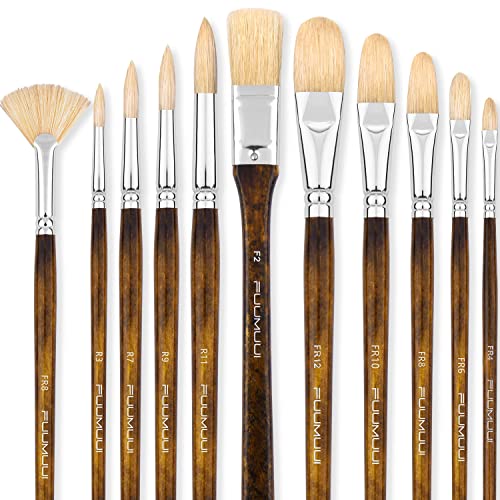
Quick answer: The Fuumuui 25-Piece Brush Set is the most complete choice for oil painters, with 24 brushes in 9 shapes (wide flat, flat, filbert, fan, dagger, cat tongue, round, angle, rigger) plus a palette knife and a waterproof canvas roll. The Nicpro 30-Piece Set is a close alternative with double-crimped aluminum ferrules and a wide size range. For a budget start, the Conda 24-Piece Set covers the key shapes in a roll-up case.
Brush Shapes for Oil Painting
| Shape | What it does | Typical uses |
|---|---|---|
| Flat | Square end, crisp edges, broad strokes | Blocking in, architecture, hard edges |
| Bright | Short flat, more control with thick paint | Impasto, short dabbing strokes |
| Filbert | Flat with rounded tip, soft edges | Portraits, blending, organic forms |
| Round | Pointed tip | Lines, details, signatures |
| Fan | Spread bristles | Foliage, texture, softening |
| Angle | Slanted flat | Corners, petals, tapered strokes |
| Rigger / liner | Long, thin hair | Branches, rigging, fine lines |
| Dagger / cat tongue | Specialty pointed flats | Expressive tapered strokes, leaves |
If you buy only three, choose a medium filbert, a large flat and a small round.
Hog Bristle vs Synthetic for Oils
Hog bristle is the traditional oil brush. It is stiff with split ends (“flags”) that hold thick paint and leave textured strokes. It suits impasto and loose, painterly work.
Synthetic brushes, usually nylon or polyester blends, are smoother and springier. They give cleaner, more controlled strokes and suit blending, glazing and detail. Modern synthetics handle oil and solvent cleaning well and are often more affordable.
The sets below all use synthetic bristles. Many oil painters pair a synthetic set with a few hog bristle brushes for heavy texture.
Our Top Picks at a Glance
- Fuumuui 25-Piece Paint Brush Set, 9 Shapes — Best for the most complete oil brush kit
- Nicpro 30-Piece Paint Brush Set — Best for a wide size range with sturdy ferrules
- Conda 24-Piece Professional Paint Brush Set — Best for a budget kit that covers the essentials
- KEVIN&SASA CRAFTS 24-Piece Paint Brush Set with Case — Best for varied shapes including mop and bright
- AROIC 10-Piece Paint Brush Set — Best for the lowest-cost starter brushes
| Product | Best For | Key Spec | Key Strength | Price Tier |
|---|---|---|---|---|
| Fuumuui 25-Piece Paint Brush Set, 9 Shapes | The most complete oil brush kit | 24 brushes in 9 shapes, palette knife, canvas roll | Wide flat to rigger, plus a waterproof storage roll | $$ |
| Nicpro 30-Piece Paint Brush Set | A wide size range with sturdy ferrules | 30 brushes: flats, rounds, filberts, angles, fans, daggers | Double-crimped aluminum ferrules, canvas roll | $$ |
| Conda 24-Piece Professional Paint Brush Set | A budget kit that covers the essentials | 24 brushes in different shapes, roll-up pouch | Heavier glue at the ferrule; soak-tested | $ |
| KEVIN&SASA CRAFTS 24-Piece Paint Brush Set with Case | Varied shapes including mop and bright | 24 brushes: fan, bright, detail, round, mop, angle | Natural wood handles, canvas case | $ |
| AROIC 10-Piece Paint Brush Set | The lowest-cost starter brushes | 10 sizes; anti-rust nickel ferrules; solid wood handles | Anti-shedding bristles at the lowest price tier | $ |
How We Chose
These picks are based on Amazon listing details and specifications checked in October 2026; we did not paint with these brushes ourselves. We compared shape variety, size range, ferrule and handle construction, storage, and stated suitability for oil paint, and favored sets widely reviewed by Amazon buyers.
Criteria:
- Shape variety covering flats, filberts and rounds at minimum.
- Size range from small detail to large coverage.
- Construction: ferrules that stay tight and handles that resist cracking.
- Oil compatibility stated on the listing.
- Storage: rolls or cases that protect bristle shape.
Best Paint Brush Sets for Oil Paint Reviewed
1. Fuumuui 25-Piece Paint Brush Set, 9 Shapes — Best for the most complete oil brush kit

Fuumuui covers every shape most oil painters need: large wide flat, flat, filbert, fan, dagger, cat tongue, round, angle and rigger, across 24 brushes, plus a palette knife. The listing describes synthetic bristles with high pigment capacity for good loading and smooth flow, and birch handles balanced to reduce wrist strain.
A waterproof canvas roll with separate compartments protects the bristles and organizes the set for travel or class. It is listed for acrylic, oil and watercolor.
Best suited for: Beginners building a full kit, plein air painters and anyone wanting every shape in one purchase.
Key features:
- 24 brushes, 9 shapes
- Large wide flat for backgrounds
- Palette knife included
- Waterproof canvas roll with compartments
Pros:
- Broadest shape range here
- Storage roll protects tips
- Includes specialty shapes like cat tongue and dagger
Cons and limitations:
- Highest price tier in this list
- Synthetic only; add hog bristle for heavy impasto
Buying consideration: Learn the filbert and flat first. Specialty shapes are useful, but most oil painting happens with those two.
2. Nicpro 30-Piece Paint Brush Set — Best for a wide size range with sturdy ferrules

Nicpro’s 30 brushes include eight flats, six rounds (14 down to 0), six filberts (14 down to 2), three angles, three fans and two daggers, among others. Bristles are nylon, described as having good absorption, elasticity and shape retention.
Construction is a strong point: double-crimped aluminum ferrules hold bristles securely, and birch handles are shaped for comfort. A nylon canvas roll, resistant to oil and water, protects the set. The listing names oil among compatible paints.
Best suited for: Painters who want multiple sizes of each core shape and long-term durability.
Key features:
- 30 brushes in 6+ shapes
- Six filberts and six rounds in graded sizes
- Double-crimped aluminum ferrules
- Oil- and water-resistant canvas roll
Pros:
- Excellent size range for flats, rounds and filberts
- Sturdy ferrule construction
- Organized storage
Cons and limitations:
- Nylon only
- More brushes than many beginners need
Buying consideration: Keep separate brushes for darks and lights. With 30 brushes, you can avoid muddying pale colors with residue from dark paint.
3. Conda 24-Piece Professional Paint Brush Set — Best for a budget kit that covers the essentials

Conda’s 24 brushes come in a roll-up nylon pouch described as waterproof and oil-proof. The listing focuses on durability issues beginners often face: high-quality nylon selected to minimize hair loss, and a heavier glue where wood meets bristle so ferrules do not loosen, with a stated soak test of over 48 hours.
It lists watercolor, acrylic, gouache, inks, oil and enamel among compatible media, and is positioned for beginners, students and all levels.
Best suited for: Beginners, students and painters building a second set for experiments.
Key features:
- 24 brushes
- Nylon bristles
- Reinforced ferrule glue
- Waterproof, oil-proof roll pouch
Pros:
- Low-mid price tier for 24 brushes
- Addresses shedding and loose ferrules
- Protective pouch
Cons and limitations:
- Listing gives less shape-by-shape detail
- Synthetic only
Buying consideration: Never leave brushes standing in solvent or water even if the ferrule is soak-tested; bristles still bend out of shape.
4. KEVIN&SASA CRAFTS 24-Piece Paint Brush Set with Case — Best for varied shapes including mop and bright

This set contains fan brushes, bright brushes, detail brushes, rounds, mop brushes and angle brushes, with 100% natural wood handles and a canvas case. The listing states all types work with all paint types, although its own description focuses on watercolor and acrylic.
The inclusion of brights (short flats) is useful for oils: they handle thick paint with control. Mop brushes are soft and better for softening edges or thin glazes than for pushing heavy oil.
Best suited for: Mixed-media painters and beginners who want a variety of shapes in one case.
Key features:
- 24 brushes
- Brights, rounds, fans, angles, mops and detail
- Natural wood handles
- Canvas brush case
Pros:
- Includes brights for thick paint
- Varied shapes
- Low-mid price tier
Cons and limitations:
- Listing emphasizes watercolor and acrylic
- Mops are less useful for heavy oil
Buying consideration: Dedicate this set to oil or to water media, not both. Switching between media in the same brushes shortens their life.
5. AROIC 10-Piece Paint Brush Set — Best for the lowest-cost starter brushes

AROIC’s set includes 10 brushes in multiple sizes and shapes with anti-shedding bristles, anti-rust nickel ferrules and solid wood handles. It lists watercolor, oil, gouache and acrylic among compatible paints.
For someone trying oils for the first time, ten brushes cover the basics without much spend. Expect to replace or upgrade them as your preferences become clearer.
Best suited for: First-time oil painters, students and backup brushes for rough jobs like toning grounds.
Key features:
- 10 brushes
- Anti-shedding bristles
- Anti-rust nickel ferrules
- Solid wood handles
Pros:
- Lowest price tier
- Covers basic sizes
- Easy to replace
Cons and limitations:
- Fewer shapes
- Less durable than higher-tier sets
Buying consideration: Use these for toning canvases and underpainting, and save better brushes for final layers.
Matching Brushes to Oil Techniques
Alla prima (wet-on-wet). Painting in one session rewards confident strokes. Use larger filberts and flats, load generously, and avoid going back over strokes too often. Stiffer bristles push thick paint without lifting the layer underneath as easily.
Glazing. Thin, transparent layers over dry paint need soft, smooth brushes that lay paint down evenly without streaks. Synthetic flats and soft filberts work well; a soft mop-style brush can gently even out a glaze.
Blending and soft edges. A clean, dry filbert or fan brush lightly dragged across the meeting point of two colors softens transitions. Wipe the brush often so you do not muddy either color.
Impasto. Thick, textured paint holds the shape of the stroke. Brights and short, stiff flats give the most control; palette knives add crisp ridges.
Scumbling and dry brush. Dragging a small amount of stiff paint over a dry layer creates broken color for skies, stone and foliage. Older, splayed brushes are surprisingly good at this.
Details. Small rounds and riggers add highlights, branches and signatures at the end. Thin paint slightly with medium so lines flow.
Rotating through these techniques with the same set is the fastest way to understand which shapes you truly need, and which ones to upgrade first.
Sizes: What to Start With
Brush sizes vary by brand, but a practical starter range for a 9×12 to 16×20 canvas is:
- Large flat (about size 10 to 14): blocking in and backgrounds.
- Medium filbert (about size 6 to 8): most of the painting.
- Small filbert or flat (about 2 to 4): smaller shapes.
- Small round (about 0 to 2): details and lines.
- Rigger: branches and fine lines.
Larger canvases need proportionally larger brushes. A common beginner mistake is painting a big canvas with tiny brushes, which leads to fussy, overworked results.
Caring for Oil Painting Brushes
- Wipe excess paint on a rag after each session.
- Rinse in odorless mineral spirits or a vegetable oil.
- Wash with brush soap and lukewarm water until clean.
- Reshape the bristles and dry flat or tip-down.
- Store in a roll or upright in a jar only once dry.
Buying Guide: How to Choose a Paint Brush for Oil Paint
Start with shapes, not quantity
A set with flats, filberts and rounds in several sizes is more useful than many brushes of one type.
Consider bristle type
Synthetics give smooth, controlled strokes; hog bristle handles heavy paint and texture. Many painters use both.
Check the ferrule
Double-crimped, rust-resistant ferrules keep bristles secure through repeated solvent and soap cleaning.
Handle length
Long handles let you stand back from the easel; short handles suit close work at a table. Many sets use a medium length.
Storage matters
Rolls and cases protect bristle shape between sessions and make transport easier.
Match size to canvas
Bigger canvases need bigger brushes. Make sure your set includes at least one large flat.
Plan an upgrade path
Once you know which shapes you use most, replace those with higher-quality single brushes and keep the set for rough work, toning and experiments. That way your budget goes where it makes a visible difference.
Avoid house-painting brushes for artwork
Wall and trim brushes are designed for even coats of house paint, not for the varied strokes of oil painting.
Brush Reviews and Technique Guides
For deeper reviews of individual brands, see our Liquitex oil painting brush review, Jackson’s oil painting brush review and Escoda oil painting brush review. To practice specific strokes, read how to use a liner brush and how to paint dots with a round brush.
Common Mistakes to Avoid
- Using only tiny brushes. Paintings become fussy; start big.
- Letting paint reach the ferrule. It dries there and splays the bristles.
- Leaving brushes in solvent. Bristles bend permanently.
- Skipping soap after solvent. Residual oil hardens in bristles.
- Using wall brushes for art. They are built for coverage, not control.
- Sharing brushes between oil and water media. It shortens brush life.
FAQs
What type of brush is best for oil paint?
Synthetic brushes give smooth control for blending and detail, while hog bristle brushes handle thick paint and texture. A set with flats, filberts and rounds covers most needs.
What brush shape is most used in oil painting?
The filbert is often considered the most versatile oil brush because it makes both broad strokes and softer edges. Flats and small rounds are the other essentials.
Can I use acrylic brushes for oil painting?
Many synthetic brushes are labeled for both acrylic and oil. Clean them thoroughly and consider keeping separate sets for each medium to extend brush life.
How many brushes do I need to start oil painting?
Three to six brushes are enough to start: a large flat, one or two filberts, a small round and a rigger. Sets give more options, but you will use a few favorites most.
How do I clean oil paint brushes?
Wipe off excess paint, rinse in solvent or oil, wash with brush soap and lukewarm water, reshape and dry flat. Never leave brushes standing in solvent.
Are expensive brushes worth it for beginners?
Not at first. Affordable synthetic sets are fine for learning. Upgrade the shapes you use most once your style and preferences develop.
Final Recommendation
For the most complete kit, choose the Fuumuui 25-Piece Set with its nine shapes and protective roll. The Nicpro 30-Piece Set gives the best range of sizes with durable ferrules, and Conda is the budget kit that covers essentials. KEVIN&SASA adds brights and mops for mixed-media painters, and AROIC is the lowest-cost way to start or to stock brushes for rough work.