

PaintingProGuide is reader-supported. When you buy through links on this page we may earn an affiliate commission at no extra cost to you.
Landscape painting in oils has a long teaching tradition, and the best books in that tradition do more than show finished paintings. They explain why a sky is usually the lightest plane, how atmosphere cools and softens distant hills, how to simplify a forest into a few readable shapes, and how to plan a composition before light changes. The best oil painting books for landscapes combine that theory with practical exercises you can carry outdoors or into the studio.
Below are six landscape books from the Amazon listings we checked, ranging from a century-old classic to contemporary guides, with notes on who each one suits and how to get the most from it.
Quick answer: If you buy one book, start with Carlson’s Guide to Landscape Painting, the classic text on how light and planes shape a landscape, in the lowest price tier. For modern exercises in color and composition, add New Lessons in Landscape Painting by Mitchell Albala. For element-by-element rendering of sky, terrain, trees and water in oil, The Elements of Landscape Oil Painting by Suzanne Brooker is the most practical.
Our Top Picks at a Glance
- Carlson’s Guide to Landscape Painting (John F. Carlson) — Best classic foundation in landscape theory
- New Lessons in Landscape Painting (Mitchell Albala) — Best for color and composition exercises
- The Elements of Landscape Oil Painting (Suzanne Brooker) — Best for rendering sky, terrain, trees and water
- The Field Guide to Landscape Painting in Oils (Scott Maier) — Best for plein air planning
- Landscapes in Oil (Ken Salaz) — Best for realistic painting in the classical tradition
- Landscape Painting Essentials (Johannes Vloothuis) — Best budget multi-medium lessons
| Product | Best For | Key Spec | Key Strength | Price Tier |
|---|---|---|---|---|
| Carlson’s Guide | Theory foundation | Paperback classic | Light and planes | $ |
| New Lessons (Albala) | Color and composition | Paperback; concepts and exercises | Exercise-based | $$ |
| Elements of Landscape Oil Painting | Rendering elements | Hardcover; sky, terrain, trees, water | Oil-specific techniques | $$ |
| Field Guide (Maier) | Plein air | Hardcover; techniques, planning, principles | Outdoor planning | $$ |
| Landscapes in Oil (Salaz) | Classical realism | Contemporary guide, classical tradition | Realism approach | $$ |
| Landscape Painting Essentials (Vloothuis) | Multi-medium learners | Paperback; acrylic, oil, pastel, watercolor | Low price tier | $$ |
How We Chose
We have not worked through these books for this guide. The selection is based on the Amazon listing details checked in October 2026, which for books mainly means title, author, format and stated scope; how well each title’s scope fits oil landscape painters; and how widely each product is reviewed by Amazon buyers. Where a book has a well-known reputation, we mention it, but we do not invent contents.
- Landscape focus: books dedicated to landscape rather than general painting.
- Oil relevance: oil-specific or principles that transfer directly to oil.
- Theory and practice balance: concepts plus exercises or demonstrations.
- Range of levels: from foundation to advanced classical realism.
- Value: price tier relative to scope.
What a Great Landscape Painting Book Teaches
Landscape painting has a specific set of problems that general painting books only touch on. A strong landscape book should help with most of them:
- Planes and light: how the sky, flat ground, slopes and upright forms like trees receive light differently.
- Atmospheric perspective: distant forms become lighter, cooler, softer and lower in contrast.
- Simplification: turning complex scenes into a few big value shapes.
- Composition: entry points, focal areas, rhythm and the placement of the horizon.
- Color temperature: warm light and cool shadows across times of day and seasons.
- Rendering elements: believable skies, foliage, water, rocks and grass.
- Working outdoors: setup, speed, and painting under changing light.
Three Landscape Concepts Every Book Builds On
Planes of light
Imagine a sunny afternoon. The sky is the source of light, so it is usually the lightest mass. Flat ground faces the sky directly and catches a lot of that light. A hillside tilted away receives less, and upright trees, catching light only from the side, read darkest. When a landscape feels confusing, checking whether each plane sits at the right value often reveals the problem. Carlson’s guide is built around this idea, and most later books assume it.
Atmospheric perspective
Air is not perfectly clear. The more of it between you and an object, the more it scatters light, so distant forms appear lighter, cooler, softer and lower in contrast. A mountain range painted with the same dark green and crisp edges as the foreground tree will look like it is pasted on top of it. Pushing distant planes toward the sky color and softening their edges creates depth instantly.
Simplification
Nature offers millions of leaves, blades of grass and ripples. Paintings that try to render them all usually look busy and flat. Strong landscape painters group detail into big shapes first, a tree as one dark mass with a light side and a shadow side, then add only enough texture at the edges and focal point to suggest the rest. Every book in this guide returns to this principle in some form.
Studio or Plein Air: Choosing the Right Approach
Landscape books tend to lean toward one of two ways of working. Plein air books, like Maier’s, emphasize speed, planning and capturing a specific light effect before it changes. Studio-oriented books, like Brooker’s and Salaz’s, have room for layering, refinement and careful rendering from sketches and photographs.
Most professional landscape painters do both: they gather information outdoors in small studies, then develop larger paintings in the studio. If you only paint from photos, a plein air book will help you see color and value more truthfully. If you only paint outdoors, a studio book will help you finish and refine.
Best Oil Painting Books for Landscapes Reviewed
1. Carlson’s Guide to Landscape Painting by John F. Carlson — Best for a classic foundation in landscape theory

John F. Carlson’s guide is one of the most widely recommended landscape painting books ever written, first published in the early twentieth century and still in print. It is best known for explaining how different planes of a landscape receive light: the sky as the light source, flat ground next lightest, slanting planes darker, and upright forms such as trees darkest. That idea alone fixes many muddled landscapes.
The book is text-heavy and illustrated in black and white in many editions, so it rewards slow, thoughtful reading rather than quick browsing. It sits in the lowest price tier here.
Best suited for: Every landscape painter, from intermediate to professional, who wants a theory foundation.
Key features:
- Paperback
- Classic landscape theory text
- Covers light, planes, perspective and composition
Pros:
- Foundational ideas used by many teachers
- Lowest price tier
- Applies to any medium
Cons and limitations:
- Dense, older writing style
- Not a step-by-step project book
- Limited color illustration
Buying consideration: Read one chapter, then paint three small value studies applying it before moving on.
2. New Lessons in Landscape Painting by Mitchell Albala — Best for color and composition exercises
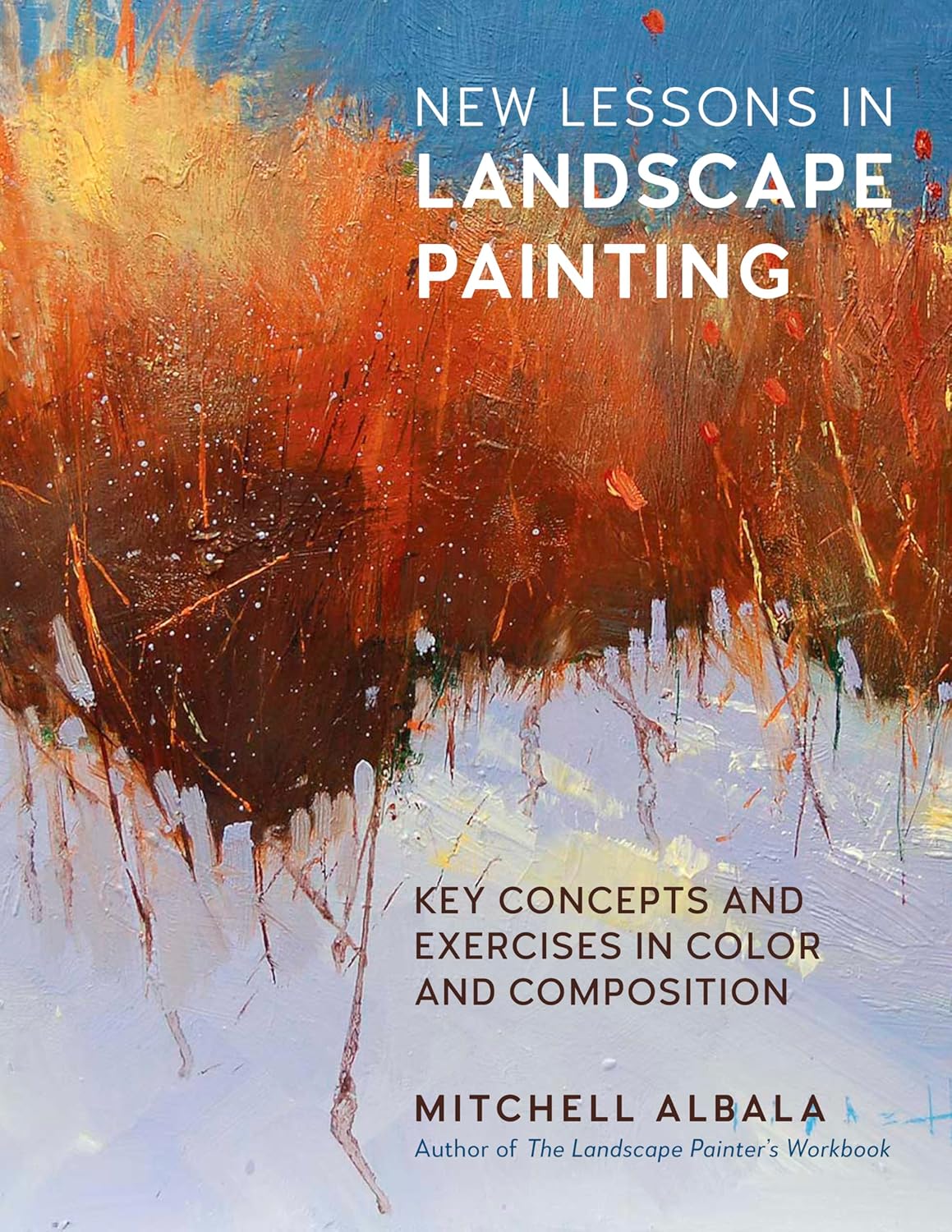
The subtitle describes key concepts and exercises in color and composition, by the author of The Landscape Painter’s Workbook. An exercise-based book suits painters who learn by doing: each concept is paired with practice.
Color and composition are where many technically competent landscape painters stall, so this is a strong second book after Carlson.
Best suited for: Intermediate painters who want structured exercises in color and composition.
Key features:
- Paperback
- Concepts plus exercises
- Color and composition focus
Pros:
- Exercise-driven learning
- Contemporary approach
- Mid price tier
Cons and limitations:
- Less focus on rendering specific elements
- Not oil-only
Buying consideration: Do the exercises in small formats on panels or oil paper so you can complete many quickly.
3. The Elements of Landscape Oil Painting by Suzanne Brooker — Best for rendering sky, terrain, trees and water

Brooker’s hardcover focuses on techniques for rendering sky, terrain, trees and water in oil. Organizing by element makes it easy to target a weakness, such as foliage that looks like cotton balls or water that lacks depth.
It is the most oil-specific book in this guide, which helps with handling questions like layering, edges and brushwork in particular passages.
Best suited for: Oil painters who want practical solutions for specific landscape elements.
Key features:
- Hardcover
- Oil-specific
- Sky, terrain, trees and water
Pros:
- Targeted problem-solving
- Oil handling detail
- Mid price tier
Cons and limitations:
- Less emphasis on composition theory
- Studio rather than plein air focus
Buying consideration: Pick your weakest element and work through that chapter with several small studies.
4. The Field Guide to Landscape Painting in Oils by Scott Maier — Best for plein air planning

Maier’s book promises techniques, planning and principles for capturing the art of the great outdoors. Planning matters most in plein air, where you have an hour or two before light shifts. Knowing how to choose a view, design a quick composition and mix key colors first is what separates finished plein air paintings from abandoned starts.
Best suited for: Painters who work outdoors or want to start plein air.
Key features:
- Hardcover
- Techniques, planning and principles
- Outdoor focus
Pros:
- Practical for plein air
- Combines theory and technique
- Mid price tier
Cons and limitations:
- Outdoor focus may be less relevant for studio-only painters
Buying consideration: Use its planning steps on your next outing: thumbnail first, then block in the big shapes in under 20 minutes.
5. Landscapes in Oil by Ken Salaz (Foreword by Peter Trippi) — Best for realistic painting in the classical tradition

The title describes a contemporary guide to realistic painting in the classical tradition. That positions it for painters drawn to the luminous, highly finished landscapes associated with the Hudson River School and similar traditions rather than loose impressionism.
It sits in the highest price tier among these books, consistent with a more advanced, specialized focus.
Best suited for: Advanced painters pursuing classical realist landscapes.
Key features:
- Contemporary guide
- Classical tradition focus
- Realistic landscape painting
Pros:
- Specialized depth for realism
- Modern take on traditional methods
Cons and limitations:
- Highest price tier here
- Less suited to loose or alla prima styles
Buying consideration: Pair it with Carlson for theory; the classical approach builds on the same understanding of light and planes.
6. Landscape Painting Essentials with Johannes Vloothuis — Best for budget multi-medium lessons

Vloothuis’s book offers landscape lessons in acrylic, oil, pastel and watercolor. Multi-medium coverage suits painters who switch media or teach mixed groups, and the principles of landscape design apply across all of them.
It is the lowest-cost contemporary option here, though the oil-specific content is shared with other media.
Best suited for: Painters who work in more than one medium or want an affordable overview.
Key features:
- Paperback
- Acrylic, oil, pastel and watercolor lessons
Pros:
- Low price tier
- Covers several media
- Lesson format
Cons and limitations:
- Less oil-specific depth
- Broad rather than deep
Buying consideration: Focus on the composition and design lessons, which transfer directly to oil.
Buying Guide: How to Choose an Oil Landscape Painting Book
Start with theory, then add technique
A foundation book like Carlson explains why landscapes work. Technique books like Brooker show how to render specific elements. Most painters benefit from both.
Match the book to your style
Loose, painterly and plein air painters will get more from Maier and Albala. Classical realists will value Salaz.
Look for exercises
Books with exercises turn reading into progress. Albala’s exercise format is especially useful.
Check oil specificity
Principles transfer across media, but handling advice for glazing, edges and drying is oil-specific. Brooker and Maier are oil-focused.
Consider your level
Carlson suits intermediate and up; Vloothuis is more accessible; Salaz is advanced.
Budget for a small library
Two or three complementary books often teach more than one expensive volume.
A Six-Week Reading and Painting Plan
- Week 1: read Carlson on light and planes; paint five small value studies of different scenes.
- Week 2: study atmospheric perspective; paint a scene with at least three distinct distance planes.
- Week 3: work through a composition exercise from Albala; make ten thumbnails before painting one.
- Week 4: pick your weakest element in Brooker (sky, trees, water or terrain) and paint three focused studies.
- Week 5: follow Maier’s planning approach on a plein air outing or from a strong photo.
- Week 6: combine everything in one finished painting, then compare it with work from before the plan.
Practice specific elements with our tutorials on painting fog in oils, which is a direct lesson in atmospheric perspective, and painting grass in oil, a classic problem area for simplification. For a small still life change of pace, try painting a seashell in oil.
Common Mistakes to Avoid
- Reading without painting: landscape theory only sticks when you apply it.
- Copying demonstration paintings exactly: use them to understand decisions, then apply them to your own scenes.
- Skipping value studies: most landscape problems are value problems.
- Rendering every leaf: simplification is a core lesson in every good landscape book.
- Ignoring atmosphere: distant hills painted as strongly as foreground ones flatten space.
- Buying only project books: step-by-step projects without theory limit growth.
FAQs
What is the best book for oil landscape painting?
Carlson’s Guide to Landscape Painting is the most widely recommended foundation. Pair it with an oil-specific technique book like The Elements of Landscape Oil Painting.
Is Carlson’s Guide still relevant today?
Yes. Its explanations of light on landscape planes, perspective and composition remain widely taught. The writing style is older, so expect a slower read.
Which landscape book is best for plein air painting?
The Field Guide to Landscape Painting in Oils by Scott Maier focuses on planning and principles for painting outdoors.
Are multi-medium landscape books useful for oil painters?
Yes. Design, value and composition principles apply in any medium. Vloothuis’s book is a budget overview covering oil alongside other media.
What landscape book suits classical realism?
Landscapes in Oil by Ken Salaz describes realistic painting in the classical tradition.
Do I need landscape books if I take workshops or online courses?
Books complement courses well. A workshop gives feedback and demonstrations for a few days, while a book stays on the shelf for years and lets you revisit a concept the moment a painting goes wrong. Many instructors recommend Carlson as background reading for exactly that reason.
How should I study a landscape painting book?
Read a short section, paint small studies that apply it, then move on. Small panels let you complete many studies quickly.
Final Recommendation
Start with Carlson’s Guide to Landscape Painting for its foundation in light and planes, then add New Lessons in Landscape Painting for color and composition exercises. Oil painters who want element-by-element help should choose The Elements of Landscape Oil Painting, and plein air painters will benefit most from The Field Guide to Landscape Painting in Oils.
Advanced realists drawn to classical landscapes can step up to Landscapes in Oil, while Landscape Painting Essentials offers an affordable, multi-medium overview. Two or three of these, read alongside regular studies, will do more for your landscapes than any single book read cover to cover.




