PaintingProGuide is reader-supported. When you buy through links on this page we may earn an affiliate commission at no extra cost to you.
Most people who give up on oil painting in the first month do so for practical reasons, not lack of talent: muddy color, paint that will not dry, a canvas that slides into chaos halfway through. A good beginner book anticipates those problems. The best oil painting books for beginners explain materials plainly, start with subjects you can actually finish, and introduce color mixing before it becomes a source of frustration.
Quick answer: If you have never touched oil paint, start with Oil Painting for the Absolute Beginner by Mark and Mary Willenbrink, which is written for exactly that reader. If you would rather learn through short finished projects, The Beginner’s Guide to Oil Painting by Craig Stephens uses simple still lifes. For color confusion, The Oil Painter’s Color Handbook by Todd M. Casey is the companion to add.
We compared seven beginner-friendly titles by approach, format and the problem each one helps you solve, then put together a first-month plan to make any of them work harder.
Our Top Picks at a Glance
- Oil Painting for the Absolute Beginner (Willenbrink) — Best for complete beginners
- The Beginner’s Guide to Oil Painting (Stephens) — Best project-based start
- The Oil Painter’s Color Handbook (Casey) — Best for learning color mixing
- Easy Oil Painting (Day) — Best for short sessions and small paintings
- The Oil Painting Course You’ve Always Wanted (Staiger) — Best for beginners who want a full course
- Painting with Bob Ross — Best for a fun, fast first landscape
- The Encyclopedia of Oil Painting Techniques (Galton) — Best reference to grow into
| Product | Best For | Key Spec | Key Strength | Price Tier |
|---|---|---|---|---|
| Absolute Beginner (Willenbrink) | Day-one beginners | Paperback, clear and easy guide | Written for zero experience | $$$ |
| Beginner’s Guide (Stephens) | Learning by projects | Paperback, simple still life projects | Finished paintings early | $$ |
| Color Handbook (Casey) | Color mixing | Hardcover; mixing, pigments, palettes, harmony | Solves muddy color | $ |
| Easy Oil Painting (Day) | Short sessions | Paperback, 9 projects, 4-inch squares | Small and achievable | $$ |
| Oil Painting Course (Staiger) | Structured study | Paperback, guided lessons | Grows with you | $$ |
| Painting with Bob Ross | First landscapes | Paperback, step by step | Encouraging, one-session paintings | $$ |
| Encyclopedia (Galton) | Later reference | Paperback, visual technique directory | Long-term value | $$ |
How We Chose
This list draws on Amazon listings checked in October 2026. We considered how clearly each title targets new oil painters, what type of instruction it offers based on its title, subtitle and format, and how widely it is reviewed by Amazon buyers. We have not summarized chapter contents beyond what the listings state, so preview sample pages before you buy.
- Beginner focus: the title or subtitle makes clear it is for people starting out.
- Approach: guide, projects, course or reference, so you can match your learning style.
- Problem solved: materials confusion, lack of finished work, or color mixing.
- Scale: small projects suit people with limited time and space.
- Shelf life: at least one book you will still use after the first year.
Best Oil Painting Books for Beginners Reviewed
1. Oil Painting for the Absolute Beginner — Best for complete beginners

Mark and Mary Willenbrink’s book describes itself as a clear and easy guide to successful oil painting, aimed at the absolute beginner. That positioning matters: books written for total newcomers usually spend more time on what to buy, how to set up, and how the paint behaves before asking you to paint anything ambitious.
It is the most expensive title here at the time we checked, landing in the higher price tier, so compare it against the others if budget is tight. For someone starting completely from scratch, though, a dedicated absolute-beginner guide is often the least frustrating entry.
Best suited for: People who have never used oil paint and want hand-holding from the first page.
Key features:
- Authors: Mark and Mary Willenbrink
- Paperback
- Clear, easy guide for absolute beginners
Pros:
- Pitched at true beginners
- Focus on success with first paintings
- From a well-known series format
Cons and limitations:
- Highest price tier on this list
- You may outgrow it relatively quickly
Buying consideration: Read the materials section before you shop so you buy only what the book uses.
2. The Beginner’s Guide to Oil Painting — Best for a project-based start

Craig Stephens’ guide is organized around simple still life projects that help you master the basics, according to its subtitle. Projects give each session a clear goal and a finished piece at the end.
Still life is a forgiving teacher. Objects do not move, light can be controlled with a single lamp, and you can repeat a project until it works.
Best suited for: Beginners who stay motivated by finishing paintings.
Key features:
- Author: Craig Stephens
- Paperback
- Simple still life projects
Pros:
- Concrete projects
- Builds core skills on easy subjects
- Moderate price
Cons and limitations:
- Still life only
- Less theory than a course
Buying consideration: Set up real objects alongside the book’s examples so you practice seeing, not just copying.
3. The Oil Painter’s Color Handbook — Best for learning color mixing

Todd M. Casey’s hardcover is subtitled a contemporary guide to color mixing, pigments, palettes and harmony. Color is where most beginners stall: mixes turn gray, greens look artificial, and skin tones go chalky. A dedicated color book addresses that directly.
It was in the lowest price tier when we checked, which makes it an easy addition to any of the general beginner books here.
Best suited for: Beginners whose paintings look muddy or whose colors do not match what they see.
Key features:
- Author: Todd M. Casey
- Hardcover
- Color mixing, pigments, palettes, harmony
Pros:
- Targets the biggest beginner problem
- Useful long after the basics
- Low price tier at checking
Cons and limitations:
- Not a step-by-step painting course
- Assumes you will practice with mixing exercises
Buying consideration: Use it with a limited palette of a few colors; that is the fastest way to understand mixing.
4. Easy Oil Painting (Design Originals) — Best for short sessions

Estelle Day’s book contains nine step-by-step projects of simple subjects, and the listing title mentions 4-inch square paintings. Tiny paintings make oil much less intimidating: less paint, less time, and less to lose if it goes wrong.
It is a good fit for people who can only paint for an hour after work.
Best suited for: Busy beginners and people with little studio space.
Key features:
- Author: Estelle Day
- Paperback
- 9 step-by-step projects
- Small square format
Pros:
- Finish a painting in one sitting
- Low material use
- Clear steps
Cons and limitations:
- Only nine projects
- Small format limits some techniques
Buying consideration: Do each project twice; the second attempt usually shows how much you learned.
5. The Oil Painting Course You’ve Always Wanted — Best for beginners who want a full course

Kathleen Lochen Staiger’s book offers guided lessons for both beginners and experienced artists. For a beginner, that means a longer runway: you start at the beginning and keep using the same book as your skills grow.
If you like structure and want something closer to a class, this is the pick.
Best suited for: Committed beginners who plan to study regularly.
Key features:
- Author: Kathleen Lochen Staiger
- Paperback
- Guided lessons for all levels
Pros:
- Long-term value
- Course structure
- Moderate price
Cons and limitations:
- Takes longer to see finished pieces
- More reading than a project book
Buying consideration: Treat it like a class: one lesson a week, with homework.
6. Painting with Bob Ross — Best for a fun first landscape

From Bob Ross Inc, this book teaches oil painting step by step in the well-known wet-on-wet landscape style. You paint into a wet base and finish in one session, which gives fast, satisfying results.
It is a single approach rather than a broad foundation, but its encouraging tone gets many people painting who otherwise would not start.
Best suited for: Beginners who want to finish a landscape in one go.
Key features:
- Publisher: Bob Ross Inc
- Paperback
- Step-by-step instruction
Pros:
- Motivating and approachable
- Complete paintings quickly
- Builds confident handling
Cons and limitations:
- One style
- Relies on particular mediums and colors
Buying consideration: Use it to build confidence, then add a general book for other methods.
7. The Encyclopedia of Oil Painting Techniques — Best for a reference to grow into
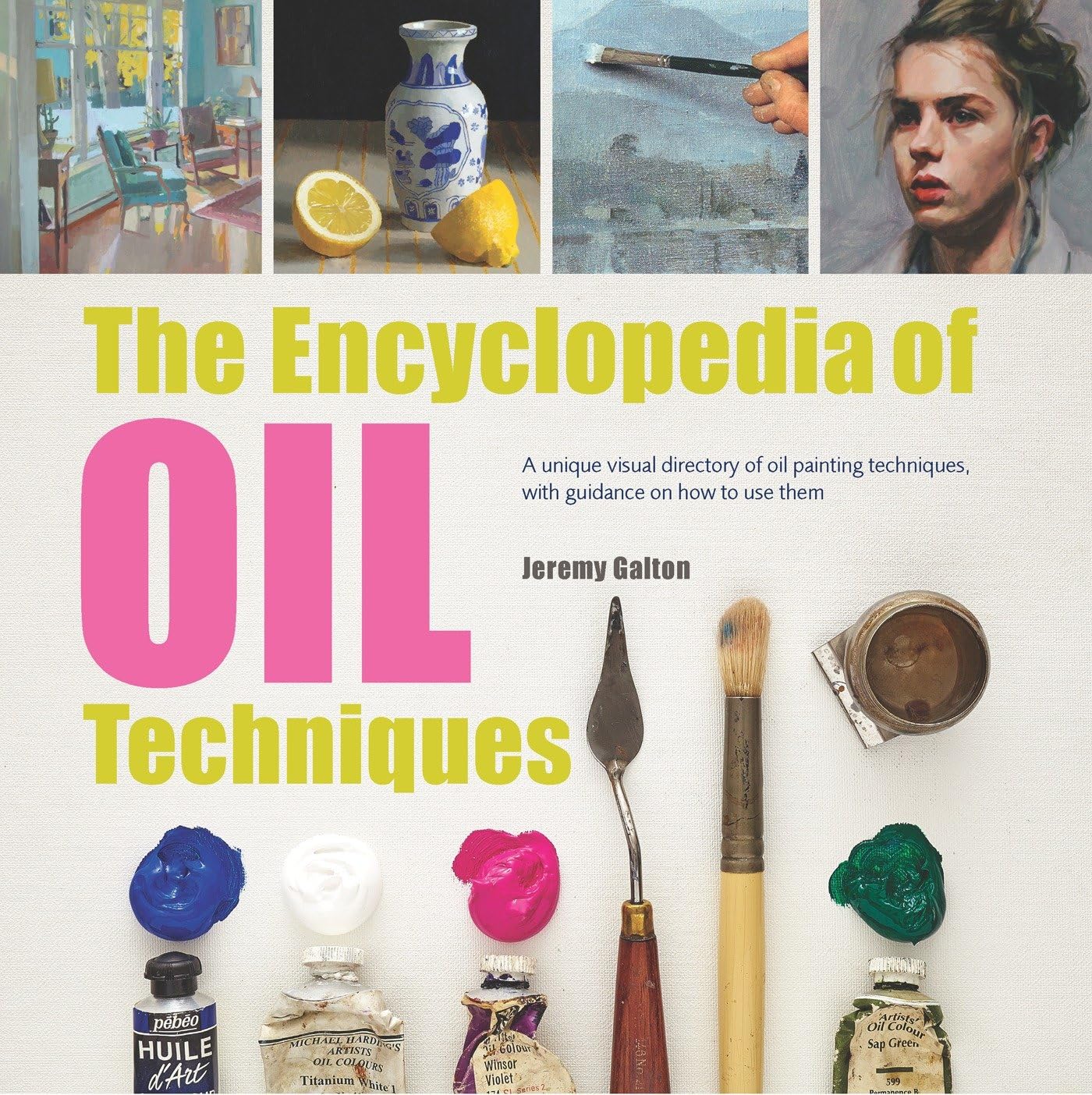
Jeremy Galton’s visual directory covers oil painting techniques with guidance on how to use them. Beginners will not read it cover to cover, but it is the book you reach for when another guide mentions glazing or scumbling and you want to see what that means.
Its value grows as you progress, making it a sensible second purchase.
Best suited for: Beginners who want a reference that will last.
Key features:
- Author: Jeremy Galton
- Paperback
- Visual directory of techniques
Pros:
- Long useful life
- Quick to look things up
- Broad coverage
Cons and limitations:
- Not a learning sequence
- Can feel overwhelming at first
Buying consideration: Bookmark techniques as you meet them in other books.
Buying Guide: How to Choose Oil Painting Books for Beginners
Start with your learning style
Readers who like explanations should pick a guide or course. People who learn by doing should pick a project book. Both work; the wrong match is what stalls progress.
Look for materials guidance
A beginner book should tell you what to buy and why, including which colors, brushes and surfaces to start with, and how to handle solvents safely or avoid them.
Favor simple subjects
Fruit, bottles and simple landscapes teach value, color and edges without the complexity of portraits. Books built on simple subjects lead to more early successes.
Add a color book early
Color mixing is the skill beginners most often lack. A focused color book alongside a general guide fills the gap.
Check sample pages
Look for clear step photos, not just beautiful finished paintings. You should be able to see what happens between steps.
Consider price and format
Beginner books vary widely in price. Paperbacks are easy to keep open on a table; a hardcover color handbook will survive years of use.
Common Beginner Problems and the Book Type That Helps
If you already have a few paintings behind you, the fastest way to choose a book is to name the problem you keep running into.
“I do not know what to buy.” An absolute-beginner guide is the answer. Its materials chapter will keep you from buying a giant set of colors you will not use and help you understand the difference between student and artist paint, and between solvent and solvent-free cleaning.
“My paintings never get finished.” Choose a project book, ideally a small-format one. Short, clearly defined projects build the habit of finishing, which is more valuable at this stage than any single technique.
“My colors turn to mud.” A color handbook will help more than another general guide. Muddy color usually comes from overmixing, using too many pigments in one mix, or getting values wrong, all things a color-focused book addresses directly.
“I can follow steps but cannot paint on my own.” Move to a structured course. Courses explain why each step happens, which is what lets you apply the ideas to your own subjects.
“I keep reading about techniques I do not understand.” A visual technique encyclopedia fills that gap. Look up the term, try it on scrap, and carry on with your main book.
“I have lost motivation.” Try a wet-on-wet book. Finishing a whole landscape in one sitting is a good reminder of why you started painting.
Your First Month with an Oil Painting Book
A book is only as good as the practice it inspires. This simple plan works with any of the titles above.
- Week one: materials and handling. Read the materials section, buy a limited palette, and paint simple swatches. Notice how the paint spreads with and without medium.
- Week two: value. Paint a value scale from white to black, then a single object, such as an egg or a cup, in grays only. This teaches you to see light and shadow without color getting in the way.
- Week three: color mixing. Make a chart mixing each color with white and with its neighbors. Then paint the same object in color.
- Week four: a full project. Follow one complete project from your book from start to finish. Then repeat it with your own setup.
For a broader overview of getting started, including setting up your space and choosing paints, read our guide on how to start oil painting as a beginner. When you are ready for a subject with a clear lesson in texture and light, try painting a seashell in oil.
Common Mistakes to Avoid
- Buying every color the book lists in a big set. Start with a limited palette and add colors as you need them.
- Skipping value exercises. Most color problems are really value problems.
- Starting too big. Small panels let you finish and learn faster.
- Overloading with medium. Too much makes paint runny and slow to dry; follow the book’s ratios.
- Expecting the first painting to look like the example. Repetition is the point.
- Ignoring safety guidance. Ventilate, or learn solvent-free cleaning from the start.
FAQs
What is the easiest oil painting book for a beginner?
Books written specifically for absolute beginners, and small-format project books, are usually the easiest. They introduce materials slowly and use simple subjects.
Is it better to learn oil painting from a book or a video?
Each has strengths. Books are better for sequencing and reference; videos show paint handling in real time. Many beginners use a book as their main guide and videos to see specific techniques.
Do I need a color theory book as a beginner?
It helps a great deal. Color mixing is the most common struggle for new oil painters, and a dedicated color book speeds up progress.
Are Bob Ross books good for beginners?
Yes, for fun and confidence. They teach one wet-on-wet style, so pair them with a general beginner book for broader skills.
How long does it take to learn oil painting from a book?
Basic handling and simple still lifes can come within a few weeks of regular practice. Confident color and composition take months of steady work.
What should I paint first in oils?
Simple objects with clear light and shadow, like fruit, eggs or a single bottle, lit by one lamp. They teach value and form without overwhelming detail.
Final Recommendation
Complete beginners should start with the Willenbrinks’ absolute-beginner guide, or with Stephens’ still life projects if they prefer learning through finished paintings. Whichever you choose, add Casey’s color handbook early; it addresses the problem most beginners hit first.
If time is short, Day’s small-square projects are ideal. For a long-term course, choose Staiger. Bob Ross is a cheerful confidence builder, and Galton’s encyclopedia is the reference you will keep reaching for as your skills grow.