
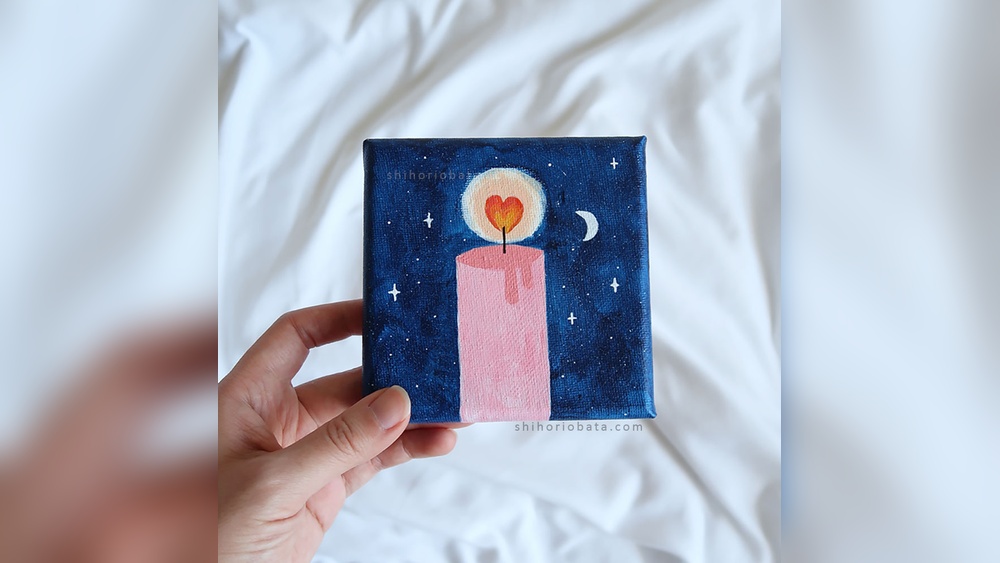
Quick answer: Simple things to paint on canvas include a coffee mug, a single leaf or flower, a lemon slice, a mountain silhouette, a crescent moon, geometric patterns, a favorite quote in bold lettering, a cat outline, a city skyline at dusk, and abstract waves. Good beginner subjects have a clear outline, few colors, and one obvious light source, so you can finish them in a single sitting.
Staring at a blank white rectangle is one of the most common reasons people put off painting. It is rarely a lack of skill; it is a lack of a good starting idea. The trick is to choose subjects that are simple to draw, forgiving to paint, and still satisfying to hang on a wall.
This list groups simple things to paint on canvas by where the idea comes from: objects around your home, nature, patterns, words, animals, and places. You will also find a quick chart to match ideas to your available time, a sample walkthrough, and methods for generating your own ideas whenever you run dry.
What Makes a Subject “Simple” to Paint?
Before the list, it helps to know why some subjects are easier than others. A simple subject usually has:
- A recognizable silhouette. You can identify it from its outline alone, so small inaccuracies inside the shape do not matter.
- Few colors. Three to five colors keep mixing manageable and the result unified.
- Large shapes. Big areas of color are easier to paint than many small details.
- Clear light. One light source gives an obvious light side and shadow side.
- Forgiving texture. Leaves, clouds, water, and fur hide uneven brushstrokes; glass and chrome do not.
Keep these points in mind and almost any idea can be simplified to suit you. If you would rather follow a complete project from blank canvas to hanging piece, our roundup of DIY canvas art ideas you can make at home has full walkthroughs.
Simple Painting Ideas on Canvas From Around Your Home
Everyday objects are free reference material and help you practice observing real light.
- Coffee mug with steam. A cylinder with a handle teaches ellipses and soft shading. Add a few wispy white curves above it.
- Stack of books. Rectangles in different colors, with thin pale lines for pages. Great for practicing straight edges.
- Potted plant. A pot and a few simple leaves. Snake plants and succulents are easiest because the leaves are bold and geometric.
- Teapot or vase. One shape, one highlight, one shadow. Place it near a window for clear lighting.
- Pair of sneakers. More challenging, but outlining them in bold color makes a fun pop-art piece.
- Glass jar of buttons or candy. Paint the jar outline and fill it with colorful dots. The dots do the work.
Good Things to Paint on Canvas From Nature
- A single leaf. A monstera, maple, or fern leaf on a plain background looks striking and modern.
- Lemon or orange slices. Circles with radiating segments. Bright and cheerful, ideal for kitchens.
- Mountain silhouettes. Layered triangles in graded tones from dark to light create depth with almost no detail.
- Crescent moon and stars. Dark background, one pale crescent, scattered dots.
- Cherry blossom branch. A dark, twisting branch with pink dabs made by a cotton swab or the end of a brush.
- Ocean waves. Curving bands of blue and white. Can be realistic or stylized, like Japanese woodblock prints.
- Clouds. A soft blue sky and white cloud shapes with gray-violet undersides. A great blending exercise.
- Single wildflower. A poppy, daisy, or tulip, painted large so the petals fill the canvas.
Pattern and Abstract Ideas
Abstract work is an excellent way to practice color mixing without worrying about drawing accuracy.
- Geometric triangles. Tape off triangles and fill each with a different shade.
- Terrazzo pattern. A cream background scattered with irregular chips of color.
- Rainbow arcs. Simple, nested curves in muted boho tones.
- Brushstroke abstract. Use a wide brush to lay down a few bold, confident strokes in two or three colors.
- Marbled effect. Swirl two or three colors with a palette knife or stick for a stone-like look. If you enjoy marbling, our guide on making DIY marbled paper at home explores the traditional floating technique, which you can later mount or collage onto canvas.
- Dots and circles. Use the ends of brushes, cotton swabs, and corks to stamp dot patterns.
Word and Lettering Ideas
Text-based canvases are popular for bedrooms, offices, and gifts.
- A single meaningful word in bold block letters
- A short quote over a soft gradient background
- Initials or a monogram surrounded by flowers
- Coordinates of a special place in clean, modern type
Sketch the letters lightly first, or print the text at the right size and transfer it by rubbing graphite on the back of the printout and tracing. Paint letters with a small flat brush and slightly thicker paint for crisp edges, or use paint markers.
Simple Animal Ideas
Animals can be intimidating, but simplified shapes make them approachable:
- Cat silhouette sitting on a windowsill against a sunset
- Whale tail rising from the water
- Fox curled up in a ball, mostly one orange shape with white and black accents
- Bird on a branch, a rounded body with a small beak and tail
- Jellyfish floating with flowing tentacles on a deep blue background
- Bee or butterfly as a close-up, symmetrical and graphic
Places and Memory Ideas
- A city skyline at dusk, with rectangles of glowing windows
- A road disappearing into the distance (great for practicing perspective)
- A lighthouse on a cliff
- Your front door or a favorite café facade, simplified
- A cabin in snowy woods
- A view from a vacation photo, cropped to its simplest part
Seasonal and Holiday Ideas
Tying a painting to the time of year gives you a ready-made theme and a reason to rotate art on your walls.
- Spring: A single tulip, a bird’s nest with three blue eggs, or a rain cloud with colorful drops.
- Summer: A watermelon slice, a beach umbrella from above, or a sunflower against a blue sky.
- Fall: One maple leaf in red and orange, a pumpkin with a curling vine, or a mug with a plaid background.
- Winter: A snowy pine silhouette, a single ornament hanging from a ribbon, or a cozy window glowing at night.
- Holidays and gifts: A heart made of overlapping brushstrokes, a simple wreath of green dabs with a red bow, or a monogram with seasonal flowers.
Seasonal pieces work well on small panels, which are easy to swap in and out of a shelf or tabletop easel. Painting a set of four with the same composition, such as one tree through the seasons, also makes a striking grouping on a wall.
Match the Idea to Your Time
| Time available | Ideas that fit | Suggested canvas size |
|---|---|---|
| 30 minutes | Crescent moon, single leaf, brushstroke abstract, dot pattern | 5 x 7 or 6 x 6 in. canvas panel |
| 1 hour | Mountain silhouettes, lemon slices, coffee mug, rainbow arcs, cat silhouette | 8 x 10 in. |
| 2 hours | Cherry blossom branch, ocean waves, city skyline, quote with background | 11 x 14 in. |
| Weekend | Lighthouse scene, still life from life, larger abstract | 16 x 20 in. or larger |
Canvas Panel Ideas on a Budget
Canvas panels and boards are an affordable way to practice. Buy them in packs and use them for:
- Daily small paintings, one subject per day
- Color studies of the same object in different light
- A series, such as four seasons of the same tree
- Small gifts and greeting-card-sized art
Cheap canvas for painting ideas is not a problem as long as you add a coat of gesso if the surface feels thin or slick. You can also paint on the back of old canvases or over paintings you no longer like.
Walkthrough: Mountain Silhouettes at Sunset
This one-hour project uses only five colors and teaches value, which is how light or dark a color is.
- Sky: On an 8 x 10 inch canvas, paint a gradient from yellow near the middle to orange and then pink-violet at the top. Blend the joins while the paint is wet.
- Dry: Let it dry fully, about 15 to 20 minutes.
- Farthest range: Mix violet with plenty of white. Paint a jagged mountain line across the canvas about halfway down and fill below it.
- Middle range: Mix a slightly darker violet. Paint a second ridge lower and overlapping the first.
- Nearest range: Use a deep violet-blue, almost black. Paint the lowest ridge across the bottom.
- Optional details: Add a sun peeking between peaks, a few birds as tiny “V” shapes, or pine trees along the nearest ridge.
Each ridge gets darker as it comes forward. That simple value step creates a strong sense of distance with no detailed drawing.
Variations to try next
- Cool version: Swap the warm sky for a pale blue-to-navy gradient and paint the ridges in blue-grays for a winter dawn.
- Monochrome: Use only one color plus white and black. This isolates value and is excellent practice.
- Reflection: Add a lake across the bottom and mirror the ridges upside down, slightly softer and darker than the originals.
- Textured: Apply the nearest ridge with a palette knife for a heavy, sculptural edge that catches light.
How to Come Up With Your Own Ideas
- Keep a list on your phone. Note colors, objects, and scenes that catch your eye during the day.
- Use a prompt jar. Write simple subjects on slips of paper and draw one at random.
- Try a 30-day challenge. One small painting per day, each with a single-word theme: “blue,” “round,” “morning.”
- Paint the same thing three ways. Realistic, simplified, and abstract versions of the same subject build range quickly.
- Limit yourself. Choose only two colors plus white, or only one brush. Constraints often spark creativity.
- Crop your photos. Zoom into a small section of a photo and paint only that.
Common Mistakes to Avoid
- Picking a subject with too much detail. Simplify by squinting or cropping.
- Starting with the details. Paint large background shapes first, then mid-tones, then details last.
- Using too many colors. A limited palette makes paintings look intentional.
- Not letting layers dry. Painting over wet paint can muddy colors.
- Judging too early. Most paintings look awkward halfway through. Finish before deciding.
Turning Ideas Into Finished Projects
A simple painting becomes a polished piece with a few finishing touches: paint the canvas edges, add a hanging wire or sawtooth hook, and apply a coat of varnish. For complete project walkthroughs, including mixed media and decor-style pieces, browse our collection of simple DIY canvas art projects for home.
FAQs
What is a good thing to paint on a canvas for beginners?
Subjects with bold outlines and few colors work best: mountain silhouettes, a crescent moon, a single leaf, lemon slices, or a simple abstract. These let you focus on handling paint rather than complicated drawing.
What can I paint when I have no ideas?
Paint something within arm’s reach, such as a mug, a plant, or fruit. Alternatively, use a prompt jar or a one-word theme like “blue” or “round” and paint the first thing that comes to mind.
What paint is best for simple canvas paintings?
Acrylic is the most popular choice because it dries quickly, cleans up with water, and works on almost any primed canvas. Gouache and oil also work on canvas, but each needs a slightly different approach and drying time.
Can I paint on cheap canvas?
Yes. Inexpensive canvases and panels are fine for practice. If the surface feels thin or overly absorbent, add one or two coats of gesso first. Save higher-quality canvas for pieces you plan to keep or gift.
How do I make a simple painting look professional?
Use a limited, harmonious palette, keep clean edges, paint the sides of the canvas, and apply varnish for an even finish. A strong composition with deliberate negative space often looks more professional than lots of detail.
Are watercolor painting ideas the same as canvas ideas?
Many simple subjects overlap, such as florals, landscapes, and skies. Watercolor relies on transparent washes on paper, while canvas work usually uses opaque layers of acrylic or oil, so the techniques differ even when the subject is the same.
Next Step
Choose one idea from this list that fits the time you have tonight, and finish it. Once you have a few small pieces done, you can build them into decor, gifts, or larger mixed-media work. Our guide to easy canvas art projects you can make at home walks you through next-level projects step by step.




