

PaintingProGuide is reader-supported. When you buy through links on this page we may earn an affiliate commission at no extra cost to you.
Open most oil paint sets and you will find the same problem: a dozen colors you rarely use and not enough of the two or three you reach for every session. The best oil colors for painting are not simply the biggest box. They are a set whose colors mix cleanly into everything else, with enough paint per tube, especially white, to actually finish paintings.
This guide looks at oil color sets the way a painter uses them. First, a checklist of the colors a useful set should contain and why. Then a side-by-side look at six oil color sets sold on Amazon, including the total amount of paint in each box, which is rarely printed on the front. Finally, practical advice on supplementing any set so it works as a real palette.
Quick answer: The Winsor & Newton Winton Basic Set, 10 x 21 ml is the best-balanced oil color set here: a focused selection from a long-established maker, described as lightfast, permanent and intermixable with other brands. If you want far more paint per color, the PHOENIX Studio 20 x 50 ml set holds about a liter of paint in total. On a tight budget, the Ohuhu 24-color set lists a practical spread of whites, yellows, reds, blues and earths.
What a Good Oil Color Set Should Contain
Use this as a checklist when reading any set’s color list. A set that covers these roles will mix nearly anything:
- A strong white, ideally titanium, and ideally a bigger tube than the rest.
- A warm and a cool yellow, such as a medium yellow and a lemon yellow.
- A warm and a cool red, such as vermilion or cadmium red plus a crimson or rose.
- A warm and a cool blue, such as ultramarine plus Prussian, phthalo or cerulean.
- Earth colors: yellow ochre, burnt sienna and burnt umber for skin, landscape and neutrals.
- Optional: one green (viridian or sap green), a black, and a violet for convenience.
Colors you can usually skip in a set: multiple near-identical greens, flesh tints (easily mixed), and metallics unless you paint decorative work. Choosing colors this way is covered in more depth in our guide on how to choose paint colors.
Our Top Picks at a Glance
- Winsor & Newton Winton Oil Color Basic Set, 10 x 21 ml — Best balanced oil color set
- PHOENIX Studio Oil Paint Set, 20 x 50 ml — Best for volume and frequent painting
- Paul Rubens Oil Paint, 20 x 50 ml — Best large-tube set for landscapes and portraits
- Ohuhu Oil Paint Set, 24 x 12 ml — Best budget set with a practical color spread
- Magicfly Oil Paint Set, 40 x 18 ml — Best for exploring many ready-made colors
- RoseArt Premium Oil Paint, 24 x 12 ml — Lowest-cost set for practice
Oil Color Sets Compared by Paint Volume
| Product | Best For | Key Spec | Key Strength | Price Tier |
|---|---|---|---|---|
| Winton Basic Set | Balanced palette | 10 x 21 ml (about 210 ml total) | Lightfast, intermixable per listing | $$ |
| PHOENIX Studio | Volume, frequent painting | 20 x 50 ml (about 1,000 ml total) | Strong tinting per listing | $$$ |
| Paul Rubens | Large tubes, broad subjects | 20 x 50 ml (about 1,000 ml total) | Refined linseed oil | $$$ |
| Ohuhu 24 | Budget beginners | 24 x 12 ml (about 288 ml total) | Clear color list | $$ |
| Magicfly 40 | Color exploration | 40 x 18 ml (about 720 ml total) | Extra whites, metallics | $$ |
| RoseArt 24 | Practice | 24 x 0.4 oz (about 288 ml total) | Lowest cost | $ |
Price per milliliter tells a similar story. Large-tube studio sets cost more upfront but usually far less per milliliter than small-tube boxes, while established brand sets like Winton cost more per milliliter in exchange for clearer labeling and the option to buy matching individual tubes later. Decide whether you are paying for quantity or for a palette you will keep building on.
Total volume is a useful reality check. A 24-color set with 12 ml tubes holds less than a third of the paint in a 20 x 50 ml set, and most of that is spread across colors you may rarely use.
How We Chose
We evaluated these sets using their Amazon listing details and specifications, checked in October 2026, the usefulness of their color selections for mixing, the amount of paint per tube and per set, and how widely each is reviewed by Amazon buyers. We have not painted with these sets; quality claims are attributed to the listings.
- Color selection: coverage of warm and cool primaries, earths and white.
- Volume: tube size and total paint.
- Maker information: lightfastness and permanence claims and how clearly they are stated.
- Value: cost relative to usable paint.
Best Oil Colors for Painting Reviewed
1. Winsor & Newton Winton Oil Color Basic Set, 10 x 21 ml — Best for a balanced palette

Winton is Winsor & Newton’s moderately priced oil line. This basic set contains 10 individually formulated colors in 21 ml tubes. The listing describes them as lightfast, permanent and intermixable with other brands.
Ten colors is close to the ideal starting palette size. It forces you to mix, and because the line is sold in individual tubes as well, you can replace the colors you use most without buying another set.
Best suited for: Beginners and returning painters who want a focused, dependable starting palette.
Key features:
- 10 colors, 21 ml each
- Individually formulated colors
- Lightfast, permanent per listing
- Intermixable with other brands
Pros:
- Established maker
- Sensible palette size
- Easy to replace individual tubes
Cons and limitations:
- Only 21 ml per tube
- White will run out first
Buying consideration: Add a 200 ml tube of white straight away; it is the single best upgrade to any small-tube set.
2. PHOENIX Studio Oil Paint Set, 20 x 50 ml — Best for volume and frequent painting

PHOENIX’s studio set contains 20 colors in 50 ml tubes, roughly a liter of paint. The listing describes high color saturation, strong tinting strength, good permanence, finely ground pigments, a thick and creamy consistency and EN 71 and ASTM D-4236 certification.
If you paint several times a week, or work large, this set means you are rarely limited by running out.
Best suited for: Frequent painters, students working through many studies, and larger canvases.
Key features:
- 20 colors, 50 ml each
- Thick, creamy consistency
- EN 71 and ASTM D-4236 per listing
Pros:
- About 1,000 ml of paint
- Large tubes
- Good for impasto
Cons and limitations:
- Studio grade, not artist grade
- Per-color pigment details limited
Buying consideration: Make a tint chart for all 20 colors so you know which are strong and which are weak before mixing.
3. Paul Rubens Oil Paint, 20 x 50 ml — Best for large tubes for varied subjects

Paul Rubens’ set also offers 20 colors in 50 ml tubes. The listing highlights high pigmentation, covering power and tinting strength, refined linseed oil for a buttery consistency, excellent lightfastness and a color selection aimed at landscape, seascape, portrait and still life.
Compared with PHOENIX, the choice comes down to which color list better matches the subjects you paint.
Best suited for: Painters who want big tubes and a color list tailored to common subjects.
Key features:
- 20 colors, 50 ml each
- Refined linseed oil
- High pigmentation per listing
Pros:
- Large tubes
- Subject-oriented color selection
- Buttery consistency
Cons and limitations:
- Per-color pigment information not listed
- Higher upfront cost
Buying consideration: Compare the full color lists of this set and PHOENIX on the listings before choosing.
4. Ohuhu Oil Paint Set, 24 x 12 ml — Best for budget beginners
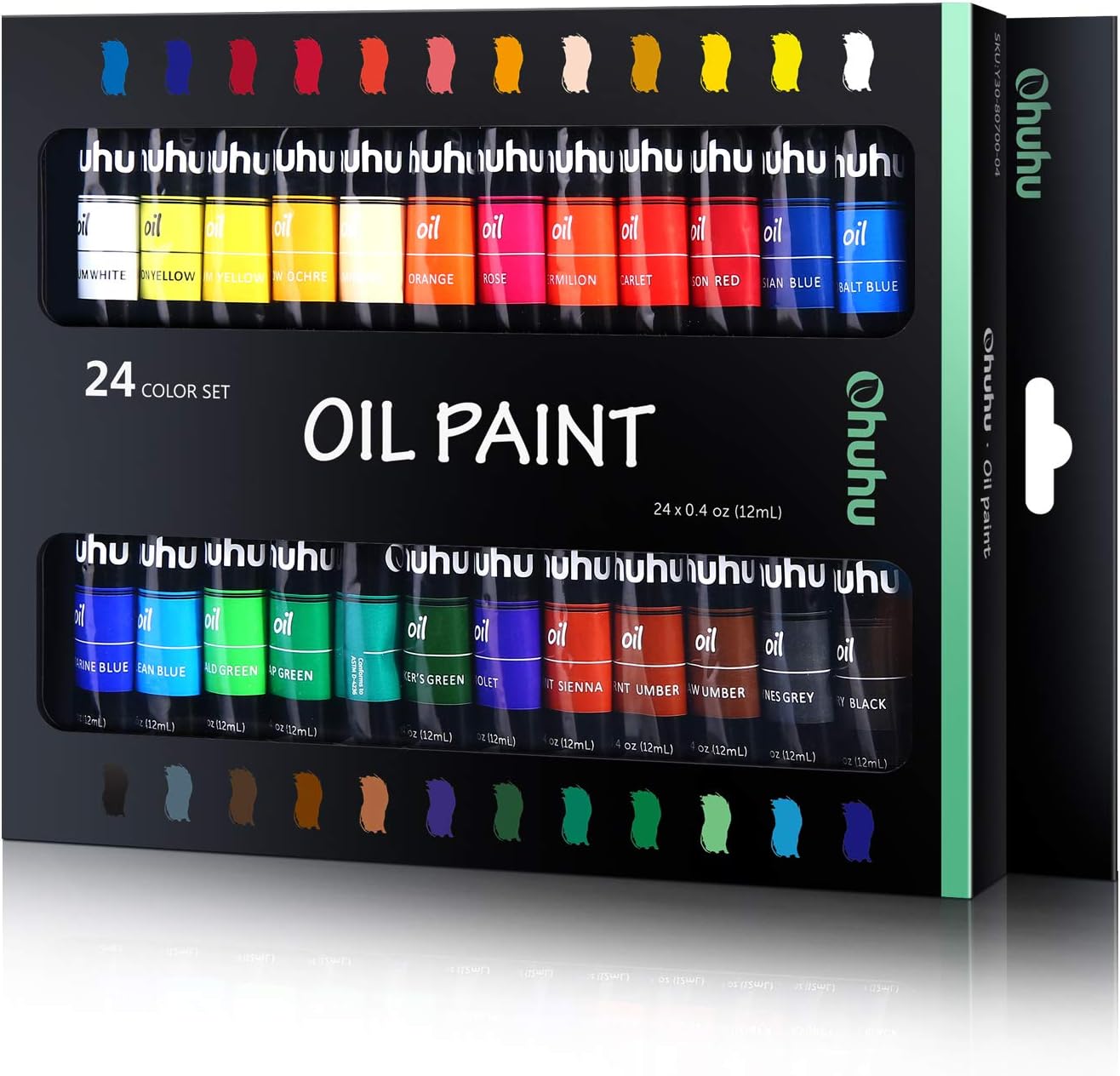
Ohuhu’s listing names its colors clearly, including titanium white, lemon yellow, medium yellow, yellow ochre, flesh tint, orange, rose, vermilion, scarlet, crimson red, Prussian blue, cobalt blue and ultramarine blue. That covers warm and cool versions of each primary plus earths.
Twelve milliliter tubes are small, but for a beginner deciding whether oils are for them, this is an inexpensive way to get a usable palette.
Best suited for: Beginners on a budget who want a complete color spread.
Key features:
- 24 colors, 12 ml each
- Warm and cool primaries listed
- Non-toxic per listing
Pros:
- Low cost
- Clear color list
- Covers mixing basics
Cons and limitations:
- Small tubes
- Includes colors you can mix yourself
Buying consideration: Set aside convenience colors like flesh tint and practice mixing them from primaries and white.
5. Magicfly Oil Paint Set, 40 x 18 ml — Best for exploring ready-made colors
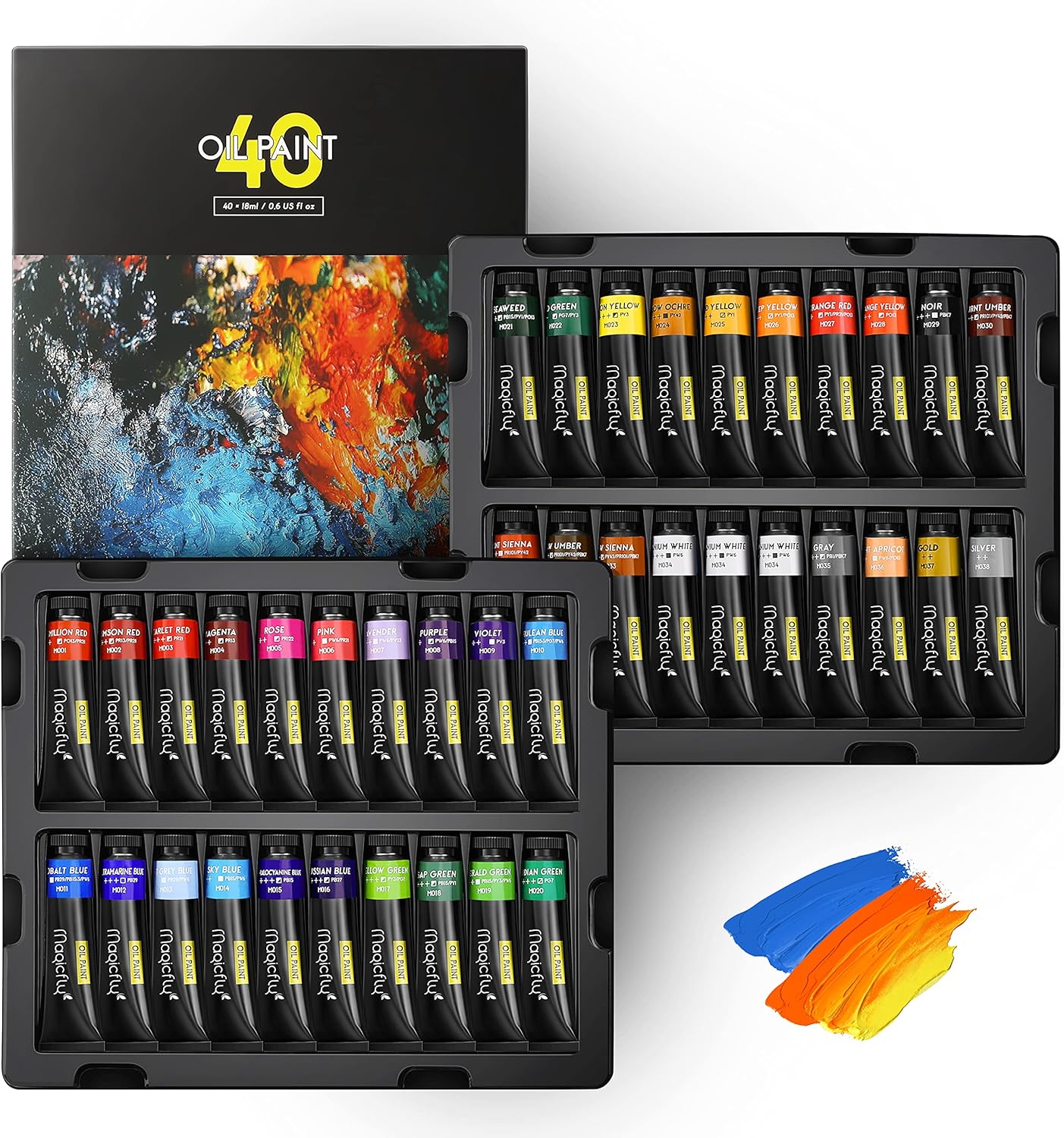
Magicfly’s set has 40 colors in 18 ml tubes, including metallic gold and silver, plus two extra white tubes. The listing notes ASTM D-4236 conformance and thick, creamy paint.
A large ready-made range is enjoyable for decorative and abstract work, and the extra whites are a thoughtful touch.
Best suited for: Hobbyists who enjoy many ready-made colors and decorative effects.
Key features:
- 40 colors, 18 ml each
- Metallic gold and silver
- Two extra whites
Pros:
- Huge variety
- Extra white
- Metallics included
Cons and limitations:
- Many colors overlap
- Encourages less mixing practice
Buying consideration: Choose eight to ten of the 40 for a limited-palette painting now and then; it improves color harmony.
6. RoseArt Premium Oil Paint, 24 Colors — Best for practice

RoseArt’s set contains 24 tubes of 0.4 oz, with colors including light green, deep yellow, orange, sap green, lemon yellow, yellow ochre, vermilion, cadmium red, alizarin rose, permanent red, titanium white and black. The listing describes rich, buttery, highly pigmented oil paint. One bullet in the listing refers to the tubes as acrylic, which appears to be an error given the product title and details, so confirm on the listing before ordering.
It is the lowest-cost option here and suits quick color studies.
Best suited for: Practice studies and casual painting on the lowest budget.
Key features:
- 24 colors, 0.4 oz each
- Includes earths and alizarin rose
- Non-toxic per listing
Pros:
- Lowest cost
- Broad color list
Cons and limitations:
- Small tubes
- Listing inconsistency about paint type
Buying consideration: Double-check the product type on the listing; the title and details describe oil paint.
Buying Guide: How to Choose Oil Colors
Start from roles, not names
Make sure the set covers warm and cool primaries, earths and a strong white.
Check tube size and total volume
Small tubes are fine for testing; larger tubes are more economical for regular painting.
Read lightfastness claims
Prefer sets and lines that state lightfastness and permanence clearly.
Plan to supplement
Almost every set benefits from an extra, larger white and one or two individual colors.
Match colors to subjects
Landscape painters use more greens and earths; portrait painters use more earths and reds; floral painters may want a high-chroma magenta.
Consistency
Buttery paint suits brushwork and impasto; softer paint suits blending and glazing with medium.
Extra Colors Worth Adding by Subject
Once you have the core palette, one or two additional tubes tailored to what you paint make a bigger difference than a larger set.
Landscapes
Add a cool blue such as cerulean for skies and a sap green or viridian as a mixing base for foliage. Yellow ochre and burnt sienna do much of the work in fields, trees and earth.
Seascapes and beaches
A phthalo or Prussian blue gives deep water; a touch of viridian makes turquoise shallows. For sand, mix yellow ochre, white and a little burnt sienna. Our guide to painting sand and beach scenes in oil shows these mixes in context.
Portraits
Earths are the backbone: yellow ochre, burnt sienna and a red such as vermilion, cooled with a touch of ultramarine. Skip tube flesh tints and mix skin from these.
Florals
Flowers often exceed what mixed colors can reach. A quinacridone magenta or a bright rose, plus a clean lemon yellow, opens up petal colors that primaries alone cannot hit.
Dramatic light and fire
High-chroma yellows and oranges with a transparent red for glazing create glowing effects. See how to paint fire and flames in oil for a practical exercise.
Turn Any Set Into a Working Palette
- Lay out a limited selection: white, two yellows, two reds, two blues and two earths.
- Make a mixing chart: each color mixed with white, and each pair mixed together.
- Mix greens from your blues and yellows instead of relying on tube greens.
- Mix darks from ultramarine and burnt umber for richer shadows than black.
- Note which tubes you finish first and buy those individually, larger.
Mixing is where any set proves its worth. Our oil paint color mixing guide walks through the basics, mixing colors for realistic effects covers temperature and value, and mixing colors for portrait painting focuses on skin tones. For subject practice, try painting autumn leaves in oil, a great test of warm color mixing.
Common Mistakes to Avoid
- Buying the biggest box for the color count. Volume and color roles matter more.
- Using every color in every painting. Limited palettes look more unified.
- Never mixing your own greens. Tube greens can look artificial.
- Running out of white mid-painting. Buy a large white separately.
- Mixing on a dirty palette. Scrape and wipe often.
- Judging a set by the box photo. Read the actual color list; printed swatches on packaging rarely match the paint.
- Squeezing out every color at once. Oil paint skins over on the palette; put out only what the painting needs.
FAQs
What oil colors do I need to start painting?
Titanium white, a warm and cool yellow, a warm and cool red, a warm and cool blue, yellow ochre, burnt sienna and burnt umber cover most needs.
Is a 24-color oil paint set good for beginners?
It can be, but a smaller set with larger tubes often teaches mixing better and runs out less quickly.
How much oil paint do I need?
It depends on canvas size and style. White is used most; buy it in the largest tube you can.
Can I mix oil paint brands?
Yes. Oil paints are generally intermixable, and the Winton listing states this explicitly for its colors.
What is the difference between 21 ml and 50 ml tubes?
Volume. A 50 ml tube holds more than twice the paint, which matters for colors you use often.
Should I buy black oil paint?
Optional. Many painters mix darks from ultramarine and burnt umber for more variety.
Final Recommendation
Choose the Winton Basic Set for a focused, dependable palette and add a large white. Pick PHOENIX or Paul Rubens if you paint often and want big 50 ml tubes. On a budget, Ohuhu has a clear, useful color list, Magicfly suits exploration and decorative work, and RoseArt is the low-cost option for practice studies. Whichever you choose, the habit of mixing from a limited palette will improve your color faster than any box of paint.





One Comment