
PaintingProGuide is reader-supported. When you buy through links on this page we may earn an affiliate commission at no extra cost to you.
Princeton built its name on synthetic brushes, and today almost every line it sells uses man-made filament instead of animal hair. That is good news for painters who want consistent, cruelty-free brushes, but it also makes the catalog confusing: a soft synthetic squirrel for watercolor and a stiff synthetic bristle for oil are both “Princeton synthetic brushes,” yet they behave nothing alike. This review sorts the current Amazon listings by what they are designed to do, explains the fiber behind each, and points out the honest trade-offs so you can match a Princeton synthetic brush to your medium.
Quick answer: For oil and heavy acrylic, the Princeton Aspen 4-Piece Set is the right synthetic, because its bristles are designed to be as stiff as natural hog. For watercolor, the Princeton Heritage Series 4050 Set of 4 gives sable-like snap and point. If you paint in several media, the Princeton Velvetouch Series 3950 Set of 4 is the most flexible, and the Princeton Real Value Series 9100 set is the low-cost starter.
Our Top Picks at a Glance
- Princeton Velvetouch Series 3950, Set of 4 — Best Princeton synthetic brush set for mixed media
- Princeton Aspen Acrylic & Oil Set, 4 Piece — Best stiff synthetic for oils and heavy acrylics
- Princeton Heritage Series 4050, Set of 4 — Best synthetic sable for watercolor
- Princeton Neptune Series 4750 Round 8 — Best soft synthetic squirrel for washes
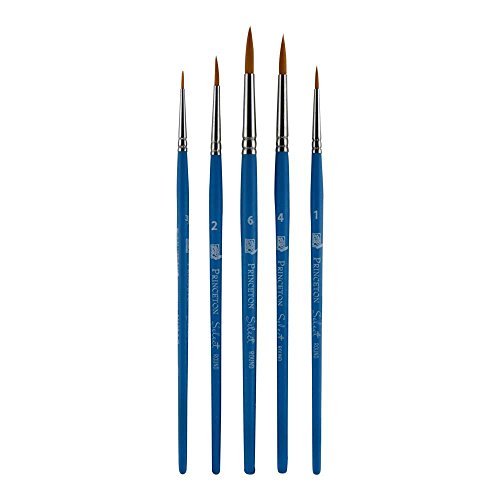
- Princeton Select Artiste Set No. 10 — Best all-purpose set for students
- Princeton Real Value Series 9100 Set — Best budget white taklon starter set
- Princeton Velvetouch Series 3950 5-Piece Set — Best Velvetouch set with named sizes
| Product | Best For | Key Spec | Key Strength | Price Tier |
|---|---|---|---|---|
| Velvetouch 3950 Set of 4 | Mixed media | Multi-filament synthetic blend | Color-holding and spring | $$ |
| Aspen 4-Piece | Oil, heavy acrylic | Stiff synthetic bristle | Holds shape under pressure | $$ |
| Heritage 4050 Set of 4 | Watercolor | Golden taklon blend | Point, edge and snap | $$ |
| Neptune 4750 Round 8 | Washes | Synthetic squirrel; 0.19 in width | Softest, thirstiest fiber | $ |
| Select Artiste No. 10 | Students | 5 brushes, satin blue handles | Works across media | $$ |
| Real Value 9100 | Beginners on a budget | White taklon rounds 3/0, 2, 4; flats 2, 6 | Lowest cost to start | $ |
| Velvetouch 3950 5-Piece | Defined mixed-media kit | Spotter 5/0, angle 1/4″, rounds 2, 8, filbert 8 | Every size listed | $$$ |
How Princeton Synthetic Brushes Differ from One Another
“Synthetic” covers a wide range of filaments. Some are fine and soft to imitate sable or squirrel hair for watercolor; others are thick and springy to imitate hog bristle for oil. Princeton blends several filament diameters in its higher-end lines so a brush can hold more paint and still form a point or a crisp edge.
Soft synthetics for water media
Heritage uses a golden taklon blend to imitate sable, with a fine point and snap. Neptune uses silky synthetic filaments to imitate squirrel, prioritizing softness and water capacity. Both are designed for watercolor and similar fluid media.
Firm synthetics for oil and acrylic
Aspen is designed with synthetic bristles described as being as stiff as natural bristles, staying together regardless of surface or pressure. That makes it the Princeton line built for moving thick paint.
All-rounders
Velvetouch and Select Artiste are designed to work across watercolor, acrylic and oil. Velvetouch uses a luxury multi-filament blend; Select Artiste varies filament type by brush shape. Real Value is the entry-level line, here in white taklon.
Why painters choose synthetic
- Animal-free construction
- More consistent from brush to brush than natural hair
- Generally tolerate acrylic and solvents better than natural hair
- Lower cost than sable at similar sizes
Honest limitations
- Most synthetics still release water faster than natural sable or squirrel.
- Very soft synthetics struggle with heavy paint; very stiff ones are too harsh for watercolor.
- Several listings omit the exact sizes in a set, so check the photos.
How We Chose
We have not painted with these brushes ourselves. Selections are based on the Amazon listing details and specifications checked in October 2026, on how well each set’s fiber stiffness, shapes and intended media fit someone looking for a Princeton synthetic brush, and on how widely each product is reviewed by Amazon buyers.
- Fiber softness or stiffness relative to the medium
- Shapes and sizes included
- Handle and ferrule details described in the listing
- Value per brush
- Breadth of Amazon buyer reviews
Princeton Synthetic Brush Review: Line by Line
1. Princeton Velvetouch Series 3950, Set of 4 — Best for Mixed Media
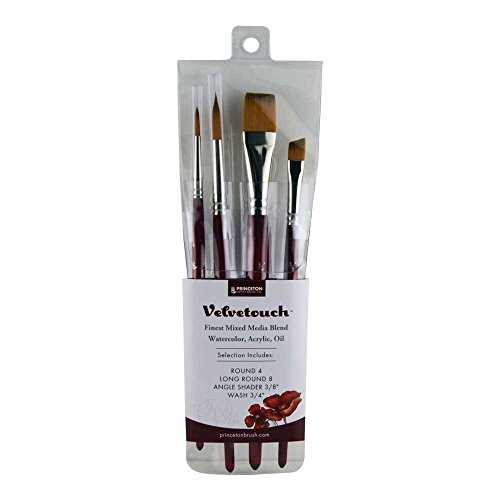
Velvetouch is Princeton’s go-anywhere synthetic. The listing says it works for watercolor, gouache, oil and acrylic, with each shape using a blend of several synthetic filaments for better color-holding, precise placement, precision tapering and resilient spring. The handle has the signature smooth Velvetouch finish and is made with FSC wood.
The full line spans 72 brushes in 20 shapes, including shaders, rounds, fans, liners, mops and spotters, so this four-piece set is an easy way to try the feel before adding individual brushes.
Best suited for: painters who switch media and want one family of brushes.
Key features:
- Set of 4 synthetic brushes
- Multi-filament blend for capacity and spring
- Velvetouch handle from FSC wood
Pros:
- Works with water media and oils
- Large line to expand from
- Comfortable handle finish
Cons/limitations:
- Set contents not specified in the bullets
- Not as stiff as Aspen for impasto
- Not as thirsty as Neptune for washes
Buying consideration: a generalist that does most jobs well; specialists may want Aspen or Heritage alongside it.
2. Princeton Aspen Acrylic & Oil Set, 4 Piece — Best Stiff Synthetic

Aspen exists because soft synthetics cannot push thick oil or heavy-body acrylic. The listing says its synthetic bristles are as stiff as natural ones and stay together regardless of surface or pressure, so acrylics, oils and water-soluble oils glide evenly off the fibers.
Princeton positions Aspen as more durable and affordable than most traditional synthetic and natural-hair brushes. The bristles are flagged per the listing, which helps them hold paint.
Best suited for: oil painters and heavy-body acrylic painters.
Key features:
- 4-piece set
- Stiff synthetic, flagged bristles
- For oil, acrylic and water-soluble oil
Pros:
- Handles thick paint and texture
- Keeps shape under pressure
- Animal-free alternative to hog bristle
Cons/limitations:
- Too firm for watercolor washes
- Sizes not stated in the bullets
- Only four brushes
Buying consideration: if you paint oils, start here rather than with a soft all-rounder.
3. Princeton Heritage Series 4050, Set of 4 — Best Synthetic Sable for Watercolor

Heritage is Princeton’s flagship watercolor line, developed by Japanese brushmaker Naohide Takamoto. The listing describes a golden taklon blend in multiple diameters that gives a fine point, crisp edge and snap like natural sable, while drinking up water and keeping its shape.
This set of four is an efficient introduction to the line. The listed brush width of 0.75 inches suggests a flat or wash brush is included, but check the photos for the exact lineup.
Best suited for: watercolorists wanting control without natural hair.
Key features:
- Set of 4, assorted sizes
- Golden taklon synthetic sable blend
- Scarlet handles
Pros:
- Sable-like point and snap
- Good water capacity for a synthetic
- Flagship-quality line
Cons/limitations:
- Exact sizes not listed
- Not designed for heavy oils
- Less water-holding than Neptune
Buying consideration: the best Princeton synthetic for controlled watercolor work.
4. Princeton Neptune Series 4750 Round 8 — Best Soft Synthetic for Washes

Neptune is described as Princeton’s softest and thirstiest brush. Its silky synthetic blend is designed to be as soft as natural squirrel and to hold a reservoir of water. A round 8 handles both broad strokes and reasonably fine details.
The listing gives a 0.19 inch width and a dark wood handle. It is the lowest-cost single brush here, so it is an easy way to try squirrel-style softness.
Best suited for: loose watercolor, wet-in-wet and soft washes.
Key features:
- Round, size 8; 0.19 in width
- Synthetic squirrel blend
- High water capacity
Pros:
- Very soft and absorbent
- Low price tier for a single brush
- Line offers daggers, quills, mottlers and more
Cons/limitations:
- Less snap for crisp control
- Unsuitable for thick paint
- Single brush
Buying consideration: pair it with a Heritage round if you also need crisp edges.
Alternatives Worth Comparing
These three Princeton sets are general-purpose rather than medium-specific. They make sense for students, classrooms and anyone who wants a low-cost starting kit.
5. Princeton Select Artiste Set No. 10 — Best All-Purpose Student Set

Select Artiste is described as Princeton’s best-selling brush, usable with acrylic, oil and watercolor. This five-piece set has satin-finished jewel-blue handles and silver ferrules, and filament type varies by brush style. The full line covers 29 shapes and 108 styles.
The title says synthetic, though a detail field lists natural bristle, so trust the title and bullets.
Best suited for: students and hobbyists who want one set for several media.
Key features:
- 5 brushes
- Synthetic filaments by shape
- Satin blue handles
Pros:
- Versatile across media
- Huge line for later additions
- Attractive, durable finish
Cons/limitations:
- Set shapes not named
- Not specialized for any medium
- Conflicting bristle field
Buying consideration: good classroom value; check photos for shapes.
6. Princeton Real Value Series 9100 Set — Best Budget Starter

Real Value is Princeton’s entry-level line. This set includes white taklon rounds 3/0, 2 and 4 plus flats 2 and 6, which covers detail, lines and small flat areas. The listing describes it as suitable for acrylic, watercolor, oil and tempera.
It is the lowest price tier on this page and an obvious choice for kids, classrooms and first-time painters.
Best suited for: beginners, classrooms and craft painting.
Key features:
- Rounds 3/0, 2, 4; flats 2, 6
- White taklon synthetic
- Blue handles
Pros:
- Very low cost
- Sizes clearly listed
- Works with many media
Cons/limitations:
- Small sizes only
- White taklon is soft for thick oils
- Entry-level durability
Buying consideration: a fine starter; upgrade to Aspen or Heritage as your medium becomes clear.
7. Princeton Velvetouch Series 3950 5-Piece Set — Best Velvetouch Set with Listed Sizes

If the Velvetouch set of four appeals but you want to know exactly what is in the box, this five-piece version spells it out: a 5/0 spotter, a 1/4″ angle shader, rounds 2 and 8, and a filbert 8. That spread covers tiny details, crisp angled edges, general linework and soft blending.
The listing says the set mirrors the characteristics of sable without the cost, with precision tapering, resilient snap and enhanced color-holding. The handle has the slip-free satin Velvetouch finish and FSC wood, and the bullets describe the fiber as an animal-friendly synthetic blend, even though one material field mentions animal hair.
Best suited for: mixed-media painters who want a defined kit for detail and blending.
Key features:
- Spotter 5/0, angle shader 1/4″, rounds 2 and 8, filbert 8
- Synthetic blend per bullets
- Satin Velvetouch handles
Pros:
- Every brush named in the listing
- Covers detail, edges and blending
- Usable in watercolor, gouache, acrylic and oil
Cons/limitations:
- Highest price tier of the sets here
- No large brush for washes or backgrounds
- Material field conflicts with the bullets
Buying consideration: choose this over the set of four when you want certainty about shapes and sizes.
Synthetic vs Natural Hair: What You Gain and Give Up
Choosing a Princeton synthetic is partly a choice against natural hair, so it helps to be clear about the trade. Natural sable and squirrel still hold and release water more gradually than most synthetics, which watercolorists notice on long strokes. Natural hog bristle has split tips that carry thick oil paint well.
Synthetics answer with consistency, durability and price. They tolerate the abrasion of acrylic and canvas better, survive solvent cleaning, and do not vary from batch to batch the way natural hair can. For most acrylic painters, synthetics are simply the better tool. For oil and watercolor, the gap has narrowed, and lines like Aspen and Heritage are designed specifically to close it.
If you avoid animal products, every brush on this page is described in its listing or title as synthetic, so you can build a complete kit without natural hair.
Matching a Princeton Synthetic to Your Medium
If you are still unsure, this quick map ties the lines above to common painting situations.
- Oil painting, impasto, palette-heavy acrylic: Aspen.
- Controlled watercolor, botanical, urban sketching: Heritage.
- Loose watercolor, skies, wet-in-wet: Neptune.
- Gouache, fluid acrylic, mixed media: Velvetouch.
- Classrooms and first experiments: Real Value or Select Artiste.
Many painters end up with two lines: a firm synthetic for thick paint and a soft one for fluid work. Keeping them separate also stops acrylic residue from building up in soft watercolor brushes.
Buying Guide: How to Choose a Princeton Synthetic Brush
Match stiffness to paint thickness
Thick paint needs firm fibers; fluid paint needs soft, absorbent ones. This single rule explains most of the differences between Princeton lines.
Choose the right shapes
Rounds handle lines and detail, flats and brights handle blocks and edges, filberts blend, and liners or spotters handle the smallest marks. A starter kit should include at least a round and a flat.
Consider handle length
Long handles suit easel painting at arm’s length, common in oils. Short handles suit close, table-top work, common in watercolor.
Look at set contents
Some listings, like Real Value 9100, name every brush. Others do not, so check images before buying.
Think about durability and cleaning
Synthetics tolerate acrylic and solvents better than natural hair, but they still need prompt cleaning. Dried acrylic ruins any brush.
Buy single brushes to fill gaps
Once you know your favorite line, buying single brushes like the Neptune Round 8 is more efficient than buying another set.
Learn More About Synthetic Brushes
For background on the fibers themselves, read our explainer on what a synthetic paint brush is. When you are ready for fine work, our guide on what size brush to use for detail acrylic work helps you choose the right small round.
Common Mistakes to Avoid
- Using a soft watercolor synthetic for thick oil or acrylic.
- Using stiff Aspen-style brushes for delicate washes.
- Assuming all “synthetic” brushes behave the same.
- Letting acrylic dry in the ferrule.
- Buying large sets before you know which shapes you use.
- Ignoring set contents listed in photos.
FAQs
Are Princeton synthetic brushes good?
Princeton specializes in synthetics and offers lines designed for specific media, from soft squirrel-style watercolor brushes to stiff oil brushes. Choosing the right line for your medium matters more than the brand.
Which Princeton synthetic brush is best for acrylic?
For heavy-body acrylic, Aspen is designed to be stiff. For fluid acrylic and mixed media, Velvetouch is a good fit.
Which Princeton synthetic brush is best for oil painting?
Aspen, because its synthetic bristles are designed to be as stiff as natural bristle and to keep their shape under pressure.
Do Princeton synthetic brushes work for watercolor?
Yes. Heritage and Neptune are designed specifically for watercolor, imitating sable and squirrel respectively.
Is Velvetouch or Select Artiste better?
Both are all-purpose lines. Velvetouch emphasizes a multi-filament blend and comfort handle, while Select Artiste is a broad, student-friendly line.
How do I clean synthetic brushes?
Rinse during painting, then wash with mild soap and water for water media, or the appropriate solvent followed by soap for oils. Reshape and dry flat or upright.
Final Recommendation
Pick by medium. Oil and heavy acrylic painters should start with the Princeton Aspen 4-Piece Set. Watercolorists who want control should choose the Heritage Series 4050 Set of 4, and those who paint loose washes should add the Neptune Round 8.
If you paint in several media, the Velvetouch Series 3950 Set of 4 is the most flexible single purchase. Students and beginners can start cheaply with the Real Value Series 9100 or Select Artiste Set No. 10 and upgrade once their medium is clear.




3 Comments