
PaintingProGuide is reader-supported. When you buy through links on this page we may earn an affiliate commission at no extra cost to you.
Buying a Claessens canvas roll is a decision about workflow as much as surface. A roll lets you cut any size, stretch as tightly as you like and paint on Belgian linen at a lower cost per square foot than ready-made linen canvases. In exchange, you take on cutting, stretching and storage. This Claessens canvas roll review focuses on that trade: which roll to choose, how much you will actually get out of it, and when a cheaper cotton roll makes more sense.
Four Claessens rolls were listed on Amazon when we checked in October 2026: #13 and #15 (oil primed, 54 inches wide by 3 yards), #109 (universal primed, 82 inches by 6 yards) and #066 (unprimed, 84 inches by 6 yards). We also compare three cotton rolls for painters who want the roll format without the linen price.
Quick answer: Oil painters who want a manageable first roll should start with Claessens #15 or #13 at 54 inches by 3 yards. Painters who use acrylic, or both acrylic and oil, should choose Claessens #109, the universal-primed roll. If you want a large roll for studies or murals at a fraction of the cost, the DPDIAN 48-inch primed cotton roll is the practical alternative.
Our Top Picks at a Glance
- Claessens #15 Single Oil Primed Linen Roll, 54″ x 3 yd — Best first Claessens roll for oil painters
- Claessens #13 Double Oil Primed Linen Roll, 54″ x 3 yd — Best roll for smooth, detailed oil work
- Claessens #109 Universal Primed Linen Roll, 82″ x 6 yd — Best roll for acrylic and large formats
- Claessens #066 Unprimed Linen Roll, 84″ x 6 yd — Best roll for preparing your own ground
- DPDIAN Primed Cotton Canvas Roll, 48″ x 20 ft — Best budget primed roll
- Creative Mark Unprimed Cotton Duck Roll, 72″ x 30 yd — Best bulk roll for studios and schools
- VViViD Double Primed Cotton Roll, 1 ft x 120 in — Best small roll for testing the format
| Product | Best For | Key Spec | Key Strength | Price Tier |
|---|---|---|---|---|
| Claessens #15 | First linen roll, oil | Single oil primed, medium, 54″ x 3 yd | Manageable size, visible weave | $$$ |
| Claessens #13 | Detailed oil work | Double oil primed, very fine, 54″ x 3 yd | Smoothest Claessens roll here | $$$ |
| Claessens #109 | Acrylic, large work | Universal primed, 82″ x 6 yd | All-media ground, very wide | $$$ |
| Claessens #066 | Custom grounds | Unprimed linen, 84″ x 6 yd | Full control of priming | $$$ |
| DPDIAN Cotton Roll | Budget primed roll | Primed cotton blend, 48″ x 20 ft | Ready to stretch, low cost | $$$ |
| Creative Mark Cotton Duck | Bulk studies, schools | Unprimed 7 oz, 72″ x 30 yd | Huge yardage | $$$ |
| VViViD Cotton Roll | Testing, small pieces | Double primed, 1 ft x 120 in | Smallest commitment | $ |
How We Chose
We did not cut, stretch or paint on these rolls for this review. Picks are based on the Amazon listing details and specifications checked in October 2026, on how well each roll’s priming, dimensions and fabric suit the reasons painters buy Claessens rolls, and on how widely each product is reviewed by Amazon buyers. Yield figures below are our own arithmetic from the listed roll sizes, not manufacturer claims.
- Priming and medium compatibility: oil primed, universal, double primed or raw.
- Roll dimensions: width sets the largest single canvas; length sets total yield.
- Fabric: linen versus cotton, and stated weight.
- Handling burden: how much preparation each roll demands before you paint.
Why Painters Buy Canvas on a Roll
Three reasons come up again and again. First, custom sizes: you are not limited to stock dimensions, which matters for unusual compositions, commissions and multi-panel pieces. Second, control: you choose your stretcher bars and stretch to the tension you like. Third, cost per square foot: buying fabric in bulk is usually cheaper than buying the same area pre-stretched, especially with linen.
The downsides are real. You need stretcher bars, canvas pliers and a staple gun. You need floor or table space to cut accurately. And you need somewhere to store a roll that may be 7 feet long. If those sound like obstacles rather than tasks, ready-made canvases or panels are a better fit.
Claessens Canvas Roll Reviewed
1. Claessens #15 Single Oil Primed, 54″ x 3 yd — Best First Claessens Roll

The #15 is a sensible entry point into Claessens rolls. At 54 inches wide and 3 yards long, it fits on a standard worktable for cutting and stores without needing a dedicated rack. It is single oil primed with a medium texture and is sold cut by the yard.
Single priming leaves the linen weave noticeable, which gives the brush something to bite and keeps paint handling lively. The listing describes hand priming for oil and alkyd, with layers sanded and dried in a warm-air oven.
Best suited for: oil painters stretching their own linen for the first time, working small to medium sizes.
Key features:
- Single oil primed linen, medium texture
- 54″ wide x 3 yards
- For oil and alkyd
Pros:
- Easiest Claessens roll to handle
- Good tooth for direct painting
Cons/limitations:
- Not for acrylic
- 54-inch width caps your largest single canvas
Buying consideration: If your largest planned painting is under about 48 inches on its shorter side, this width is enough.
2. Claessens #13 Double Oil Primed, Very Fine, 54″ x 3 yd — Best for Smooth Detail

Same width and length as the #15, but double oil primed with a very fine texture. The extra coat and finer weave create a smoother surface, which suits portraits, realism and thin glazing in oil. The listing calls it professional quality and archival.
Smooth linen shows every stretching flaw, so careful, even tension matters more here. If you are new to stretching, practice on cheaper fabric first.
Best suited for: portrait, figurative and realist oil painters who stretch their own canvases.
Key features:
- Double oil primed, very fine texture
- 54″ x 3 yards
- Hand primed and sanded
Pros:
- Smoothest Claessens surface in this roundup
- Manageable roll size
Cons/limitations:
- Oil and alkyd only
- Less forgiving of uneven stretching
Buying consideration: Choose #13 over #15 only if you genuinely want a smooth surface; texture lovers will prefer #15.
3. Claessens #109 Universal Primed, 82″ x 6 yd — Best for Acrylic and Large Work

The #109 is the roll to buy if acrylic is anywhere in your practice. It has universal acrylic priming, listed as suitable for acrylics, alkyds, oils and mixed media, with a heavier, pronounced texture. A glue layer is applied before priming, and primer is troweled on by hand with a large knife, according to the listing.
At 82 inches wide and 6 yards long, this is a serious amount of linen: roughly 82 by 216 inches. That width allows single canvases close to 6 feet on the short side once you subtract wrap allowance. The listing is inconsistent about whether the priming is one or two coats; confirm with the seller if that matters to you. The roll weighs about 17 pounds.
Best suited for: acrylic and mixed-media painters, and anyone working large-format linen.
Key features:
- Universal acrylic primed linen
- 82″ x 6 yards, about 17 lb
- Heavier, pronounced texture
Pros:
- Works with acrylic and oil
- Widest primed Claessens roll here
Cons/limitations:
- Large and heavy to handle and store
- Conflicting priming details in the listing
Buying consideration: Make sure you have a floor area at least 7 feet across to unroll and cut it accurately.
4. Claessens #066 Unprimed, 84″ x 6 yd — Best for Your Own Ground

Raw Claessens linen, medium texture, 84 inches by 6 yards. The listing is minimal, but the use case is clear: you size and prime it yourself. That lets you choose acrylic gesso, a traditional oil ground, a toned ground or a clear primer that keeps the linen’s natural color visible.
Best suited for: experienced painters with a clear priming routine, and those who want raw linen as part of the finished look.
Key features:
- Unprimed natural linen, medium texture
- 84″ x 6 yards
Pros:
- Total control of ground and absorbency
- Widest roll in this review
Cons/limitations:
- Extra preparation time and materials
- Sparse product information
Buying consideration: Stretch unprimed linen before priming; priming first and stretching later can crack the ground.
Alternatives Worth Comparing
5. DPDIAN Primed Cotton Canvas Roll, 48″ x 20 ft — Best Budget Primed Roll

DPDIAN sells a 48-inch by 20-foot primed roll made of a high-density cotton-blend material with a tight, uniform weave. The listing says it can be cut with ordinary scissors, lays flat without creases, and works with acrylic, oil, watercolor, tempera and gouache. It ships on a rigid paper core to prevent creasing.
Best suited for: students, muralists and painters practicing large compositions without linen prices.
Key features:
- 48″ x 20 ft primed cotton blend
- Cuts with scissors
- Multi-media compatible
Pros:
- Large primed area at a far lower tier than linen
- Ready to stretch
Cons/limitations:
- Cotton blend, not linen
- Fabric weight not stated
Buying consideration: Ideal for practicing stretching technique before cutting into expensive linen.
6. Creative Mark Unprimed Cotton Duck, 72″ x 30 yd — Best Bulk Roll
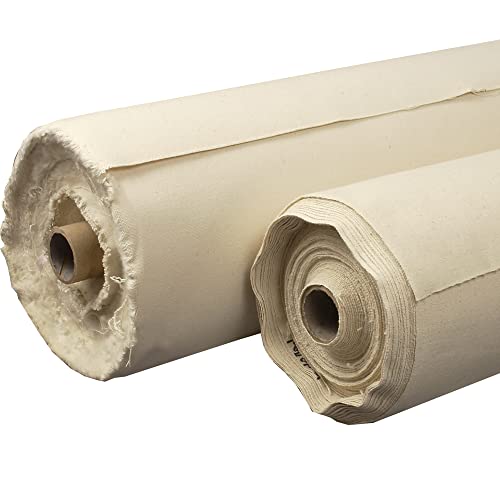
Thirty yards is a lot of canvas. Creative Mark’s 7 oz unprimed cotton duck is 72 inches wide and described as an economy-grade, lightweight single-fill weave suited to sketching, underpainting and studies. Being raw, it needs priming, which gives you control over the ground.
Best suited for: schools, busy studios and painters who prime their own canvas in volume.
Key features:
- 7 oz unprimed cotton duck
- 72″ x 30 yards
- Economy single-fill weave
Pros:
- Massive yardage
- Prime exactly how you want
Cons/limitations:
- Light, economy-grade fabric
- Requires priming and storage space
Buying consideration: Best for studies and teaching; use heavier fabric or linen for important finished work.
7. VViViD Double Primed Cotton Roll, 1 ft x 120 in — Best Small Test Roll

If you are unsure whether you even like working from a roll, VViViD’s 1-foot-wide, 120-inch-long double-primed cotton is the smallest step. The listing says it is acid-free with an acrylic-based primer that resists yellowing, cuts easily, and suits oil, acrylic and water-based painting.
Best suited for: testing roll canvas, small studies, collage and canvas strips for mixed media.
Key features:
- Double primed, acid-free cotton
- 1 ft x 120 in
- Ready to use
Pros:
- Lowest tier and smallest commitment
- Works with oil and acrylic
Cons/limitations:
- Only 12 inches wide
- Not linen
Buying consideration: Good for small panels you mount to board as well as tiny stretched pieces.
How Much Canvas Does a Roll Really Give You?
Every stretched canvas needs extra fabric to wrap around the bars and staple on the back. A practical allowance is the bar depth plus about 2 inches, on every side. On 3/4-inch bars, that means adding roughly 5.5 inches to each dimension.
Here is the arithmetic for a 54-inch by 3-yard roll (54 by 108 inches) cut for 16×20 canvases on 3/4-inch bars. Each piece needs about 21.5 by 25.5 inches. Two pieces fit across the 54-inch width with the 25.5-inch side running across, and five rows fit along 108 inches. That is about 10 canvases, before any cutting mistakes. Work this out for your own sizes before buying; a mix of sizes often packs more efficiently than one size.
For the 82-inch by 6-yard #109 roll (82 by 216 inches), the same 16×20 pieces fit three across and about ten rows down, roughly 30 canvases. In practice most people use wide rolls for larger paintings rather than many small ones.
Stretching From a Roll: The Short Version
- Assemble and square the stretcher bars. Measure both diagonals; equal diagonals mean a square frame.
- Cut the fabric with the allowance above, using a straightedge and following the weave.
- Staple the center of each side first, working opposite sides in turn.
- Work outward from the centers, alternating sides and keeping tension even with canvas pliers.
- Fold the corners neatly and staple them on the back.
- Prime if needed. Raw linen and cotton duck need sizing and priming after stretching.
Buying Guide: How to Choose a Claessens Canvas Roll
Medium First
Oil-primed rolls are for oil and alkyd only. Acrylic painters need universal-primed or self-primed linen.
Width Sets Your Maximum Size
Subtract wrap allowance from the roll width to find the largest short side you can make. A 54-inch roll gives roughly 48 inches; an 82- or 84-inch roll gives far more.
Length Sets Total Yield
Do the cutting math before you buy. A 3-yard roll suits a season of small to medium paintings; 6 yards suits large work or heavy production.
Texture and Priming Layers
Very fine, double primed surfaces suit detail. Medium, single primed surfaces suit texture and direct painting.
Space and Tools
You need a clean cutting area, a long straightedge, stretcher bars, pliers and a staple gun. Wide rolls need a lot of floor.
Storage
Store primed rolls primed side out, off the floor, and never folded. Keep them away from heat and damp.
Related Reading
For a closer look at Claessens priming numbers and linen panels, see our Claessens linen canvas review. Cutting a roll into several canvases for one wall piece? Our guide to painting a multi-canvas wall art set shows how to plan it. And to transfer a large composition accurately once the canvas is stretched, read how to grid a canvas for painting.
Common Mistakes to Avoid
- Cutting without a plan. Sketch the layout on paper first to avoid waste.
- Forgetting wrap allowance. Too little fabric makes stapling impossible.
- Using oil-primed linen with acrylic. Choose #109 or prime raw linen with acrylic gesso.
- Folding primed fabric. Creases can crack the ground.
- Stretching unevenly. Work from the centers outward, alternating sides.
- Priming before stretching raw linen. Stretch first, then size and prime.
FAQs
Is a Claessens canvas roll cheaper than pre-stretched linen?
Usually, per square foot, yes, but only if you use most of the roll and already own stretching tools.
Which Claessens roll works with acrylic?
The #109 universal-primed roll. The #13 and #15 are oil primed. The #066 is raw, so you can prime it with acrylic gesso.
How wide a canvas can I make from a 54-inch roll?
After wrap allowance, roughly 48 inches on the short side, depending on bar depth.
Do I need to prime Claessens #066?
Yes. It is unprimed linen and needs sizing and priming before painting, especially with oil.
How should I store a canvas roll?
Rolled, primed side out, horizontal or upright off the floor, in a dry room. Never fold it.
Can I mount roll canvas to panels instead of stretching?
Yes. Many painters glue cut pieces to rigid boards with an archival adhesive, which works well for small sizes and plein air.
Final Recommendation
- First Claessens roll for oil: #15, single oil primed.
- Smooth surface for detailed oil: #13, double oil primed.
- Acrylic, mixed media or large formats: #109, universal primed.
- Custom grounds: #066, unprimed.
- Budget primed roll for practice: DPDIAN 48″ x 20 ft.
- Bulk studies and teaching: Creative Mark cotton duck 72″ x 30 yd.
- Testing the roll format: VViViD 1 ft x 120 in.
Buy the roll that matches your medium and your space. Then practice stretching on cotton before you cut your first piece of Claessens linen.




2 Comments