As an Amazon Associate, we earn from qualifying purchases. This post contains affiliate links, and buying through one costs you nothing extra.
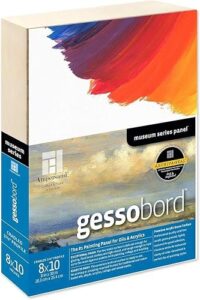
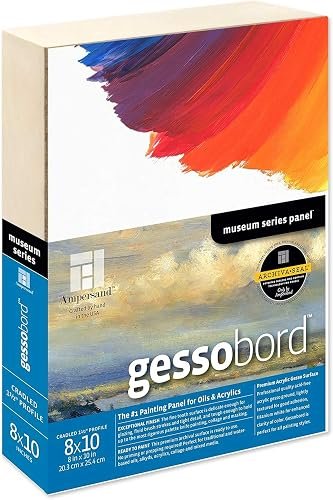
Buy the Ampersand Gessobord for Acrylic if you want a rigid, pre-primed painting panel for detailed paintwork. Its biggest strength is the ready-to-use ground that Ampersand claims won’t dull colors. Its profile is a flat 1/8-inch depth. It is best for small-format painters using oils, acrylics, or mixed media who prefer hardboard over flexible canvas.
Good for: Artists who want a ready surface for fine lines and palette knives. Not for: Painters wanting a deep canvas that hangs without extra framing.
Pros:
- Wood hardboard base prevents stretching issues
- Primed surface handles oils, acrylics, and media
- Bright white finish keeps colors vivid
- Ready for fine brushwork and palette knife
Cons:
- Flat 1/8-inch depth
- Limited to 8 by 10 inch workspace

- Wood hardboard panel primed with an acrylic gesso thicker than most brands
- Great for oils- acrylics and mixed media
- For fine brushwork – palette knife painting – glazing – layering
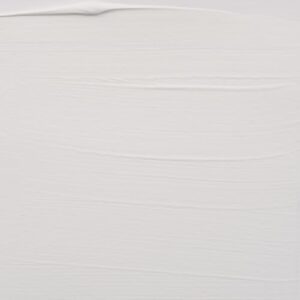
- Consistently even bright white finish- absorbency will not dull colors
The three things that decide it
Choosing this panel comes down to three practical factors found in the listing specifications.
The solid wood hardboard core changes how paint applies
The Ampersand Gessobord for Acrylic uses a wood hardboard base instead of woven fabric. Flexible canvas bounces under a brush, but this hard surface supports firm pressure. The manufacturer lists it for fine brushwork and palette knife painting, which require a steady base. Because the wood core does not flex, layers of paint and heavy knife strokes will not bend the substrate. This rigid design suits artists doing tight detail work, precise layering, or glazing. It won’t suit artists who prefer the natural give and texture of stretched cloth.
The ready acrylic gesso formula controls paint absorption
Ampersand treats this panel with an acrylic gesso that the company describes as thicker than most brands. The maker states the absorbency will not dull colors, providing a consistently even bright white finish. When priming absorbs too much liquid, oil and acrylic pigments can lose their natural shine and look muted. A sealed, bright ground keeps your mixed media work vibrant directly out of the tube. Artists who hate spending time preparing boards with raw gesso will value this convenience, while those who prefer custom, self-mixed grounds won’t need it.
The 1/8-inch flat profile requires deliberate display choices
The listed dimensions measure 8 x 10 inches with a flat 1/8-inch depth. This thin design slips easily into standard picture frames, travel boxes, and storage racks. This thin profile works well for desktop studies, but it won’t satisfy buyers seeking immediate wall-ready art.
What you get, and what you still need
The package includes a single 8 x 10 inch wood hardboard panel primed on its face. Because it comes pre-primed, you don’t need to buy separate acrylic gesso, sanding pads, or priming brushes before you start.
To complete a finished project, you must provide your own paints, brushes, and palette knives. It provides a complete, usable painting ground right away, making it a practical purchase for painters who already own their basic coloring supplies.
Specifications
Listed specifications for this art board:
| # | What Amazon lists |
|---|---|
| 1 | Wood hardboard panel primed with an acrylic gesso thicker than most brands |
| 2 | Great for oils- acrylics and mixed media |
| 3 | For fine brushwork – palette knife painting – glazing – layering |
| 4 | Consistently even bright white finish- absorbency will not dull colors |
| 5 | 8 x 10 inches – 1/8 inch depth |
Should you buy it?
If you are an illustrator or portrait painter working in tight detail, this board solves the issue of surface bounce. The flat hardboard base lets your knife and fine brush place color exactly where you want it without the board sinking underneath.
If you are an expressive painter who likes huge brush sweeps, loose washes, or thick display edges without frames, you should skip this model. You will be better served by a traditional stretched canvas or a deep-cradled wood panel. The central trade-off is surface rigidity against display readiness: you get an unyielding, high-contrast base for intricate technique, but you take on the task of mounting a slim board when the paint dries.
Quick answers
How do you store and prepare the panel before painting?
You can paint directly onto the board because it arrives fully primed. Store the thin board flat in a dry space so it stays free of dust before your work begins.
Is a flat wood board better than a standard stretched canvas?
It is not necessarily better, but it behaves differently. A flat panel offers a firm, non-giving foundation suited for sharp palette knife strokes and thin glazes. If you enjoy paint spring and frameless edges, woven canvas remains the better selection for your creative style.