PaintingProGuide is reader-supported. When you buy through links on this page we may earn an affiliate commission at no extra cost to you.
Arteza cotton canvas comes up constantly when painters shop for affordable surfaces, and the brand’s current panel listings are unusually specific about what is under the paint. This Arteza cotton canvas review focuses on the two Arteza canvas panel packs we found on Amazon in October 2026, the 8×10 and the 9×12, both sold in packs of 14, and then compares them with stretched and bulk alternatives.
The headline is simple. Arteza panels are mid-priced, clearly specified practice and small-finished-work surfaces. They are not a replacement for stretched canvas when you want gallery-wrapped edges or large formats, and that distinction decides whether they are right for you.
Quick answer: For most acrylic and oil painters who work small, the ARTEZA Canvas Panels 9×12, Pack of 14 is the better Arteza buy: it gives more room for composition on the same primed cotton and MDF construction. Choose the ARTEZA 8×10 Pack of 14 if you want the lowest cost per panel and a standard frame size. If you need far more panels, the Simetufy 52-pack is the bulk alternative, and if you want stretched canvas instead of boards, look at the FIXSMITH 11×14 8-pack.
Our Top Picks at a Glance
- ARTEZA Canvas Panels, 9×12, Pack of 14 — Best overall Arteza cotton canvas for studies and finished small works
- ARTEZA Canvas Panels, 8×10, Pack of 14 — Best Arteza value and easiest size to frame
- Simetufy 52-Pack 8×10 Canvas Boards — Best bulk alternative for classes and daily practice
- FIXSMITH 11×14 Stretched Canvas, 8 Pack — Best stretched alternative for display pieces
- ESRICH 24×36 Stretched Canvas, 2 Pack — Best for large statement paintings
| Product | Best For | Key Spec | Key Strength | Price Tier |
|---|---|---|---|---|
| ARTEZA 9×12 Panels (14) | Studies and small finished works | 3 coats titanium gesso; 280 gsm; MDF | Clear spec, roomy size | $$ |
| ARTEZA 8×10 Panels (14) | Value and framing | 3 coats titanium gesso; 280 gsm; MDF | Standard frame size | $ |
| Simetufy 8×10 (52) | Classes, bulk practice | 3 mm MDF core; acid-free gesso | Lowest cost per panel | $$ |
| FIXSMITH 11×14 Stretched (8) | Hanging without a frame | Pinewood bars; 5/8 in profile | Ready-to-hang edges | $$ |
| ESRICH 24×36 Stretched (2) | Large paintings | Cross bar; 5/8 in frame | Big format, braced | $$ |
How We Chose
We have not painted on these surfaces. The picks come from the Amazon listing details and specifications checked in October 2026, from how well each canvas’s construction, size and priming fit the needs of a painter looking at Arteza cotton canvas, and from how widely each product is reviewed by Amazon buyers. When a listing’s claim cannot be checked from the page, we say it is the listing’s claim.
- Surface material: 100% cotton, as opposed to blends or polyester.
- Priming detail: number of coats, acid-free primer and stated primed weight where given.
- Support: MDF panel, paper board or stretched pinewood frame.
- Size and count: how many usable surfaces you get and how easy they are to frame.
- Medium fit: acrylic, oil and gouache compatibility as stated by the maker.
Arteza Cotton Canvas Review: What You Are Buying
Both Arteza panel packs share one specification, and it is worth reading closely because it answers the questions people usually ask about cheap canvas.
The surface
Arteza states a 100% cotton surface pre-primed with three coats of acid-free titanium acrylic gesso. Titanium gesso is the standard bright white base used under acrylic and oil. Three coats usually means a more even, less absorbent surface than a single coat, although the actual texture still depends on the weave beneath.
The weight
The listings give an 8 oz, or 280 gsm, primed surface. That is a useful number because many budget canvas listings do not mention weight at all. It indicates a reasonably substantial primed fabric for a panel, comparable to the 8 oz primed weight quoted by several stretched canvas brands.
The support
The cotton is mounted on lightweight MDF. MDF stays flat and does not flex, which keeps paint films stable and makes the panels easy to stack, store and frame. The trade-off is that MDF panels are thin and need a frame to display well, unlike stretched canvas with painted sides.
Stated compatibility
Arteza lists acrylic, oil, gouache, tempera and pouring paint. That broad compatibility is typical of acrylic-primed cotton. For oil, acrylic gesso is widely accepted as a ground; for gouache, a light sanding helps the first layer grip.
Arteza Canvas Panels and Alternatives Reviewed
1. ARTEZA Canvas Panels, 9×12 in, Pack of 14 — Best Overall Arteza Cotton Canvas

The 9×12 pack is the more useful of the two Arteza options for most painters. The extra inch on each side over 8×10 gives noticeably more room to place a subject, leave negative space and add detail, while staying small enough to finish in one or two sessions.
You get fourteen panels, each with the same three-coat titanium gesso, 280 gsm primed cotton and lightweight MDF backing. Arteza positions the size for portraits, landscapes, color studies, collage and mixed media, which matches how 9×12 is commonly used.
Best suited for: acrylic and oil painters who want a step up from 8×10 for studies and small finished pieces.
Key features:
- 14 panels, each 9×12 inches
- 100% cotton, three coats acid-free titanium acrylic gesso
- 8 oz / 280 gsm primed surface
- Lightweight MDF backing
- Listed for acrylic, oil, gouache, tempera and pouring
Pros:
- Clear, detailed specification
- Comfortable working size for composition
- Rigid MDF keeps the surface flat
Cons and limitations:
- Needs a frame for display
- 9×12 frames are a little less common than 8×10 in some stores
- Mid price tier, more than bulk unbranded packs
Buying consideration: If you mostly do quick color studies, the 8×10 pack gives more panels per dollar; buy 9×12 when composition space matters.
2. ARTEZA Canvas Panels, 8×10 in, Pack of 14 — Best Arteza Value

The 8×10 pack carries the identical specification to the 9×12: 100% cotton, three coats of acid-free titanium gesso, a 280 gsm primed surface and an MDF backing. The difference is size and price, and this pack sits in the lowest price tier.
8×10 is one of the easiest sizes to frame, which makes these panels practical for small finished gifts, series work and wall groupings. Arteza describes them for everyday painting, studies, color tests and smaller finished pieces.
Best suited for: everyday practice, color studies and small framed pieces on a budget.
Key features:
- 14 panels, each 8×10 inches
- Three coats acid-free titanium acrylic gesso on cotton
- 8 oz / 280 gsm primed surface
- Lightweight MDF backing
Pros:
- Low price tier for a branded, specified panel
- Very easy to frame
- Same surface as the 9×12 pack
Cons and limitations:
- Less room for complex compositions
- Fourteen panels go quickly with daily practice
- Thin edge is not meant to be displayed unframed
Buying consideration: If you need more than one or two packs a month, the Simetufy 52-pack is likely more economical.
Alternatives Worth Comparing
If the Arteza panel format is not quite right, these three options cover bulk practice, stretched display canvas and large paintings.
3. Simetufy 52-Pack 8×10 Canvas Boards — Best Bulk Alternative

The Simetufy pack is built for volume: fifty-two 8×10 panels with a 100% cotton, acid-free primed surface and a rigid 3 mm MDF core. It is clearly aimed at art teachers, workshops and prolific beginners, and the listing says as much.
Compared with Arteza, Simetufy gives fewer surface details (no coat count or primed weight), but a stated MDF thickness. If you burn through practice panels, the cost per surface is far lower.
Best suited for: art teachers, workshop hosts and painters who practice daily.
Key features:
- 52 panels, each 8×10 inches
- 100% cotton, fine-grained, acid-free primed surface
- Rigid 3 mm MDF core
- Flat profile fits standard frames
Pros:
- Very low cost per panel
- MDF thickness stated
- Enough for a full class
Cons and limitations:
- No coat count or primed weight given
- Heavy box at a listed 12.57 pounds
- Only one size
Buying consideration: Buy this for quantity; buy Arteza when you want the more detailed priming spec.
4. FIXSMITH 11×14 Stretched Canvas, 8 Pack — Best Stretched Alternative

If you want a painting that can hang without a frame, a panel is the wrong format. The FIXSMITH pack gives eight 11×14 stretched canvases on pinewood bars with a 5/8-inch profile, made of 100% cotton and triple primed with acid-free acrylic gesso.
The listing gives useful weights: 4 oz unprimed and 8 oz primed. That primed weight matches the Arteza panels, so the main difference is the support and the ability to paint around the edges.
Best suited for: acrylic painters who want ready-to-hang pieces at a medium size.
Key features:
- 8 stretched canvases, 11×14 inches
- 100% cotton; triple primed with acid-free gesso
- Unprimed 4 oz, primed 8 oz
- Pinewood stretcher bars; 5/8 in profile
Pros:
- Hang straight on the wall
- Stated fabric weights
- Larger working size than the Arteza panels
Cons and limitations:
- Stretched canvas flexes, which can stress thick or brittle paint films
- Bulkier to store than panels
- Listing paint type field mentions acrylic only, though bullets say oil too
Buying consideration: Stretched canvas suits acrylic well; for gouache or heavy texture, a rigid panel is safer.
5. ESRICH 24×36 Stretched Canvas, 2 Pack — Best for Large Paintings
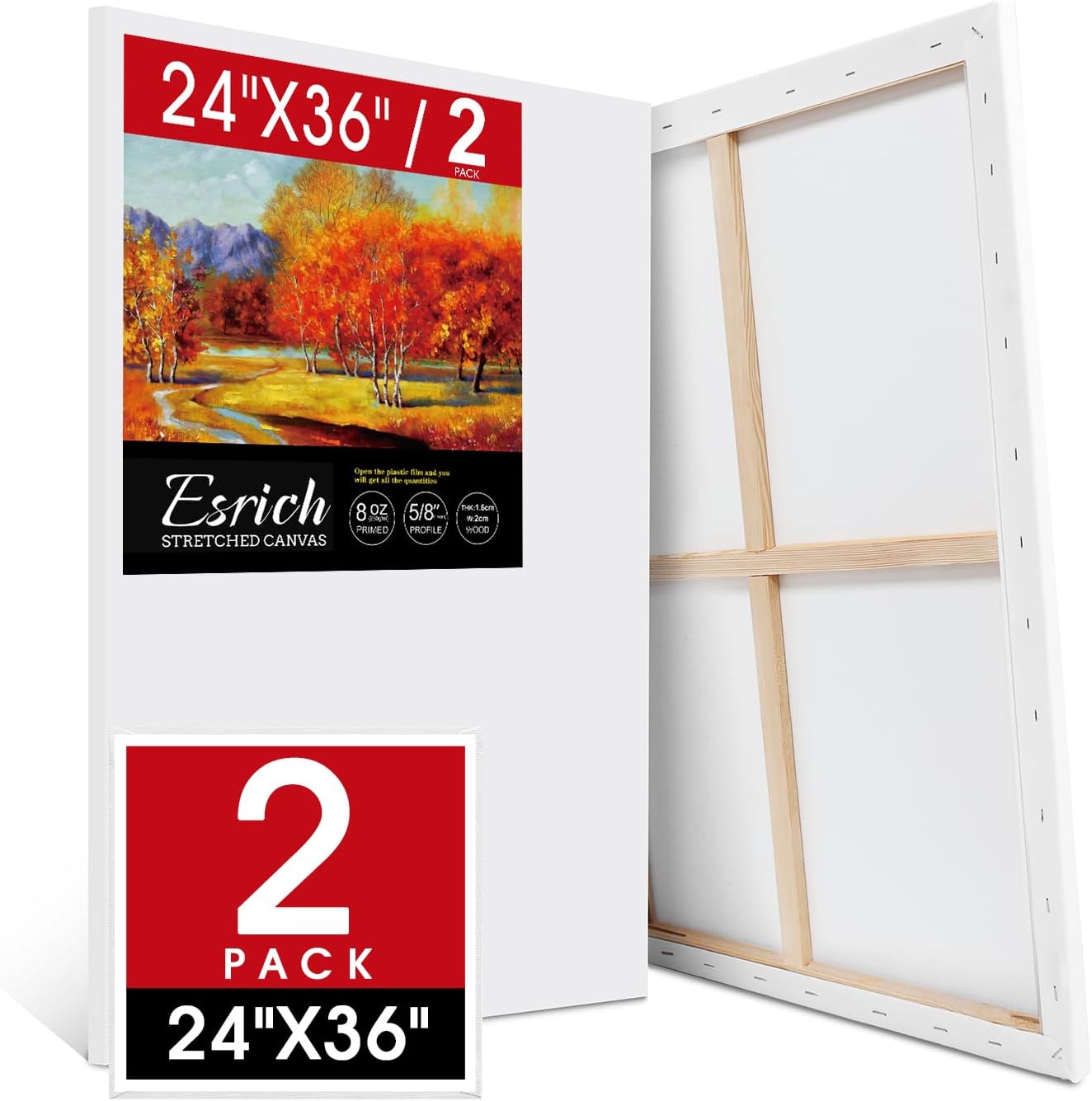
Arteza panels top out at small and medium sizes in this comparison. For a large statement painting, the ESRICH 24×36 pack gives two primed cotton stretched canvases on pinewood frames with an extra cross bar for stability and a 5/8-inch frame depth.
The primed weight is listed at 8 oz, again in line with the others here. A cross bar matters at this size because long stretcher bars can bow without support.
Best suited for: large wall pieces, abstract work and painting parties at a big scale.
Key features:
- 2 stretched canvases, 24×36 inches
- Cotton, acid-free acrylic gesso; 8 oz primed
- Pinewood frame with extra cross bar
- 5/8 in frame depth
Pros:
- Large format at a modest price tier
- Cross bar adds stability
- Ready to hang
Cons and limitations:
- Only two canvases
- Large size needs more paint and time
- Not suitable for gouache in thick layers
Buying consideration: Plan your paint budget too: a 24×36 surface uses far more paint than a 9×12 panel.
Arteza Cotton Canvas: Overall Pros and Cons
Pulling the two Arteza listings together, this is how the brand’s cotton canvas panels stack up as a product line rather than as individual packs.
What Arteza does well:
- States the coat count, gesso type and primed weight, which few competitors at this price do.
- Uses 100% cotton rather than a blend, with acid-free priming.
- MDF backing keeps panels flat for framing and stacking.
- Fourteen panels per pack is a practical quantity for a month of regular practice.
Where Arteza falls short:
- Only small and medium sizes in this panel range; large work needs stretched canvas.
- Panels are meant to be framed, not displayed bare.
- Cost per panel is higher than bulk unbranded packs.
- The listings do not state MDF thickness, which some painters want to compare.
Who Should Skip Arteza Panels
Arteza panels are not the right buy for everyone. If you want to hang paintings straight on the wall with painted edges, buy stretched canvas. If you teach a weekly class of twenty, the per-panel cost of a fourteen-pack adds up fast and a bulk pack is the better tool.
Painters who work very large, or who build heavy impasto texture that needs a deep, braced frame, should also look elsewhere. And if you paint mainly in watercolor, a heavy watercolor paper or a canvas specifically sold for watercolor will behave much better than an acrylic-primed panel.
Preparing an Arteza Panel for Different Media
For acrylic, the panel is ready as it comes. Many painters still tone it with a thin wash of a mid-value color, which makes it easier to judge lights and darks than on bright white gesso.
For oil, the acrylic gesso ground is ready to use. Thin early layers with solvent or medium and build toward thicker paint, following the usual fat-over-lean approach. For gouache, sand lightly to add tooth and keep the first layer slightly drier than you would on paper.
Buying Guide: How to Choose Arteza Cotton Canvas or an Alternative
Panel or stretched canvas
Panels are rigid, cheap to ship and easy to store. Stretched canvas is lighter for its size, hangs without a frame and has the classic springy surface. Choose panels for practice and framed work, stretched canvas for display pieces.
Priming detail
Listings that state the number of gesso coats and the primed weight make comparison easier. Arteza’s three coats and 280 gsm are among the more specific claims. More coats generally mean a smoother, less absorbent surface.
Weave and texture
Cotton canvas has a visible weave. If you want a smoother surface for portraits or fine detail, add a coat or two of gesso and sand lightly. If you like brush texture to read, use the panel as it comes.
Size and framing
8×10 and 11×14 are the easiest sizes to frame off the shelf. 9×12 is a common art-pad size and well supported by frame makers too. Think about where the finished piece will go before you buy.
Medium compatibility
Acrylic-primed cotton suits acrylic and oil. For gouache, use rigid panels rather than stretched canvas and consider sanding. For pouring, a stretched canvas or rigid panel both work, but keep the surface level as it dries.
Quantity versus brand detail
Branded packs like Arteza give more information about the surface. Bulk unbranded packs give more panels. If you are learning, quantity often helps more than a slightly better primer.
Getting More From Your Canvas
A few surface skills pay off whichever brand you choose. If you transfer reference photos, our walkthrough on how to grid a canvas for painting works well on 9×12 and 11×14 panels. And if a stretched canvas ever gets punctured, the steps in how to fix a ripped canvas painting can save the piece.
Common Mistakes to Avoid
- Assuming all canvas boards are the same: priming, core material and weight vary a lot.
- Using thin panels for heavy texture without a frame: panels are best framed, not hung bare.
- Skipping surface prep for smooth work: the weave will show through thin layers.
- Buying stretched canvas for gouache: flexing can crack brittle paint films.
- Leaving panels in damp storage: board cores can warp with moisture.
- Ignoring frame sizes: an odd size can cost more to frame than the canvas did.
FAQs
Is Arteza canvas 100% cotton?
Yes. Both Arteza canvas panel listings state a 100% cotton surface, primed with three coats of acid-free titanium acrylic gesso and mounted on lightweight MDF.
Can you use oil paint on Arteza canvas panels?
Arteza lists oil among compatible paints. The panels are acrylic-primed, which is widely used as a ground for oil painting.
What is the weight of Arteza canvas?
The panel listings give an 8 oz, or 280 gsm, primed surface.
Are Arteza canvas panels good for beginners?
They are a good middle ground: more clearly specified than many bulk packs, but still affordable enough for practice. Beginners who paint every day may prefer a bulk pack for cost.
Should I buy Arteza 8×10 or 9×12?
Choose 8×10 for value and easy framing, 9×12 when you want more space for composition and detail. The surface and construction are the same.
Do Arteza canvas panels warp?
The MDF backing is meant to keep them flat. Keep any panel away from damp storage and avoid soaking it with water-heavy techniques to reduce the risk.
Final Recommendation
Arteza cotton canvas panels are a sensible, well-specified choice for small acrylic and oil paintings. The 9×12 pack is the better all-round buy for composition room, while the 8×10 pack wins on cost per panel and framing convenience.
If you need volume, the Simetufy 52-pack lowers the cost per surface. If you want to hang work without a frame, the FIXSMITH 11×14 stretched canvases are the closer match, and the ESRICH 24×36 pack covers large paintings. Pick the support first, then the brand.