

PaintingProGuide is reader-supported. When you buy through links on this page we may earn an affiliate commission at no extra cost to you.
Acrylic pouring looks effortless in finished pieces, all swirling color and lacy cells, but the results depend almost entirely on paint consistency. Too thick and the paint will not flow to the edges; too thin and colors muddy together and crack as they dry. The best acrylic paints for pouring either arrive premixed to the right flow or mix easily with a pouring medium, and they hold strong color when spread thin across a canvas.
This guide compares seven products from the October 2026 listings: premixed pouring sets, metallic and iridescent options, a bulk set for large pieces, a regular acrylic set you can convert and the medium many pourers swear by. We also explain ratios, cells and how to avoid the most common pouring failures.
Quick answer: For beginners, the Pouring Masters 8-Color Ready-to-Pour Set is the best start: premixed to a honey-like consistency, with silicone oil and a gloss pouring medium included. For metallic shine, choose the ABEIER 18-color metallic set, or the Nicpro 20-color iridescent kit for color-shifting effects. For large canvases, the Nicpro 8-color 1000ml bulk set is the value pick. If you prefer to mix your own, combine regular acrylics with Floetrol.
Our Top Picks at a Glance
- Pouring Masters 8-Color Ready-to-Pour Set — Best for beginners
- Acro Color 30-Color Pouring Paint Set — Best color variety in premixed bottles
- ABEIER 18-Color Metallic Pouring Set — Best metallic pouring paint
- Nicpro 20-Color Iridescent Metallic Pour Kit — Best iridescent effects with supplies
- Nicpro 8-Color 1000ml Bulk Pour Paint — Best for large pours
- Nicpro 14-Color 500ml Bulk Acrylic — Best regular acrylic to mix with medium
- Flood Floetrol, 1 Gallon — Best pouring medium on a budget
| Product | Best For | Key Spec | Key Strength | Price Tier |
|---|---|---|---|---|
| Pouring Masters 8-Color | Beginners | Premixed, honey consistency | Silicone oil and 16 oz gloss medium included | $$ |
| Acro Color 30-Color | Variety | 30 x 2 oz, metallic, neon, pastel | Premixed high flow | $$ |
| ABEIER Metallic 18-Color | Metallic finishes | 18 x 2 oz premixed | Cell-friendly metallics | $$ |
| Nicpro Iridescent 20-Color | Color-shifting effects | 20 x 8.45 oz, silicone oil, gloves | Large bottles plus supplies | $$$ |
| Nicpro 8-Color Bulk | Large canvases | 8 x 1000 ml, silicone oil | Lowest cost per ounce here | $$$ |
| Nicpro 14-Color 500ml | Mix-your-own | 14 x 500 ml regular acrylic | Also for painting and crafts | $$ |
| Floetrol 1 Gallon | Pouring medium | 128 oz additive | Improves flow, cells | $$ |
How We Chose
We did not pour with these paints for this guide. Picks are based on Amazon listing details and specifications checked in October 2026, how well each product’s consistency, volume and included supplies suit acrylic pouring, and how widely each product is reviewed by Amazon buyers.
- Consistency: premixed flow or ease of mixing with medium.
- Volume: pours use far more paint than brush painting.
- Color and effects: range, metallics, iridescence.
- Included supplies: silicone oil, medium, gloves and cups.
- Value: cost per ounce at the listed tier.
Premixed Pouring Paint or Paint Plus Medium?
Premixed pouring paints already contain pouring medium and are thinned to flow. You open the bottle and pour. They are the easiest way to get consistent results, especially when learning.
Regular acrylics plus a pouring medium give you more control and usually cost less per pour, especially in bulk. You mix paint with a medium such as Floetrol or a dedicated acrylic pouring medium, often with a little water, until it flows like warm honey. It takes practice to get consistent.
Many pourers start premixed, then switch to mixing their own once they know the consistency they like.
Best Acrylic Paints for Pouring Reviewed
1. Pouring Masters 8-Color Ready-to-Pour Set — Best for Beginners

U.S. Art Supply’s Pouring Masters set is premixed to the consistency of honey, which the listing says lets colors flow over and with each other when you tilt the canvas. It includes eight colors, a 2 oz bottle of silicone oil and a 16 oz gloss pouring medium for adjusting viscosity or creating extra cells. The listing names Dutch pour, flip cup and tree ring techniques as suitable.
Best suited for: first-time pourers who want a complete starter kit.
Key features
- 8 premixed colors
- 2 oz silicone oil
- 16 oz gloss pouring medium
- Honey-like consistency
Pros
- Ready to pour from the bottle
- Medium included for adjustments
- Supports many techniques
Cons
- Limited color count
Buying consideration: Start with the paint as-is; add medium only if a color seems thicker than the rest.
2. Acro Color 30-Color Pouring Paint Set — Best Color Variety

Acro Color offers 30 premixed high-flow colors in 2 oz bottles, including metallic, neon and pastel shades. The listing describes them as ready to use for canvas, paper, glass and wood, and non-toxic.
Best suited for: pourers who want many color options for experimenting with palettes.
Key features
- 30 x 2 oz premixed bottles
- Metallic, neon and pastel colors
- High flow
Pros
- Wide range of effects
- Ready to pour
Cons
- 2 oz bottles empty quickly on bigger canvases
- No silicone or medium included
Buying consideration: Choose three to five colors per pour; using too many at once is the fastest route to mud.
3. ABEIER 18-Color Metallic Pouring Set — Best Metallic Paint

ABEIER’s set includes 18 shimmering metallic colors in 2 oz bottles, premixed with the right ratio of pouring medium. The listing says they can create cellular effects, work on canvas, glass, wood, ceramic and rocks, are waterproof and fade-resistant after drying, and conform to ASTM D-4236.
Best suited for: luxe, shimmering pours and accents.
Key features
- 18 metallic colors
- Premixed
- ASTM D-4236
Pros
- Strong metallic finish
- Multi-surface
Cons
- Small bottles
- All-metallic pours can look busy
Buying consideration: Pair one or two metallics with a non-metallic base color for contrast.
4. Nicpro 20-Color Iridescent Metallic Pour Kit — Best Iridescent Effects
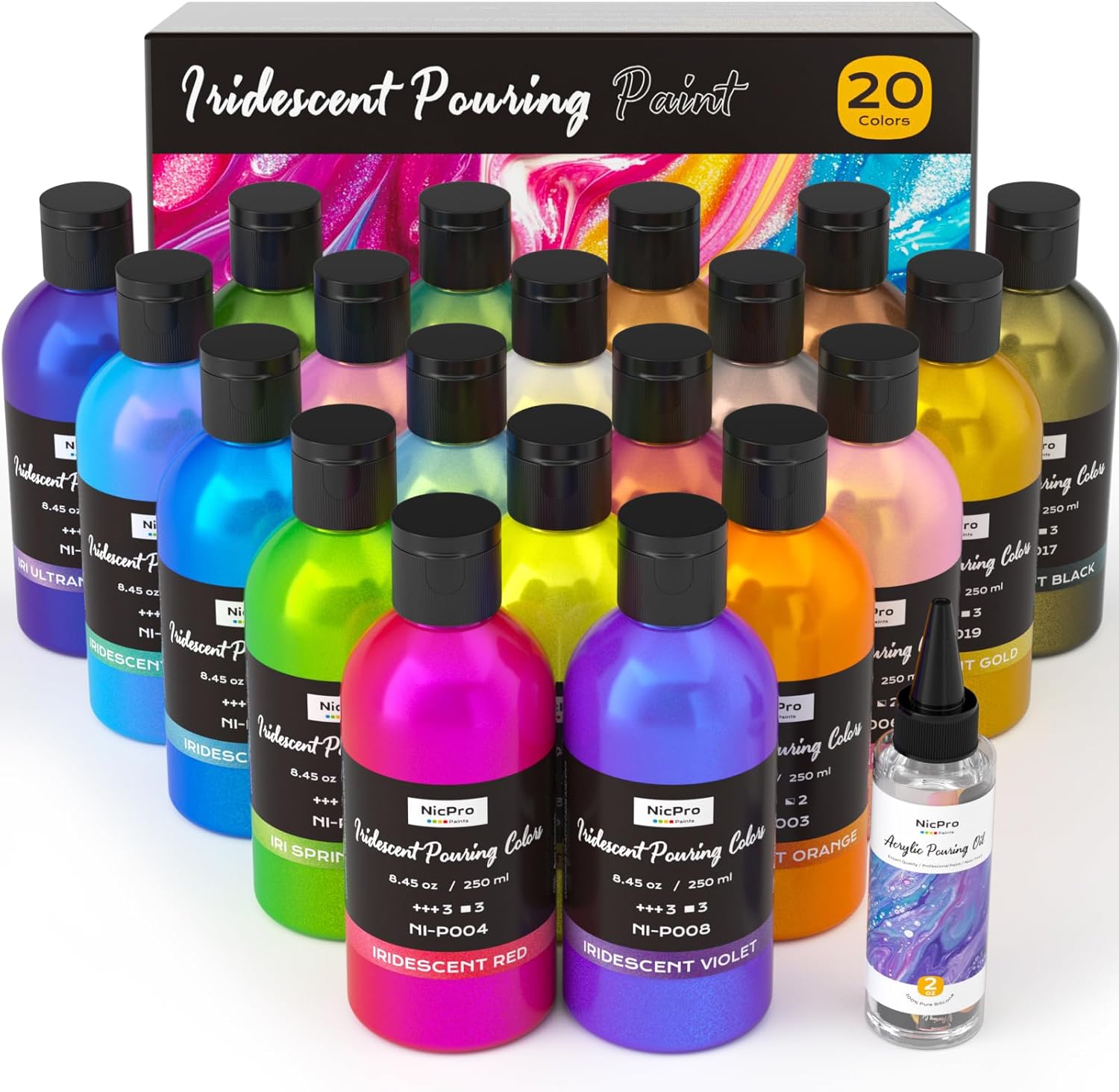
Nicpro’s iridescent kit includes 20 color-shifting shades in large 8.45 oz bottles, premixed with pouring medium. Colors shift under different light and angles. The kit adds 2 oz of pour oil for cells, 50 gloves, 5 pipettes and 3 disposable tablecloths.
Best suited for: pourers who want dramatic, light-shifting results and a full supply kit.
Key features
- 20 iridescent colors, 8.45 oz each
- Pour oil, gloves, pipettes, tablecloths
- Premixed high flow
Pros
- Large bottles
- Everything needed for setup
Cons
- Higher price tier
- Iridescent effects show best in good light
Buying consideration: Display finished iridescent pieces where light can move across them.
5. Nicpro 8-Color 1000ml Bulk Pour Paint — Best for Large Pours

For big canvases and frequent pouring, this Nicpro set provides eight colors (white, yellow, orange, red, violet, blue, green and black) in 1000 ml bottles. The listing notes it is acrylic pour paint, thinner than traditional acrylic, formulated to flow without extra mediums, and includes 2 oz of silicone pour oil and 50 pairs of gloves.
Best suited for: large canvases, classes and prolific pourers.
Key features
- 8 x 1000 ml
- No medium needed
- Silicone oil and gloves
Pros
- Huge volume
- Basic palette mixes many colors
Cons
- Fewer colors
- Large bottles need storage space
Buying consideration: White is used most in pours; this set gives you a full liter of it.
6. Nicpro 14-Color 500ml Bulk Acrylic — Best for Mixing Your Own

This is regular, creamy acrylic, not premixed pouring paint. It includes 14 colors such as white, Mars black, red, yellow, blue, green and burnt umber in 500 ml easy-squeeze bottles, plus a palette knife and sponge. Mixed with a pouring medium, it becomes economical pouring paint, and it doubles for regular painting, crafts and murals.
Best suited for: artists who want one bulk paint for pouring and brushwork.
Key features
- 14 x 500 ml
- Regular-body acrylic
- Palette knife and sponge
Pros
- Versatile beyond pouring
- Good value in bulk
Cons
- Must be mixed with medium for pouring
Buying consideration: Mix a test cup with medium and pour on a scrap panel before a full piece.
7. Flood Floetrol, 1 Gallon — Best Budget Pouring Medium

Floetrol is a paint conditioner originally designed to improve flow and leveling in latex and acrylic house paints. The listing also describes it as a go-to additive for fluid art and paint pouring that helps create cells, improves consistency and helps colors flow without cracking. It is washable with soap and water, and a gallon goes a long way.
Best suited for: pourers mixing their own paint on a budget.
Key features
- 128 oz additive
- Improves flow and leveling
- Soap and water cleanup
Pros
- Very economical
- Popular for cell creation
Cons
- Not an archival artist medium
- Can look milky until dry
Buying consideration: A common starting ratio is roughly two parts Floetrol to one part paint, adding a little water to reach a honey consistency. Test and adjust for your paint.
Setting Up Your Pouring Space
- Protect everything. Pouring is messy. Cover the table with plastic or a disposable tablecloth and wear gloves.
- Raise the canvas. Set it on cups or push pins so paint can run off the edges freely.
- Level the surface. Use a spirit level on the canvas; even a slight tilt makes paint pool while drying.
- Prepare cups and stir sticks for each color, plus a large cup for flip-cup or dirty pours.
- Plan a drying spot that is level, dust-free and away from pets, where the piece can stay for several days.
- Keep paper towels and a scraper nearby for edges and drips.
Choosing a Pouring Palette
Color choice shapes a pour more than technique. A few reliable approaches:
- Analogous: neighboring colors such as blue, teal and green blend gracefully even where they mix.
- Complementary accent: mostly cool colors with a small amount of orange or gold for contrast.
- Neutral plus metallic: white, gray and black with one metallic for an elegant modern look.
- Always include white: it separates colors, creates cells and keeps a pour from looking murky.
Avoid mixing complements such as red and green in equal amounts, since they gray each other where they overlap.
Pouring Basics: Consistency, Ratios and Cells
Aim for warm honey
The most reliable test: lift a stir stick and let the paint drizzle back. It should flow in a smooth ribbon that sits briefly on the surface before sinking in.
Typical ratios
- Regular acrylic plus Floetrol: start around 1 part paint to 2 parts Floetrol, plus a few drops of water.
- Regular acrylic plus a dedicated pouring medium: many mediums suggest 1 part paint to 1 or 2 parts medium.
- Premixed paints: use as-is, adding medium only to match consistency across colors.
Creating cells
Cells form when paints of different densities move through each other. A few drops of silicone oil stirred lightly into some colors encourages cells, and a quick pass with a heat gun or torch after pouring helps them open. Use silicone sparingly; too much leaves oily residue that must be cleaned before varnishing.
Matching consistency
All colors in a pour should have similar flow. One thick color will drag and muddy the others. Mix every color in its own cup, test each with the drizzle check and adjust with a few drops of medium or water until they match. Let mixed paint rest a few minutes so air bubbles rise before pouring.
Finishing and varnishing a pour
Once a pour has fully cured, which can take several days or longer for thick pours, clean any silicone residue with a gentle wipe of mild soap and water, then let it dry. A gloss varnish or resin coat deepens color and protects the surface. Test your varnish on a scrap pour first, since some finishes react with residual silicone and create small craters.
Storing pouring paint
Keep bottles tightly capped and shake or stir before use, since pigments can settle. Mixed paint and medium in cups can be covered with plastic wrap for a day or two, but fresh mixes behave more predictably.
Buying Guide: How to Choose Acrylic Paints for Pouring
Premixed or mix-your-own
Beginners benefit from premixed paint. Regular pourers often save money mixing bulk acrylic with medium.
Volume
A 12×12 inch canvas can use several ounces of paint. Small 2 oz bottles are fine for testing; bulk bottles suit regular pouring.
Pigment strength
Pouring thins paint, so strongly pigmented colors keep their vibrancy better.
Effects
Metallic and iridescent paints add shine; neons and pastels change the mood. Choose effects that suit your style.
Included supplies
Silicone oil, gloves, pipettes and tablecloths save extra purchases for beginners.
Medium quality
For pieces meant to last, consider an artist-grade pouring medium in addition to economical additives.
Learn the Techniques
New to pouring? Start with our step-by-step acrylic pouring guide for beginners. Once comfortable, explore flip cups, swipes and tree rings in our overview of acrylic pouring techniques, and troubleshoot common problems with these acrylic pouring tips. For more ideas, see how to make DIY wall art with acrylic.
Common Mistakes to Avoid
- Paint too thin. Overwatered paint cracks and loses color.
- Too many colors. More than five often turns to mud.
- Uneven surface. Level your canvas or paint pools to one side.
- Too much silicone. It leaves residue and craters.
- Skipping drying time. Pours can take days to cure; do not move them early.
- Varnishing too soon. Clean off silicone and wait until fully cured.
- Pouring in a cold room. Low temperatures slow drying and can affect flow.
FAQs
Can I use regular acrylic paint for pouring?
Yes, mixed with a pouring medium such as Floetrol or an acrylic pouring medium until it flows like warm honey.
What is the best pouring medium?
Floetrol is a popular budget option. Dedicated acrylic pouring mediums are designed for art use and may be preferred for archival work.
How do I get cells in an acrylic pour?
Add a few drops of silicone oil to some colors and use a heat gun or torch briefly after pouring.
How much paint do I need for a pour?
It depends on canvas size and technique, but pours use far more paint than brushwork. Bulk bottles make sense for regular pouring.
Why does my acrylic pour crack?
Usually because the paint was too thin or poured too thickly, or dried in a hot, dry spot. Use proper medium rather than lots of water.
Are metallic pouring paints good for beginners?
Yes, though they work best paired with non-metallic base colors for contrast.
Final Recommendation
Start with the Pouring Masters 8-Color set; its premixed consistency, silicone and gloss medium make first pours far more predictable. Add the Acro Color 30-color set for variety, the ABEIER metallics for shine or the Nicpro iridescent kit for color-shifting effects. When you pour often, move to the Nicpro 1000ml bulk set, or mix the Nicpro 500ml bulk acrylics with Floetrol for the lowest cost per pour.




