PaintingProGuide is reader-supported. When you buy through links on this page we may earn an affiliate commission at no extra cost to you.
Multi-panel art splits one image, or one idea, across two or more canvases hung together. A diptych uses two panels, a triptych three, and grids and staggered layouts can use five, nine or more. Done well, the gaps between panels become part of the composition, and the whole set reads as one large piece that is easier to paint, move and hang than a single huge canvas. The best canvas for multi-panel art is a set of canvases that match exactly in size, depth, surface and priming, so the image flows across the gaps without visible differences in texture, color or edge thickness. Buying all panels from the same pack and batch is the simplest way to get that consistency.
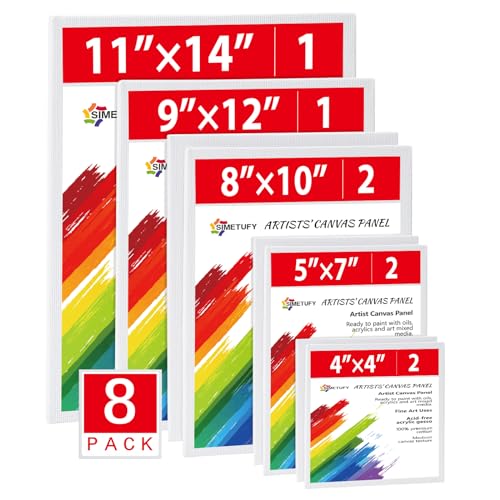
Quick answer: For grid-style and small multi-panel pieces, the ESRICH 32-pack of multi-size canvas boards is the best choice: eight each of 4×4, 5×5, 5×7 and 8×10, so you can build matching 3×3 grids or mix sizes in a salon-style arrangement. For triptychs and diptychs at slightly larger sizes, the KEFF 24-pack of triple-primed canvas boards gives six matching boards each at 5×7, 8×10, 9×12 and 11×14.
A transparent note about this page: most Amazon results for “multi-panel canvas” are printed wall art sets, such as photo prints of skylines and beaches, rather than blank canvas for painting. We excluded those, which left only two blank canvas sets in our product data that genuinely fit. Both are canvas boards, which work well for grids and smaller multi-panel pieces. For large triptychs on deep stretched canvas, use the guidance below to choose matching canvases from any brand.
Common Multi-Panel Layouts
Diptych
Two panels side by side, often split at a natural break in the image such as a tree trunk or a shoreline. Equal sizes are traditional.
Triptych
Three panels, either three equal sizes or a larger center flanked by two narrower panels. Triptychs suit landscapes, seascapes and abstract color fields.
Grid
Four, six or nine square or rectangular panels arranged in rows and columns. Grids work for both continuous images and series of related images, such as nine flowers or nine color studies.
Staggered or step layouts
Panels of different heights arranged in a row, often tallest in the middle. Common in decor prints, and easy to adapt for painting with stretched canvases of different sizes.
Salon or cluster
Different sizes grouped freely, connected by color or theme rather than a single continuous image. Canvas boards in mixed sizes are ideal for this.
Our Top Picks at a Glance
- ESRICH 32-Pack Multi-Size Canvas Boards — Best for grids and cluster layouts
- KEFF 24-Pack Multi-Size Canvas Boards — Best for diptychs and triptychs on boards
| Product | Best For | Key Spec | Key Strength | Price Tier |
|---|---|---|---|---|
| ESRICH 32-Pack | Grids, clusters, series | 8 each of 4×4, 5×5, 5×7, 8×10; cotton, acid-free primer | Eight matching boards per size | $$ |
| KEFF 24-Pack | Diptychs, triptychs | 6 each of 5×7, 8×10, 9×12, 11×14; triple primed cotton | Larger sizes, smooth priming | $$ |
How We Chose
We chose these canvas sets from the Amazon listing details and specifications checked in October 2026, by whether they provide multiple identical panels with consistent priming suitable for multi-panel paintings, and by how widely each product is reviewed by Amazon buyers. We have not painted on these sets. We excluded printed canvas wall art, which is decor rather than a painting surface.
- Matching panels: several identical sizes in one pack.
- Consistent priming across all panels.
- Blank, paint-ready surface, not prints.
- Size options for different layouts.
Best Canvas for Multi-Panel Art Reviewed
1. ESRICH 32-Pack Multi-Size Canvas Boards — Best for grids, clusters and series

ESRICH’s 32-pack includes eight boards each at 4×4, 5×5, 5×7 and 8×10 inches. The canvas is pure cotton with a smooth surface, primed with a non-toxic, acid-free primer over a sturdy board core that the listing says resists deformation. It is sold for oil, watercolor, acrylic, tempera, pouring and gouache.
Eight boards in each size is what makes this pack useful for multi-panel work. Nine 4×4 boards would be ideal for a 3×3 grid, but eight still allows a 2×4 grid, two 2×2 grids, or a cross shape. The mix of squares and rectangles is ideal for salon-style clusters connected by color.
Small boards are also quick to finish, which makes them a good way to plan a palette or composition before painting a larger multi-panel set.
Best suited for: Painters creating grids, clusters or series of small matching pieces.
Key features:
- 32 boards
- 8 each of 4×4, 5×5, 5×7, 8×10
- Pure cotton
- Acid-free primer
- Board core
Pros:
- Many matching boards per size
- Mix of squares and rectangles
- Low cost per board
Cons and limitations:
- Eight per size, so a full 3×3 grid needs a second pack
- Small sizes only
Buying consideration: Mount finished boards on a single backing panel or in a multi-opening frame for a tidy display.
2. KEFF 24-Pack Multi-Size Canvas Boards — Best for diptychs and triptychs on boards

KEFF’s 24-pack contains six boards each at 5×7, 8×10, 9×12 and 11×14, in 100 percent cotton with smooth, triple-primed surfaces according to the listing.
Six identical boards at 11×14 make two triptychs or three diptychs. Triple priming gives a consistent surface across panels, which matters when a sky or color field crosses from one board to the next.
Boards are thin, so for a gallery look many painters frame each panel or mount the set on a backing board with even gaps.
Best suited for: Painters creating diptychs and triptychs at small to medium sizes.
Key features:
- 24 boards
- 6 each of 5×7, 8×10, 9×12, 11×14
- 100% cotton
- Triple primed
Pros:
- Larger sizes than the ESRICH pack
- Six matching boards per size
- Smooth consistent surface
Cons and limitations:
- Boards need framing or mounting to hang
- Core material not stated
Buying consideration: Paint all panels side by side on a table so the image lines up across the gaps.
Choosing Canvas for Larger Multi-Panel Paintings
For multi-panel pieces meant to hang as wall art, many painters use stretched canvas rather than boards. If you shop for stretched canvas for a triptych or larger set, look for:
- Identical profile depth on every panel, so the sides line up on the wall.
- The same brand and batch, since priming color and texture vary between brands.
- Gallery-wrapped or back-stapled edges if you plan to hang without frames.
- Cross braces on panels 24 inches or larger to keep them square.
- A multi-pack at one size, which guarantees a match.
Boards or Stretched Canvas for Multi-Panel Work?
Canvas boards are inexpensive, perfectly flat and easy to align on a table, which makes them excellent for planning, practice and small finished sets. Their limitation is display: they need frames, a backing panel or mounting hardware. Stretched canvas costs more and takes more storage space, but it hangs directly on the wall, and deep-profile canvases with painted edges give a clean, gallery look without frames. Many painters try a composition as a small board triptych first, then repeat it at full size on stretched canvas once they are happy with the layout and colors.
How to Paint a Multi-Panel Piece
- Decide the layout and gap width, typically 1 to 3 inches between panels.
- Sketch the full design at small scale, including the gaps.
- Line the panels up on a table or wall with spacers matching the gap width.
- Transfer the design across all panels at once, with lines continuing across the gaps.
- Mix each color in enough quantity for all panels so values and hues match.
- Paint across all panels together, rather than finishing one before starting the next.
- Paint the edges consistently, either continuing the image or using a solid color.
- Number the backs so they are hung in the correct order.
Design Tips for Multi-Panel Art
Use the gaps
Place splits at natural breaks, such as between trees or along a horizon, rather than through a face or focal point.
Keep a focal point
Even across several panels, one area should draw the eye, often in the center panel of a triptych.
Repeat colors
Repeating key colors across panels ties the set together, especially in cluster layouts.
Consider series instead of continuous images
Multi-panel art does not have to be one image. A row of related abstracts or a grid of botanical studies works just as well.
Plan the wall
Measure the wall and mark the full width, including gaps, before choosing panel sizes. A multi-panel set should usually cover about two-thirds of the width of the furniture beneath it.
Multi-Panel Project Ideas
Seascape triptych
A horizon running across three panels, with waves building in the center panel and calmer water on the outer panels. The horizon line must align exactly across the gaps.
Botanical grid
Nine small square boards, each with a single leaf, flower or seed pod on a matching background color. The repeated background unifies the set.
Color-field abstract
Three or four tall panels with bands of color that shift gradually from one panel to the next, creating a gradient across the wall.
Seasons series
Four matching panels showing the same tree or view in spring, summer, autumn and winter.
Quote or word art
One word per panel, or a phrase spread across a row, with a shared background design.
Moon phases
A row of five or seven small square boards, each with a phase of the moon on a dark background. Easy to paint and striking as a set.
Transferring a Design Across Panels
The grid method is the most reliable way to keep lines continuous. Draw a grid over your small sketch, including bands that represent the gaps between panels. Then draw a matching, scaled-up grid lightly across all the panels while they are lined up with spacers. Copy the contents of each grid square onto the corresponding area of the panels. Because the gap bands are part of the grid, a line that leaves one panel will re-enter the next at the correct height. Erase or paint over the grid lines as you work.
Keeping Colors Consistent Across Panels
Color mismatch is the most common problem in multi-panel painting. Mix each important color in a single large batch and store it in a lidded container, rather than mixing fresh for each panel. Paint the same color on all panels in one session, so lighting and drying conditions are identical. If you use acrylic, which dries slightly darker, compare panels only when dry. Finally, varnish all panels with the same product at the same time, since varnish can shift the sheen and depth of color.
Mounting Canvas Boards for Display
Canvas boards are thin and light, which makes them easy to mount as a group. Options include gluing the boards with even gaps onto a painted wooden backing panel, setting each board into its own floating frame, or using a single large frame with several mat openings. For a simple, removable display, small boards can be hung with picture-hanging strips rated for their weight. Whatever method you choose, measure gaps with a spacer so the arrangement looks deliberate.
Hanging Multi-Panel Canvas
Use a level and a spacer cut to the gap width. Mark positions lightly in pencil first. Hang the center panel first, then work outward. For boards, mount them on a backing panel or use a frame with multiple openings. Removable picture-hanging strips can help with small, light boards, but check weight ratings.
Choosing Sizes for a Multi-Panel Set
| Layout | Example Panel Sizes | Approximate Total Width |
|---|---|---|
| Small grid (3×3) | Nine 5×5 boards, 1″ gaps | About 17 inches square |
| Small triptych | Three 8×10 boards, 1.5″ gaps | About 27 to 33 inches |
| Medium triptych | Three 11×14 boards, 2″ gaps | About 37 to 46 inches |
| Diptych | Two 11×14 boards, 2″ gap | About 24 to 30 inches |
| Large triptych | Three 24×36 stretched, 2–3″ gaps | About 76 to 114 inches |
Widths vary depending on whether panels hang in portrait or landscape orientation. Sketch the layout to scale before buying, and remember to include the gaps.
Buying Guide: How to Choose Canvas for Multi-Panel Art
Matching panels
Buy all panels in one pack so sizes, priming and color match. Even canvases sold as the same size by different brands can differ by an eighth of an inch or have a slightly different white, which shows when panels hang side by side.
Size and layout
Small boards for grids and clusters; larger boards or stretched canvas for triptychs. Decide the layout first, then count how many identical panels you need and buy a pack that covers it with a spare.
Surface consistency
Triple-primed surfaces help colors read the same across panels. If panels absorb differently, the same mixed color can look lighter on one and darker on another.
Display method
Boards need framing or mounting; stretched canvas can hang directly. Factor the cost of frames or a backing panel into your budget for board-based sets.
Quantity
Buy extra panels in case one is damaged or you want to repaint a section. A spare panel from the same pack is far easier to match than a replacement bought later.
Related Guides
Step-by-step projects help with planning: see how to paint a multi-canvas wall art set, how to paint a three-panel canvas set and how to paint a quote across canvas wall art.
Common Mistakes to Avoid
- Buying printed multi-panel wall art when you want to paint your own.
- Mixing canvas brands with different depths or priming.
- Painting panels one at a time and getting mismatched colors.
- Placing a split through the focal point.
- Forgetting to number panels before hanging.
- Leaving uneven gaps on the wall.
- Varnishing panels at different times or with different products, so the sheen does not match.
FAQs
What canvas is best for a triptych?
Three identical canvases from the same pack, with matching depth and priming.
How far apart should multi-panel canvases hang?
Typically 1 to 3 inches, depending on panel size and the look you want.
Can I use canvas boards for multi-panel art?
Yes, especially for grids and smaller pieces; mount or frame them for display.
How do I make the image line up across panels?
Line panels up with spacers and transfer the design across all of them at once.
Should the edges be painted?
For unframed stretched panels, paint the edges with the image or a solid color for a finished look.
What size should a multi-panel set be?
Plan the total width, including gaps, to cover about two-thirds of the furniture or wall area it hangs above.
Final Recommendation
For grids, clusters and series, the ESRICH 32-pack gives eight matching boards in each of four sizes. For diptychs and triptychs on boards, the KEFF 24-pack offers six matching, triple-primed boards at sizes up to 11×14. For large multi-panel wall pieces on stretched canvas, buy a single-size multi-pack so every panel matches in depth, priming and texture.