
PaintingProGuide is reader-supported. When you buy through links on this page we may earn an affiliate commission at no extra cost to you.
The best oil painting courses online are the ones that make you paint, not just watch. A good course gives you a clear sequence of projects, shows the instructor’s palette and brushes so you can copy the setup, explains why each step works, and ideally offers some way to get feedback on your own canvases. Oil is a slow, layered medium with rules (fat over lean, drying times, solvent safety) that a course should teach explicitly, because they are the reasons beginner paintings crack, stay tacky or look muddy.
This guide explains the main types of online oil painting courses, what to look for in a curriculum, a realistic learning path for your first three months, and the reference books that pair best with any course you choose. The books are real titles available on Amazon; the course guidance is designed so you can evaluate any platform or instructor yourself.
Quick answer: For most beginners, the best online oil painting course is a structured, project-based video course with downloadable reference photos and a stated materials list, ideally from an instructor who paints in the subject you care about (landscape, still life or portrait). Add live classes or paid critiques once you have finished a dozen paintings. Pair your course with a reference book: The Beginner’s Guide to Oil Painting by Craig Stephens for still life basics, or The Elements of Landscape Oil Painting by Suzanne Brooker if landscapes are your goal.
Types of Online Oil Painting Courses
Online oil painting instruction comes in five broad formats. Each suits a different stage and budget.
| Format | How it works | Best for | Watch out for |
|---|---|---|---|
| Recorded project course | A set of pre-recorded lessons, usually built around complete paintings | Beginners who want structure at their own pace | No feedback unless a community or critique is included |
| Subscription platform | Monthly or yearly access to many courses from different instructors | Exploring styles before committing | Uneven quality; easy to start many and finish none |
| Live online class | Scheduled sessions over video with a teacher and small group | Learners who need accountability and questions answered | Fixed times, often across time zones |
| One-on-one mentoring or critique | Private lessons or feedback on submitted paintings | Intermediate painters stuck on specific problems | Highest cost per hour |
| Free video tutorials | Individual demos on video sites | Learning single techniques | No progression; materials and safety often skipped |
How We Chose
The course guidance on this page reflects established ways oil painting is taught: drawing and value first, limited palettes, fat over lean, and project-based practice. We did not enroll in or review specific paid courses. The reference books were selected from Amazon listing details checked in October 2026, based on how well each title’s stated focus fits learners taking online courses, and how widely each book is reviewed by Amazon buyers.
- Curriculum fit — does the book or course match a beginner, intermediate or realist path?
- Subject focus — still life, landscape and realism are covered separately.
- Practical structure — step-by-step projects beat general theory for most learners.
- Reference value — visual technique directories stay useful long after a course ends.
What a Good Online Oil Painting Course Should Include
Before paying for any course, check the course page or syllabus for these elements. A course missing more than two of them is probably not worth the money.
A full materials list with exact colors
You should know the specific pigments the instructor uses (for example, Titanium White, Cadmium Yellow, Alizarin or a quinacridone red, Ultramarine Blue, Burnt Sienna), the brush shapes and sizes, the surface, and the medium. Without this, you cannot reproduce the results on screen.
Safety and solvent guidance
Oil painting traditionally uses solvents for thinning and cleaning. A responsible course covers ventilation, odorless mineral spirits or solvent-free methods, and how to dispose of oily rags, which can self-heat if balled up.
Fat over lean, explained
Each oil layer should contain slightly more oil than the one beneath it, so upper layers stay flexible as the painting dries. If a course does not explain this early, expect cracked paintings later.
Drawing and value before color
Strong courses start with a monochrome underpainting or value study. Most beginner problems are value problems disguised as color problems.
Complete paintings, not just exercises
Finishing a whole painting teaches decision-making that isolated exercises cannot. Look for courses built around several complete projects of increasing difficulty.
Reference photos and close-ups
Downloadable references and close-up camera angles on the palette and brush let you see mixing and stroke direction, which wide shots hide.
A way to get feedback
A student community, assignment uploads or optional critiques speed progress enormously. Even one critique every few paintings changes how you see your own work.
A Realistic 12-Week Learning Path
Whatever course you choose, this pacing keeps beginners progressing without burning out:
- Weeks 1–2: Materials setup, safe cleanup, mixing a value scale in one color, and a simple monochrome still life.
- Weeks 3–4: Limited palette color mixing (white plus three primaries), color charts, and two small still lifes.
- Weeks 5–6: Edges and brushwork: soft versus hard edges, blending, and a still life with a reflective object.
- Weeks 7–8: First landscapes: sky gradients, atmospheric perspective, simple trees and fields.
- Weeks 9–10: Layering: underpainting, glazing over dry layers, fat over lean in practice.
- Weeks 11–12: A larger finished painting using everything so far, plus a self-critique against your week-one work.
Our Top Picks at a Glance
These books work as companions to an online course: a visual reference, a beginner project book, and deeper guides for landscape and realism.
- The Beginner’s Guide to Oil Painting (Craig Stephens) — Best for complete beginners learning with still life
- The Encyclopedia of Oil Painting Techniques (Jeremy Galton) — Best visual technique reference
- The Elements of Landscape Oil Painting (Suzanne Brooker) — Best for landscape-focused courses
- Easy Oil Painting: Small Still Life (Estelle Day) — Best for short, small-format projects
- Realistic Oil Painting (Jan Matěják) — Best for learners heading toward realism
- HowExpert Guide to Oil Painting: 33-Day System — Best for a structured daily routine
| Product | Best For | Key Spec | Key Strength | Price Tier |
|---|---|---|---|---|
| The Beginner’s Guide to Oil Painting | First paintings | Paperback; still life projects | Simple, guided projects | $$ |
| Encyclopedia of Oil Painting Techniques | Looking up techniques | Paperback; visual directory | Broad technique coverage | $$ |
| The Elements of Landscape Oil Painting | Landscape learners | Hardcover; sky, terrain, trees, water | Subject-specific depth | $$ |
| Easy Oil Painting: Small Still Life | Quick wins | Paperback; 9 step-by-step projects | Small 4-inch formats | $$ |
| Realistic Oil Painting | Realism | Paperback; underpainting and layering | Indirect and direct methods | $$ |
| HowExpert Guide to Oil Painting | Daily practice | Paperback; 33-day system | Day-by-day structure | $$ |
Best Oil Painting Books to Pair With an Online Course
1. The Beginner’s Guide to Oil Painting by Craig Stephens — Best for complete beginners

As the subtitle says, this book focuses on simple still life projects designed to help you master the basics. Still life is the classic starting subject because the lighting and arrangement stay constant, so you can concentrate on drawing, value and color without chasing changing light.
Used alongside an online course, a printed project book gives you extra exercises between video lessons and a physical reference you can keep open on the table while you paint.
Best suited for: Absolute beginners and anyone whose online course moves too quickly.
Key features:
- Paperback
- Still life project format
- Focus on fundamentals
- Beginner level
Pros:
- Projects are practical and achievable
- Still life builds transferable skills
- Good complement to video lessons
Cons and limitations:
- Not focused on landscape or portrait
- Beginner level only
- Product listing gives limited detail on contents
Buying consideration: Paint each project twice: once following along, once from your own setup.
2. The Encyclopedia of Oil Painting Techniques by Jeremy Galton — Best for a visual reference
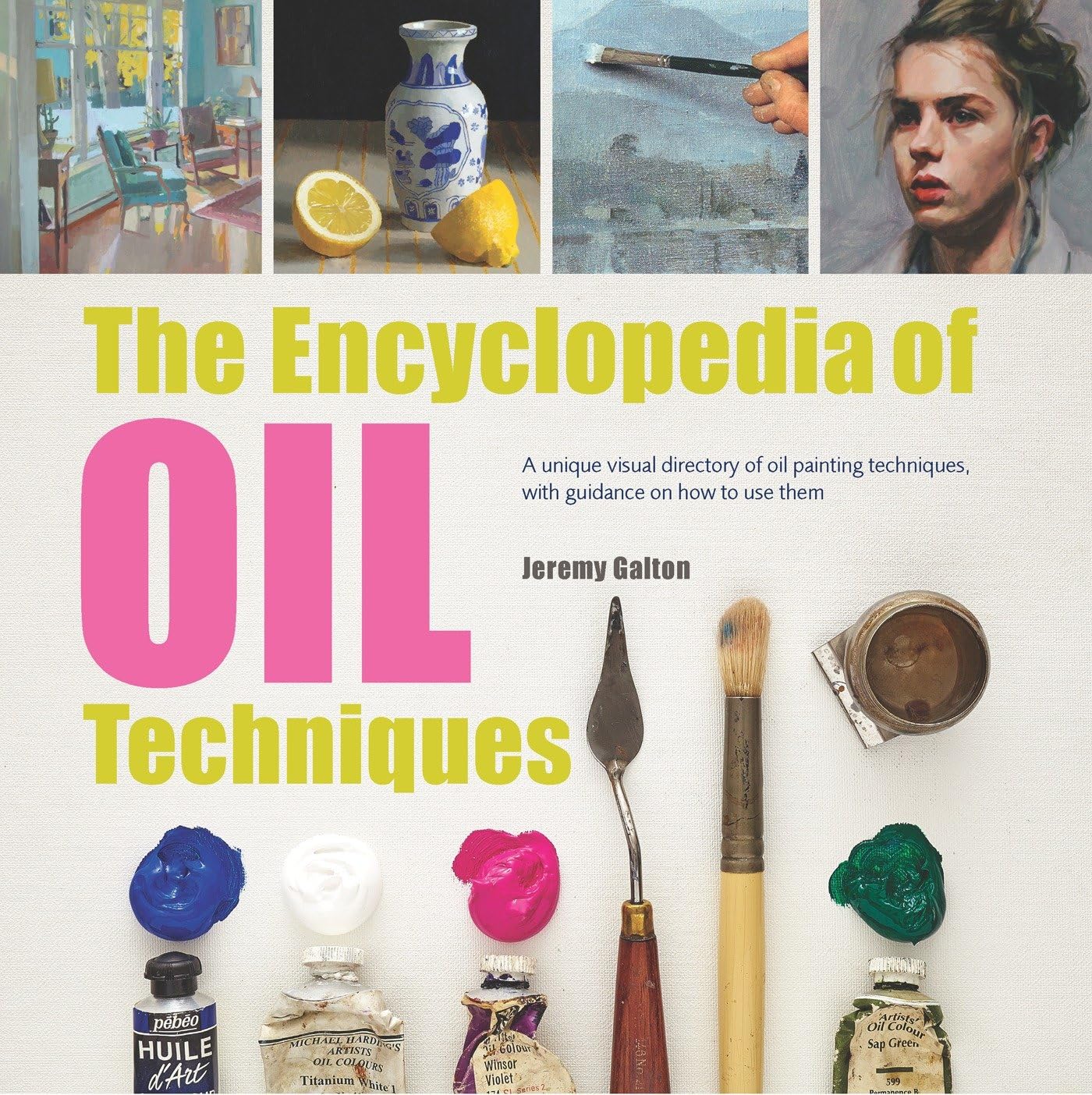
Galton’s book is described as a unique visual directory of oil painting techniques with guidance on how to use them. That format is ideal next to an online course: when an instructor mentions scumbling, glazing, impasto or sgraffito, you can look the technique up and see it illustrated.
Encyclopedia-style books do not replace a structured course, but they are the books painters tend to keep for years.
Best suited for: Learners at any level who want a reference shelf book.
Key features:
- Paperback
- Visual directory of techniques
- Guidance on applying each technique
- Wide coverage across styles
Pros:
- Useful for years
- Fast lookup format
- Covers many techniques in one place
Cons and limitations:
- Not a step-by-step course
- Breadth over depth
- Better as a companion than a first book
Buying consideration: Keep it near your easel and look up each technique the first time a course mentions it.
3. The Elements of Landscape Oil Painting by Suzanne Brooker — Best for landscape-focused learners

If your online course is about landscapes, this hardcover is the natural companion. The subtitle lists the subjects it covers: techniques for rendering sky, terrain, trees and water, the four elements of almost every landscape.
Breaking a landscape into elements mirrors how many landscape courses are structured, and it helps you practice a weak area, such as trees or water, in isolation.
Best suited for: Learners taking landscape courses who want deeper coverage of specific elements.
Key features:
- Hardcover
- Sky, terrain, trees and water techniques
- Landscape-specific
- Suitable for beginners and intermediates
Pros:
- Subject-specific depth
- Element-by-element structure
- Durable hardcover
Cons and limitations:
- Not for portrait or still life
- Assumes basic oil handling
- Product listing gives limited detail on contents
Buying consideration: Practice one element per week from the book while following your course’s full paintings.
4. Easy Oil Painting: Beginner Tutorials for Small Still Life by Estelle Day — Best for short, small-format projects

This Design Originals title offers nine step-by-step projects of simple subjects, designed for small (about 4-inch) canvases according to the listing title. Small formats are a smart way to learn oil because each painting can be finished in one sitting, before the paint begins to set.
Finishing more paintings, faster, is one of the most reliable ways to improve, and small panels use very little paint.
Best suited for: Busy beginners who have an hour at a time and want finished results.
Key features:
- Paperback
- Nine step-by-step projects
- Small still life subjects
- Small canvas format
Pros:
- Quick, finishable projects
- Low material cost
- Confidence-building
Cons and limitations:
- Small scale only
- Simple subjects
- Limited coverage of advanced techniques
Buying consideration: Use these projects as warm-ups before longer course lessons.
5. Realistic Oil Painting by Jan Matěják — Best for learners aiming for realism
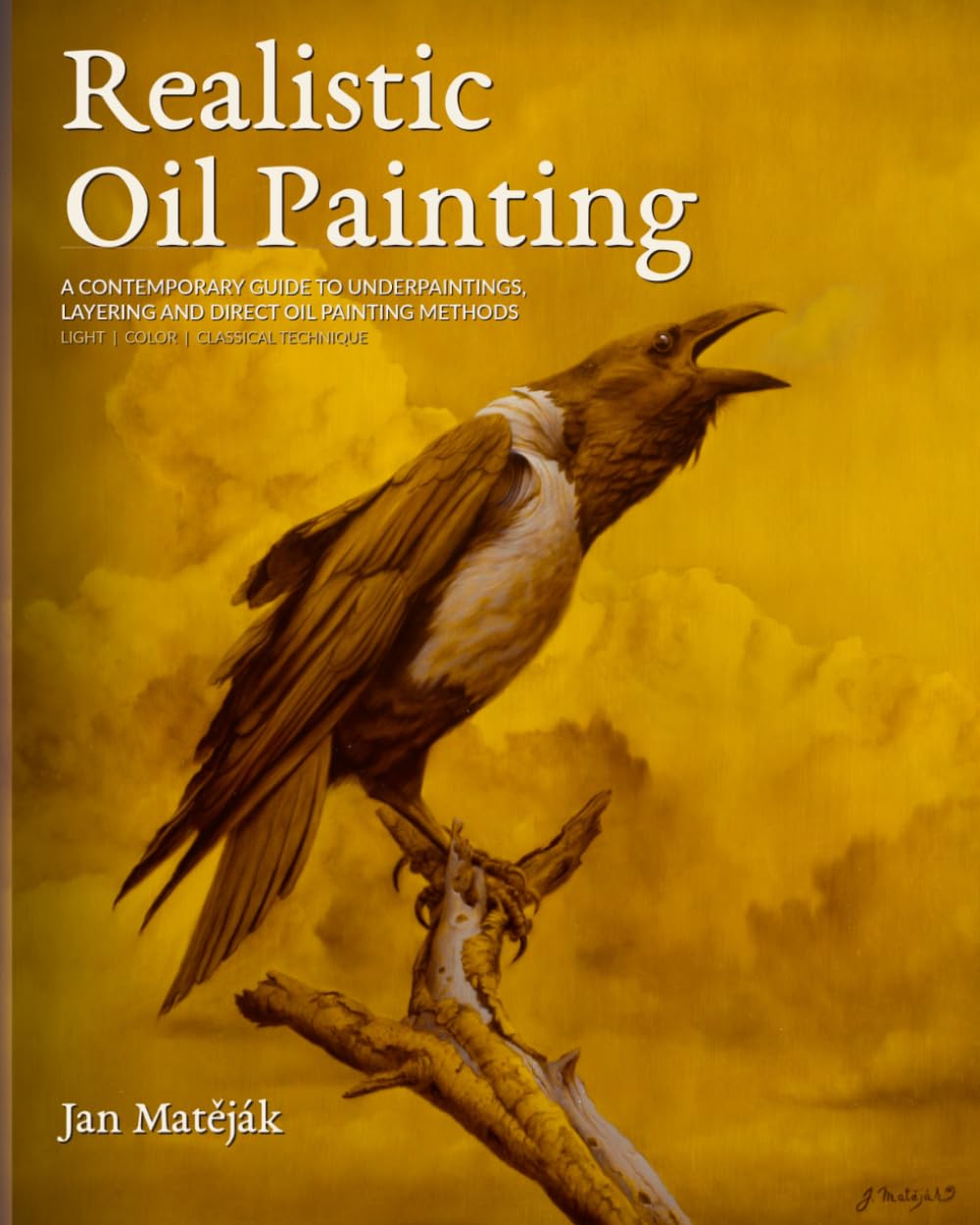
Matěják’s book is described as a contemporary guide to realistic oil painting, covering underpaintings, layered technique and the direct painting method. That combination is useful because many online courses teach only one approach; understanding both indirect layering and direct painting lets you choose for each subject.
It suits learners who have finished a beginner course and want to push toward realistic rendering.
Best suited for: Intermediate painters and ambitious beginners focused on realism.
Key features:
- Paperback
- Underpainting and layered (indirect) method
- Direct painting method
- Realism-focused
Pros:
- Covers two major oil approaches
- Bridges beginner and intermediate
- Contemporary perspective
Cons and limitations:
- More demanding than beginner books
- Realism-specific
- Highest price tier among these books
Buying consideration: Read the underpainting chapter before attempting a multi-session course painting.
6. HowExpert Guide to Oil Painting: A 33-Day System — Best for a daily structured routine

HowExpert structures its guide as a 33-day step-by-step system, and the subtitle lists color mixing, building layers and controlling light and shadow among its goals. A day-by-day format works well for people who struggle with consistency in self-paced online courses.
Think of it as a practice planner you can run alongside video lessons.
Best suited for: Self-paced learners who need a daily structure to stay on track.
Key features:
- Paperback
- 33-day step-by-step system
- Color mixing, layers, light and shadow
- Beginner-friendly
Pros:
- Clear daily plan
- Covers core skills
- Supports habit building
Cons and limitations:
- Less depth on any single subject
- Mid-to-high price tier for a paperback
- Product listing gives limited detail on contents
Buying consideration: If you miss days, continue from where you stopped rather than restarting.
Buying Guide: How to Choose an Online Oil Painting Course
Match the instructor’s subject to yours
Landscape, portrait and still life require different emphasis. A landscape instructor will teach atmosphere and edges; a portrait instructor will focus on drawing and skin color. Choose someone whose finished paintings you would like to make.
Check the materials before you enroll
Some courses rely on a specific brand, many colors or special mediums. Add up the cost of supplies, not just the course.
Look for progression
Lessons should build from simple to complex. A list of unrelated demos is a video library, not a course.
Value feedback
Courses with critiques, student galleries or live Q&A are worth more than recorded-only courses for most beginners.
Try a free lesson
Most instructors publish sample lessons. Watch for clear audio, close-ups of the palette and explanations of why, not just what.
Consider solvent-free options
If you paint in a small apartment, look for courses that teach solvent-free cleanup and thinning with oil only, or water-mixable oils.
Practice Projects on PaintingProGuide
Supplement any course with focused exercises: try painting grass in oil to practice texture, painting fog in oil to learn soft edges and atmospheric perspective, or painting a seashell in oil for a small still life study.
Common Mistakes to Avoid
- Collecting courses instead of finishing them. One completed course beats five started ones.
- Skipping the materials list. Different pigments mix differently, and results will not match.
- Ignoring fat over lean. It leads to cracking as paintings dry.
- Painting too large too soon. Small panels let you finish and learn faster.
- Working in an unventilated room with solvents. Open a window or go solvent-free.
- Comparing yourself to instructors. Compare your week-twelve painting with your week-one painting instead.
FAQs
Can you really learn oil painting online?
Yes. Online courses can teach materials, mixing, layering and composition effectively, especially when they include close-up demos and feedback. Painting regularly alongside the lessons is what makes the difference.
How long does it take to learn oil painting basics?
With two or three sessions a week, most beginners can handle simple still lifes and landscapes within about three months. Mastery takes years, but basics come relatively quickly.
What supplies do I need for an online oil painting course?
A typical starter kit is a limited set of oil colors (white plus primaries and an earth tone), a few bristle and synthetic brushes, canvas panels, a palette, a palette knife, a medium or linseed oil, and odorless solvent or solvent-free cleanup.
Are free YouTube oil painting tutorials enough?
They are excellent for learning individual techniques, but they rarely offer a structured progression or feedback. Many learners combine free tutorials with one paid structured course.
Should beginners start with landscapes or still life?
Still life is usually easier at first because the subject does not change. Landscapes are a great second step once you are comfortable mixing and blending.
Do I need a book if I am taking an online course?
Not strictly, but a reference book helps you look up techniques, review between lessons and practice extra projects. It also works without a screen or internet connection.
Final Recommendation
Choose a structured, project-based online course from an instructor who paints the subjects you love, confirm it includes a full materials list and some form of feedback, and commit to finishing it. Support it with one good book: The Beginner’s Guide to Oil Painting for still life fundamentals, The Elements of Landscape Oil Painting for landscapes, or Realistic Oil Painting if realism is your goal. Keep the Encyclopedia of Oil Painting Techniques nearby as a reference, and use Easy Oil Painting or the HowExpert 33-day system for quick, regular practice.




