
PaintingProGuide is reader-supported. When you buy through links on this page we may earn an affiliate commission at no extra cost to you.
Acrylic paint has one habit that shapes every palette decision: it dries fast and it dries permanently. On porous or textured surfaces, dried acrylic grips and never lets go. On smooth, non-porous plastic, a dried puddle of acrylic usually peels off in a rubbery sheet. That is why a plastic palette for acrylic paint is the default choice in classrooms and home studios alike: it is cheap, light, unbreakable and easy to reset.
The differences come down to shape and scale. Some painters want big rectangular trays with many wells; others want a clear, flat mixing slab; teachers want a stack of small round palettes, one per student. This guide compares six plastic palettes listed on Amazon, explains which format suits which kind of acrylic painting, and covers how to keep paint workable longer on any of them.
Quick answer: For most acrylic painters, the best plastic palette for acrylic paint is the DUGATO 20-Well 2-Pack: two large 10 x 13 inch trays with 20 wells and a smooth, non-stick surface listed for acrylics and other thick paints. If you prefer mixing on a flat, transparent surface, the Tamaki 2-Pack clear palettes with thumb holes are the best budget slab. For classrooms and parties, the LNAUJS 15-Pack round palettes give each student 10 wells and a central mixing area.
Our Top Picks at a Glance
- DUGATO 20-Well Plastic Palette 2-Pack — Best overall for acrylic painting
- Tamaki 2-Pack Clear Acrylic Palettes — Best flat mixing surface with thumb hole
- LNAUJS 15-Pack Round Palettes — Best for classrooms and group painting
- HYL.LL&RQ 22-Piece Round Palettes — Best bulk pack for camps and workshops
- Hulameda 12-Piece Paint Tray Palettes — Best for kids and paint parties
- LNAUJS 8-Pack 6-Well Rectangular Palettes — Best mini palettes for crafts
| Product | Best For | Key Spec | Key Strength | Price Tier |
|---|---|---|---|---|
| DUGATO 20-Well (2-pack) | Studio and serious hobby acrylics | 10 x 13 in; 20 wells | Most wells and space per tray | $ |
| Tamaki Clear (2-pack) | Flat color mixing | 11.8 x 7.9 in rectangle + oval; thumb hole | Transparent surface | $ |
| LNAUJS Round (15-pack) | Classrooms | 6.69 in; 10 wells + 3.07 in center | Detailed well dimensions | $ |
| HYL.LL&RQ Round (22-pack) | Large groups | 6.6 in; 10 wells + center | Most palettes per pack | $ |
| Hulameda Trays (12-pack) | Kids and parties | Stackable round trays | Break-proof and lightweight | $ |
| LNAUJS 6-Well (8-pack) | Crafts and small projects | 3.4 x 5 in; six 1.3 in wells | Tiny, one-handed format | $ |
How We Chose
These picks are based on the Amazon listing details and specifications checked in October 2026, how well each palette’s size, well layout and surface fit acrylic painting, and how widely each product is reviewed by Amazon buyers. We have not painted on these palettes; what follows is drawn from the listings and from how acrylic paint is known to behave on smooth plastic.
Our criteria:
- Surface: smooth, non-porous plastic lets dried acrylic peel away.
- Mixing area: acrylic painters mix a lot; generous flat space or a large central well matters.
- Well count and depth: deep wells keep colors separate and hold enough paint for a session.
- Size and handling: thumb holes and lighter trays help when painting at an easel.
- Pack size: individual painters need one or two palettes; classrooms need a stack.
- Durability: break-proof plastic survives drops and kids.
We left out one small 4-piece tray set that duplicated the 12-piece Hulameda palette in a smaller pack.
Best Plastic Palettes for Acrylic Paint Reviewed
1. DUGATO 20-Well Plastic Paint Palette, 2-Pack — Best for studio and serious hobby acrylic painting

DUGATO’s trays are the largest palettes in this guide at 10 by 13 inches each, and each one carries 20 individual wells. That is enough to lay out a full acrylic palette, keep warm and cool versions of each hue, and still have room for custom mixes. The listing describes sturdy, non-toxic white plastic with a smooth, non-stick surface that resists scratching and breaking.
The two-pack format is genuinely useful for acrylics. Paint on one tray dries while you work on the other, and you can let the first tray dry completely before peeling it clean. DUGATO lists the palettes for acrylics, oils, watercolor, gouache, tempera and other thick paints, and says most paints rinse off under water.
Best suited for: Acrylic painters working on canvases and panels who need room for many colors and mixes; students in painting classes.
Key features:
- Two 10 x 13 inch palettes
- 20 wells per palette
- Smooth, non-stick white plastic
- Listed for acrylic, oil, watercolor, gouache and tempera
- Lightweight but scratch and break resistant
Pros:
- Largest working area in this guide
- Two trays let you rotate while one dries
- White surface shows true color
- Durable enough for daily use
Cons and limitations:
- Large size takes up desk space
- No lid, so paint dries in open air
- No thumb hole for handheld use
Buying consideration: Pair with a spray bottle or a sealable container if you need to pause; for long sessions, mist the wells lightly to slow drying.
2. Tamaki 2-Pack Clear Acrylic Paint Palettes with Thumb Hole — Best for a flat, transparent mixing surface

Tamaki takes a different approach: two flat, crystal-clear palettes, one rectangular and one oval, each 11.8 by 7.9 inches with a thumb hole. Without wells, the whole surface becomes mixing space, which suits painters who like to push large piles of acrylic around with a palette knife.
Because it is transparent, you can place a sheet of gray or white paper underneath to judge color against a neutral background, or lay it over your reference. The listing describes high-quality transparent acrylic sheet (the material, not the paint) that is smooth, non-toxic, reusable and easy to clean. Peel off the protective film on both sides before first use.
Best suited for: Painters who mix with a palette knife, artists who work handheld at an easel, and anyone who wants to judge color on a custom background.
Key features:
- Two palettes: rectangular and oval, each 11.8 x 7.9 inches
- Thumb hole for handheld use
- Transparent acrylic sheet
- Smooth, reusable, easy to clean
- Protective film on both sides
Pros:
- Entire surface is usable for mixing
- Thumb hole for easel painting
- Transparency allows a neutral backing
- Lowest price tier among single-painter options
Cons and limitations:
- No wells to keep colors separate
- Acrylic sheet can scratch with metal palette knives over time
- Flat surface lets thin paint run
Buying consideration: Use plastic or rounded palette knives to reduce scratching, and put a mid-gray card underneath for more accurate color mixing.
3. LNAUJS 15-Pack Round Plastic Palettes — Best for classrooms and group painting

LNAUJS publishes unusually precise dimensions. Each of the 15 round palettes measures 6.69 inches across, with a central mixing area 3.07 inches wide and 0.34 inch deep, ringed by 10 wells each 1.25 inches across and 0.41 inch deep. For a student painting with acrylics, that is plenty: a well for each color and one central mixing pool.
The palettes stack neatly, which matters when you are storing a class set. The white plastic shows color accurately, and the round shape keeps the footprint small on crowded tables.
Best suited for: Art teachers, homeschool groups, scout troops and paint-and-sip hosts.
Key features:
- 15 round palettes, 6.69 inches across
- 10 wells, each 1.25 inches wide and 0.41 inch deep
- Central mixing area 3.07 inches wide
- White plastic; stackable
- Suitable for classroom and outdoor use
Pros:
- Precise, published well dimensions
- One palette per student at a low cost
- Compact footprint on shared tables
- Stacks for storage
Cons and limitations:
- Central mixing area is small for large canvases
- Lighter plastic than the DUGATO trays
- No thumb hole
Buying consideration: Ideal when every student needs their own palette. Adult painters working larger will want more mixing space.
4. HYL.LL&RQ 22-Piece Round Paint Palettes — Best for large groups, camps and workshops

If you need the most palettes per pack, this 22-piece set is the answer. Each round tray is 6.6 by 6.6 inches with 10 wells and one central reservoir, very close to the LNAUJS layout. The listing describes molded plastic that is lightweight and not easy to break, with deep wells that keep colors separate.
It is listed for watercolor, oil, gouache and acrylic, and is marketed for painting classes, summer camps, outdoor sketching and parties.
Best suited for: Summer camps, workshops, church and community groups, and big birthday painting parties.
Key features:
- 22 round palettes, 6.6 x 6.6 inches
- 10 wells plus a central reservoir
- Molded plastic, stackable
- Listed for watercolor, oil, gouache and acrylic
Pros:
- Highest palette count per pack
- Familiar 10-well layout
- Lightweight and stackable
- Good value for large groups
Cons and limitations:
- Fewer published well measurements than LNAUJS
- Small mixing area
- Lightweight trays can slide on slick tables
Buying consideration: Buy for numbers. If you only need 10 to 15 palettes, the LNAUJS pack offers similar trays with more detailed specs.
5. Hulameda 12-Piece Paint Tray Palettes — Best for kids and paint parties

Hulameda’s 12-piece set is aimed squarely at kids. The listing describes sturdy, break-proof plastic with a smooth surface that washes off quickly, small and light enough for children to hold. It even suggests using the trays for decorating cupcakes at a party, which tells you the intended audience.
For children painting with washable or student acrylic, a break-proof tray that cleans quickly is exactly what you want. Hulameda also offers a 45-day money-back guarantee according to the listing.
Best suited for: Parents and party hosts setting up kids’ painting activities.
Key features:
- 12 plastic paint trays
- Break-proof, smooth surface
- Lightweight for small hands
- Stackable for storage
- 45-day money-back guarantee listed
Pros:
- Durable for kids
- Easy cleanup
- Low price tier
- Doubles for party crafts
Cons and limitations:
- Listing gives few dimensions or well details
- Not designed for advanced mixing
- Fewer pieces than the 15 and 22 packs
Buying consideration: A simple, reliable choice for children. Adults painting seriously should look at the DUGATO or Tamaki options.
6. LNAUJS 8-Pack 6-Well Rectangular Palettes — Best for mini palettes for crafts and details

These are the smallest palettes here: 3.4 by 5 inches, each with six 1.3-inch wells. They are designed for one-handed use, which makes them handy for craft projects, rock painting, miniatures and detail work where you only need a few colors at a time.
Eight palettes in a pack means you can set up different color groups and swap them out, or give each child at a craft table their own. The listing describes smooth, easy-to-clean white plastic that stacks neatly.
Best suited for: Crafters, miniature and rock painters, and anyone who works with small amounts of acrylic at a time.
Key features:
- 8 rectangular palettes, 3.4 x 5 inches
- Six 1.3-inch wells each
- One-handed size
- Smooth white plastic, stackable
Pros:
- Tiny footprint for detail work
- Separate palettes for different color groups
- Lowest price tier
- Easy to hold while painting
Cons and limitations:
- No dedicated mixing area
- Too small for canvas painting
- Wells hold small quantities
Buying consideration: Great alongside a larger palette: use the minis for accent colors or craft sessions.
Buying Guide: How to Choose a Plastic Palette for Acrylic Paint
Acrylic behaves differently from watercolor and oil, so choose with its drying speed in mind.
Smooth, non-porous surface
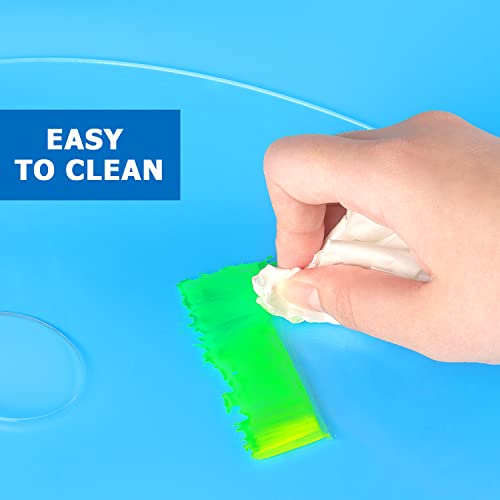
The single biggest advantage of plastic for acrylic is that dried paint usually peels away. Choose smooth, glossy plastic and avoid textured or matte surfaces that give dried acrylic something to grip.
Wells vs. flat mixing space
Wells keep colors separate and hold paint in a small exposed area, which slows drying slightly. Flat palettes give unlimited mixing room for palette-knife work. Many acrylic painters use both: a well palette for storing colors and a flat slab for mixing.
Size for your canvas
Large canvases need large mixes. A 10 x 13 inch tray or an 11.8 x 7.9 inch slab suits canvases of 16 x 20 inches and up. Round 6.6-inch palettes suit small studies, student work and crafts.
Handheld or table use
If you paint at an easel, a thumb hole lets you hold the palette like a traditional painter. If you paint on a table, a larger, heavier tray stays put.
Number of palettes
One painter may want two palettes so one can dry for cleaning while the other is in use. Teachers need a stack, so multi-packs make sense.
Plan for drying time
Open plastic palettes do not stop acrylic from drying. Mist with water, use a retarder medium if your paint allows it, or move to a sealed or wet palette for long sessions.
White vs. clear
White plastic shows color as it will look on a white-primed canvas. Clear palettes let you choose the background, such as a mid-gray card for better value judgment.
Keep Your Palette and Paint Working
Plastic palettes are easy to care for once you know the tricks. Our guide on how to remove dried paint from a plastic palette covers peeling, soaking and safe scraping. If you are losing paint between sessions, read what a wet palette is and how it keeps acrylic workable for days, and see how to rehydrate dried acrylic on a palette for what can and cannot be saved.
Common Mistakes to Avoid
- Squeezing out too much paint. Acrylic dries quickly; put out small amounts and add more as needed.
- Scrubbing wet acrylic down the sink. Let palette paint dry and peel it off into the trash instead.
- Using sharp metal knives on clear acrylic sheet. Scratches trap paint and cloud the surface.
- Leaving palettes in direct sun. Heat speeds drying and can warp thin plastic.
- Using one tiny palette for a big canvas. You will run out of mixing room and end up with muddy color.
- Forgetting to peel the protective film. Clear palettes often ship with film on both sides.
FAQs
What is the best plastic palette for acrylic paint?
For most painters, a large tray with plenty of wells and a smooth surface, such as the DUGATO 20-well 2-pack, is the best all-round choice. If you prefer palette-knife mixing, a flat clear palette like the Tamaki 2-pack works well.
How do you get dried acrylic off a plastic palette?
Let it dry fully, then peel it away; on smooth plastic it often lifts in sheets. Soaking in warm water can loosen stubborn spots. Avoid harsh solvents that could damage the plastic.
Is plastic or glass better for acrylic paint?
Glass is the easiest to scrape clean and does not stain, but it is heavy and breakable. Plastic is light, cheap and unbreakable, and dried acrylic usually peels off it easily, which is why it is popular for classrooms and travel.
How can I keep acrylic paint from drying on my palette?
Put out small amounts, mist lightly with water, keep the palette out of the sun, and consider a wet palette or a sealable container for breaks. A slow-drying medium can also help if your paint brand supports it.
Can I use a watercolor palette for acrylic?
Yes, but acrylic will dry permanently in the wells. Choose smooth plastic so it can be peeled out, and avoid porcelain palettes with fine crazing that dried acrylic can grip.
Are cheap plastic palettes safe for kids?
The kids’ palettes in this guide are described as plastic and, in some cases, non-toxic and break-proof. As with any art supply, supervise young children and use paint labeled for their age group.
Final Recommendation
For acrylic painting at home or in a studio, start with the DUGATO 20-Well 2-Pack; its size and well count handle real painting sessions, and having two trays makes cleanup painless. Add the Tamaki clear palettes if you mix with a palette knife or paint handheld at an easel.
Teachers should look at the LNAUJS 15-Pack for its detailed well layout, or the HYL.LL&RQ 22-Piece set for larger groups. For children’s activities, the Hulameda 12-piece trays are durable and simple, and the LNAUJS 6-well minis are perfect for crafts and detail work.




