

PaintingProGuide is reader-supported. When you buy through links on this page we may earn an affiliate commission at no extra cost to you.
Good painting tutorials do more than show a finished picture. They break a painting into decisions you can repeat: where to start, which colors to mix, how to move from big shapes to small details, and when to stop. The best painting tutorials teach a transferable process, so after a few lessons you can paint subjects that were never in the tutorial at all.
This page gives you a complete beginner tutorial you can follow today, a framework for choosing and learning from other tutorials, and a short list of books and a video kit that teach well.
Quick answer: Start with a simple acrylic landscape like the one below, then follow a structured beginner book such as Acrylics for the Absolute Beginner (Charles Evans) or Learn to Paint in Acrylics with 50 Small Paintings (Mark Daniel Nelson). If you prefer video with all supplies included, the Painting4Real DIY Painting Class Kit pairs a 9-piece acrylic set with a pause-and-rewind video lesson.
Tutorial: A Simple Acrylic Sunset Landscape
This beginner tutorial uses five colors, three brushes and one small canvas. It teaches gradients, layering from back to front and simple silhouettes.
You will need: an 8×10 or 9×12 canvas panel; acrylic paint in titanium white, cadmium yellow (or any warm yellow), a red, ultramarine blue and black; a 1-inch flat brush, a medium filbert and a small round; water cup, paper towels and a palette.
Step 1: Paint the sky gradient
Mix yellow with a little white. Paint a horizontal band across the lower third of the sky. Above it, add a band of orange (yellow plus a touch of red), then a band of pink-red, then purple (red plus blue), and finally blue at the top. While the paint is still wet, brush horizontally back and forth where bands meet to blend them. Work quickly; acrylic dries fast.
Step 2: Add the sun
With the small round, paint a circle of pale yellow just above the horizon line. Soften its edge with a clean, slightly damp brush so it glows rather than looking pasted on.
Step 3: Paint distant hills
Mix purple with a little white and a touch of blue for distant hills. Paint a gentle rolling shape across the canvas just below the sun. Distant objects look lighter and cooler, which creates depth.
Step 4: Paint middle-ground hills
Mix a darker purple-blue (less white). Paint a second, lower hill line overlapping the first. The value contrast between the two hill layers is what makes the landscape feel deep.
Step 5: Add a foreground silhouette
Mix blue and black. With the filbert, paint a dark foreground across the bottom. Add a simple tree silhouette: a trunk with the small round, branches with flicking strokes, and dabbed foliage with the filbert tip.
Step 6: Final details
Add a few birds as tiny “v” shapes in the sky with the small round. Add light reflections near the horizon if you painted water. Step back, squint, and only fix what looks wrong from a distance.
What this tutorial teaches
- Blending gradients wet-into-wet.
- Atmospheric perspective: lighter and cooler in the distance, darker in front.
- Layering back to front.
- Silhouettes as strong, simple shapes.
How to Learn Effectively From Painting Tutorials
- Paint along, then repeat without the tutorial. The second attempt shows what you actually learned.
- Pause often. Watch a step, pause, paint the step, then continue.
- Focus on one skill per tutorial. Gradients, edges, values or color mixing.
- Use the same materials when possible. It removes variables while you learn.
- Keep a painting journal. Note mixtures and what went wrong.
- Change one thing next time. Different colors, time of day or subject.
- Do small paintings. Many small studies teach faster than one big canvas.
Types of Painting Tutorials
| Type | Best for | Watch out for |
|---|---|---|
| Step-by-step video | Seeing brush handling and timing | Rushed edits that skip steps |
| Live or real-time video | Following at true painting speed | Long run times |
| Books with projects | Structured progression, reference | Harder to see brush motion |
| Technique compendiums | Learning specific effects | Less guidance on full paintings |
| Kits with lessons | Zero-prep starting point | Fixed subject and materials |
Our Top Picks at a Glance
- Acrylics for the Absolute Beginner (Charles Evans) — Best for complete beginners in acrylic
- Learn to Paint in Acrylics with 50 Small Paintings (Mark Daniel Nelson) — Best for building skills through many small studies
- Lee Hammond’s Big Book of Acrylic Painting — Best for painting favorite subjects quickly
- Compendium of Acrylic Painting Techniques (Gill Barron) — Best for learning specific effects
- Acrylics: Techniques and Tutorials for the Complete Beginner (Adrian Burrows) — Best for a budget beginner tutorial book
- Artist’s Painting Techniques (DK) — Best for exploring watercolor, acrylic and oil
- Painting4Real DIY Painting Class Kit (Frankenstein) — Best for video-guided learning with supplies included
| Product | Best For | Key Spec | Key Strength | Price Tier |
|---|---|---|---|---|
| Acrylics for the Absolute Beginner (Charles Evans) | Complete beginners in acrylic | Paperback | Written for absolute beginners | $$ |
| Learn to Paint in Acrylics with 50 Small Paintings (Mark Daniel Nelson) | Building skills through many small studies | Paperback, 50 small paintings | Small-format practice you can hang | $$ |
| Lee Hammond’s Big Book of Acrylic Painting | Painting favorite subjects quickly | Paperback | Fast, easy techniques for popular subjects | $ |
| Compendium of Acrylic Painting Techniques (Gill Barron) | Learning specific effects | Paperback technique compendium | Reference for many acrylic techniques | $ |
| Acrylics: Techniques and Tutorials for the Complete Beginner (Adrian Burrows) | A budget beginner tutorial book | Paperback, Art Techniques series | Techniques plus tutorials in one volume | $ |
| Artist’s Painting Techniques (DK) | Exploring watercolor, acrylic and oil | Hardcover | Covers three major media | $$ |
| Painting4Real DIY Painting Class Kit (Frankenstein) | Video-guided learning with supplies included | 9-piece acrylic kit with video tutorial | Real-time video you can pause and rewind | Varies |
How We Chose
We based this selection on Amazon listing details checked in October 2026. For books, our listings provided titles, authors and formats rather than full descriptions, so we describe each book based on its stated subject and approach. We did not work through these books or kits ourselves. We favored resources with a clear beginner focus or a strong technique emphasis, a sensible format, and wide reviews from Amazon buyers.
Criteria:
- Clear structure from fundamentals to complete paintings.
- Beginner suitability stated in the title or listing.
- Medium focus that matches what most learners paint.
- Format: project-based, technique-based or video-guided.
Best Painting Tutorial Books and Kits Reviewed
1. Acrylics for the Absolute Beginner (Charles Evans) — Best for complete beginners in acrylic

As the title states, Charles Evans’ book is aimed at absolute beginners in acrylic painting. Beginner-specific books tend to start with materials and simple exercises before moving on to complete paintings, which is exactly the progression new painters need.
Pair it with a small set of primary colors and a few brushes rather than a huge kit, and work through it in order.
Best suited for: First-time painters starting with acrylics.
Key features:
- Paperback
- Acrylic medium
- Beginner level
- Project-oriented series format
Pros:
- Clear beginner focus
- Low-mid price tier
- Good first book
Cons and limitations:
- Acrylic only
- Less useful for experienced painters
Buying consideration: Paint each project twice: once following the book, once from memory. It cements the process.
2. Learn to Paint in Acrylics with 50 Small Paintings (Mark Daniel Nelson) — Best for building skills through many small studies
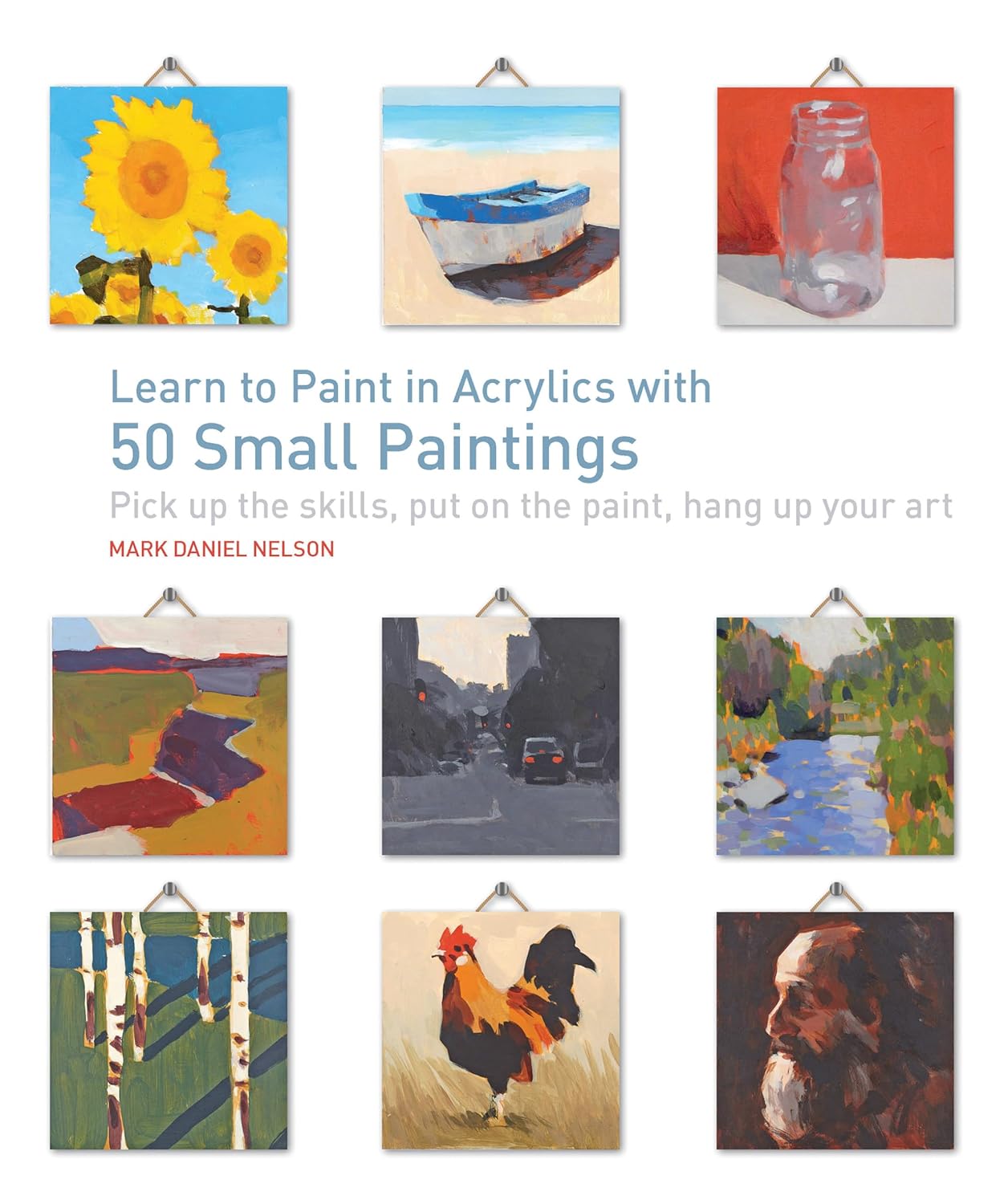
The title captures its approach: 50 small paintings that help you pick up the skills, put on the paint and hang up your art. Small paintings are one of the most efficient ways to learn because you finish often and repeat techniques many times.
It suits people who want a sense of achievement each session.
Best suited for: Beginners and improvers who want frequent, finishable projects.
Key features:
- Paperback
- 50 small acrylic projects
- Skill-by-skill progression
- Displayable results
Pros:
- Many finishable projects
- Builds habit and confidence
- Practical scale
Cons and limitations:
- Small format may not suit large-canvas goals
- Acrylic only
Buying consideration: Use inexpensive canvas paper or small panels so you are not afraid to paint all 50.
3. Lee Hammond’s Big Book of Acrylic Painting — Best for painting favorite subjects quickly

Lee Hammond’s book promises fast, easy techniques for painting favorite subjects. A subject-focused approach is helpful once you have the basics and want to paint specific things such as animals, landscapes or still lifes.
It works well as a second book after a pure beginner guide.
Best suited for: Improving beginners who want subject-specific guidance.
Key features:
- Paperback
- Acrylic medium
- Subject-based techniques
- “Big book” breadth
Pros:
- Wide subject coverage
- Emphasis on easy techniques
- Good second book
Cons and limitations:
- Less focus on foundations
- Acrylic only
Buying consideration: Pick one subject chapter and paint it three times in different color schemes.
4. Compendium of Acrylic Painting Techniques (Gill Barron) — Best for learning specific effects

A compendium is a reference rather than a course: it gathers many techniques in one place so you can look up how to create a particular effect. That makes it a useful companion to any tutorial when you need to know how to paint texture, glaze or create a specific finish.
Keep it near your painting area and dip in as needed.
Best suited for: Painters who want a technique reference alongside tutorials.
Key features:
- Paperback
- Acrylic techniques
- Reference format
- Look-up style
Pros:
- Broad technique coverage
- Handy reference
- Low-mid price tier
Cons and limitations:
- Not a step-by-step course
- Requires self-direction
Buying consideration: Try one new technique per week on a scrap panel and keep the panels as a visual library.
5. Acrylics: Techniques and Tutorials for the Complete Beginner (Adrian Burrows) — Best for a budget beginner tutorial book

Adrian Burrows’ book combines techniques and tutorials for complete beginners, according to its title. That mix of short technique lessons and complete projects is a good balance for self-learners.
It sits in the lowest price tier among the books here.
Best suited for: Budget-conscious beginners and students.
Key features:
- Paperback
- Techniques and tutorials
- Complete beginner focus
- Art Techniques series
Pros:
- Lowest price tier
- Combines skills and projects
- Beginner friendly
Cons and limitations:
- Acrylic only
- Limited listing detail
Buying consideration: Pair technique pages with the matching tutorial right away so the skill sticks.
6. Artist’s Painting Techniques (DK) — Best for exploring watercolor, acrylic and oil

DK’s hardcover, per its title, explores watercolors, acrylics and oils and encourages readers to discover their own style and grow as artists. A multi-media book is valuable when you are not yet sure which medium suits you.
It is broader than single-medium guides, which makes it a good reference shelf book.
Best suited for: Curious beginners choosing a medium and artists branching out.
Key features:
- Hardcover
- Watercolor, acrylic and oil
- Style development focus
- DK reference format
Pros:
- Three media in one book
- Durable hardcover
- Good for exploring
Cons and limitations:
- Less depth per medium
- Higher price tier among books
Buying consideration: Use it to sample each medium, then commit to one for a few months before switching.
7. Painting4Real DIY Painting Class Kit (Frankenstein) — Best for video-guided learning with supplies included

Painting4Real combines a video lesson with all the supplies: acrylic paints, a palette, brushes, graphite paper and a canvas panel. The listing describes a real-time, step-by-step video you can pause and rewind, and says you can complete the painting in about two hours, with guidance on brush technique, color mixing and light and shadow.
Graphite paper lets you transfer the outline, which removes the drawing hurdle many beginners worry about.
Best suited for: Beginners who want a guided video session, paint nights and gifts.
Key features:
- Video tutorial at your own pace
- 9-piece acrylic painting kit
- Graphite transfer paper and canvas panel
- About 2 hours to complete
Pros:
- Everything included
- Video shows brush handling
- Fixed, achievable goal
Cons and limitations:
- Single subject per kit
- Listing price not shown at the time of checking
Buying consideration: After finishing, try painting the same subject again on your own canvas without the transfer paper.
Buying Guide: Choosing Painting Tutorials and Books
Pick a medium first
Acrylic is the most common starting point for beginners because it dries fast and cleans up with water. Oil and watercolor tutorials teach different skills.
Match the level
“Absolute beginner” books start with materials and basics. Subject-focused books assume some skill.
Choose format by how you learn
Visual learners benefit from video; readers who like reference prefer books. Many people combine both.
Prefer projects you will finish
Small, achievable projects build confidence and habit.
Look for transferable skills
The best tutorials explain why, not just what, so you can apply ideas to new subjects.
Keep materials simple
Most beginner tutorials need only a few colors and brushes. A limited palette makes tutorials easier to follow.
More Tutorials on PaintingProGuide
Ready for your next lesson? Try our space and galaxy painting tutorial, which builds on the gradient skills above. If you want to try a new medium, follow our step-by-step oil painting tutorial or gouache painting tutorial for beginners. For crafts, try scratch art painting or painting pottery at home.
Common Mistakes to Avoid
- Jumping between tutorials every day. Repetition builds skill faster than variety.
- Copying without understanding. Ask why each step works.
- Using too many colors. Stick to the tutorial palette.
- Comparing your first attempt to the instructor’s. Compare your third attempt to your first.
- Skipping value. If a painting feels flat, check light and dark contrast before color.
- Painting too big too soon. Small canvases are easier to finish.
FAQs
What is the best painting tutorial for beginners?
A simple landscape or sunset in acrylic is a classic first tutorial because it teaches gradients, layering and silhouettes with few colors. Beginner books like Acrylics for the Absolute Beginner provide a structured path afterward.
Are painting tutorial books better than videos?
They teach differently. Videos show brush motion and timing; books give structure and reference. Many learners use both.
How often should I follow painting tutorials?
Short, regular sessions work best. Two or three small paintings a week, repeating key tutorials, builds skill steadily.
Which medium should I start with?
Acrylic is the most common starting medium because it is affordable, dries quickly and cleans up with water. Watercolor and oil are rewarding but have different learning curves.
Can I learn to paint only from tutorials?
Yes, many people learn this way. Combine tutorials with observation, such as painting simple objects from life, to develop your own seeing skills.
How long does it take to get good at painting?
It varies, but consistent practice over a few months usually brings visible improvement in control, color mixing and composition.
Final Recommendation
Start with the sunset tutorial on this page, then choose one structured book: Acrylics for the Absolute Beginner for a clear foundation or 50 Small Paintings for frequent, finishable practice. Add Lee Hammond’s Big Book for subjects, Gill Barron’s Compendium as a technique reference, Adrian Burrows for a budget option, or DK’s Artist’s Painting Techniques to explore other media. Prefer video? The Painting4Real kit gives a guided session with supplies included.




