PaintingProGuide is reader-supported. When you buy through links on this page we may earn an affiliate commission at no extra cost to you.
Acrylic is the friendliest paint to learn from a tutorial. It dries in minutes, so you can follow a step, let it set and move to the next without waiting days. It cleans up with water, it covers mistakes with a single opaque layer, and it works on canvas, paper and wood. The best acrylic painting tutorials take advantage of that speed: short, focused lessons that each teach one skill, building toward complete paintings.
Below are five short beginner tutorials you can follow right now with a basic set of acrylics, each designed to practice a core technique: blending a gradient, layering a simple landscape, painting a flower with light and shadow, loose abstract mark-making and observing a still life from life. After that, we compare seven acrylic tutorial books sold on Amazon, for when you want a longer, structured path from complete beginner to confident painter.
Quick answer: Start with the five quick tutorials on this page to learn blending, layering, light and shadow, mark-making and observation. For a structured series of step-by-step lessons, Learn to Paint in Acrylics with 50 Small Paintings builds skills through many small, finishable projects. For a technique reference to dip into, Compendium of Acrylic Painting Techniques is a broad guide, and Jerry Yarnell’s Secrets of Acrylic: Landscapes Start to Finish suits landscape lovers.
What You Need for These Tutorials
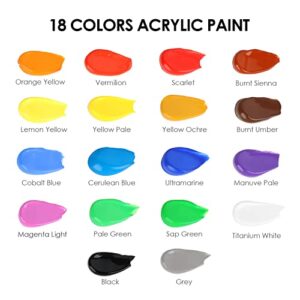
- Acrylic paints: titanium white, black or Payne’s gray, a yellow, a red, a blue and a burnt umber or burnt sienna.
- Brushes: a 1-inch flat, a medium filbert or flat, a small round.
- Surface: canvas panels or heavy acrylic paper, about 8 x 10 inches.
- A palette, a water jar, paper towels and a spray bottle to keep paint moist.
Tutorial 1: Sunset Sky Gradient (Blending)
This teaches the most important acrylic skill: blending before the paint dries.
- Mist the panel lightly with water so the paint stays workable longer.
- Paint a band of yellow mixed with a little white across the bottom third.
- Paint orange (yellow plus a touch of red) above it, overlapping slightly.
- Paint a soft pink-red above that, then purple (red plus blue plus white) at the top.
- With a clean, slightly damp flat brush, sweep side to side where colors meet to blend them. Work quickly and lightly.
- Once dry, paint a simple dark silhouette of hills or trees along the bottom.
Key lesson: blend while wet, in one direction, with a light touch. If an area dries, glaze over it later rather than scrubbing.
Tutorial 2: Simple Layered Landscape (Atmospheric Depth)
- Paint a light blue sky, fading to almost white at the horizon.
- Mix a pale blue-gray and paint distant mountains. Let dry.
- Mix a slightly darker, greener color and paint a middle range of hills overlapping the mountains.
- Paint the foreground with your darkest, warmest greens and browns.
- Add a few trees in the foreground with a small round brush, darker than everything behind.
Key lesson: things far away are lighter, bluer and less detailed. Near things are darker, warmer and sharper. Acrylic’s fast drying makes this back-to-front layering easy.
Tutorial 3: A Single Flower (Light and Shadow)
- Paint a dark background so the flower will glow. Let dry.
- Lightly sketch a simple five-petal flower with chalk.
- Block in each petal with a mid-value color, for example a medium pink.
- Add shadow to the base of each petal with a darker version of the color.
- Add light to the tips with the color mixed with white.
- Paint the center yellow, add a few dark dots and a tiny white highlight.
Key lesson: three values, dark, middle and light, make an object look three-dimensional. For a deeper floral guide, see our simple acrylic painting ideas for beginners.
Tutorial 4: Loose Abstract (Mark-Making)
- Choose three colors that sit near each other on the color wheel plus white.
- Cover the panel with broad, loose strokes using a large flat brush.
- While still wet, drag a palette knife through some areas to create texture.
- Once dry, add a few deliberate lines or shapes in a contrasting color.
- Step back, decide what to keep, and paint over anything that distracts.
Key lesson: acrylic’s opacity means you can always repaint, so treat early layers as experiments. Abstract work frees you to experiment with brushes and knives without worrying about drawing.
Tutorial 5: Two-Object Still Life (Observation)
- Set a mug and an apple on a table with one lamp shining from the side.
- Squint at the setup and paint the background and table in two flat values.
- Block in each object with its middle color, ignoring details.
- Paint the shadow side of each object darker and slightly cooler; paint the cast shadows on the table.
- Add light-side colors, then one small, bright highlight on each object last.
Key lesson: painting from life trains you to see values and edges, a skill that improves every other tutorial you follow. Keep the setup in place so you can repaint it on another day and compare.
How to Get More From Any Acrylic Tutorial
Follow the tutorial once exactly. Then paint it again without looking, and a third time with one change: a different time of day, a new color scheme or a different format. The first pass teaches steps; the second shows what you actually remember; the third turns someone else’s lesson into your own painting. Keep all three, dated, so you can see the improvement. If a step confuses you, isolate it: paint just that gradient or just that petal on scrap paper five times before returning to the full piece.
Want to turn your practice pieces into decor? Our guide to DIY wall art with acrylic shows how to scale up and display your work.
Best Acrylic Painting Tutorial Books at a Glance
- Learn to Paint in Acrylics with 50 Small Paintings by Mark Daniel Nelson — Best step-by-step tutorial book
- Compendium of Acrylic Painting Techniques by Gill Barron — Best technique reference
- Acrylics: Techniques and Tutorials for the Complete Beginner by Adrian Burrows — Best budget beginner tutorials
- Secrets of Acrylic: Landscapes Start to Finish by Jerry Yarnell — Best landscape tutorials
- Lee Hammond’s Big Book of Acrylic Painting — Best for many subjects in one book
- Sea and Sky in Acrylics by Dave White — Best for seascapes and skies
- The Complete Acrylic Painting Guide for Beginners by Leonard Koe — Best all-in-one beginner guide with supplies advice
| Product | Best For | Key Spec | Key Strength | Price Tier |
|---|---|---|---|---|
| 50 Small Paintings (Nelson) | Step-by-step practice | 50 small paintings | Many finishable projects | $$ |
| Compendium of Techniques (Barron) | Technique reference | Broad compendium | Look up any technique | $ |
| Acrylics: Techniques and Tutorials (Burrows) | Complete beginners | Techniques plus tutorials | Affordable start | $ |
| Secrets of Acrylic Landscapes (Yarnell) | Landscape painters | Landscapes start to finish | Complete landscape walkthroughs | $ |
| Big Book of Acrylic (Hammond) | Variety of subjects | Fast, easy techniques for favorite subjects | Broad subject range | $ |
| Sea and Sky in Acrylics (White) | Seascapes and skies | Techniques and inspiration | Focused subject | $$ |
| Complete Acrylic Guide (Koe) | Beginners wanting supplies help | Techniques, supplies, mistakes | All-in-one overview | $$$ |
How We Chose
The tutorials on this page follow standard beginner acrylic practice. The book picks are based on their Amazon listing details checked in October 2026, how clearly each offers step-by-step or technique instruction for acrylic, and how widely each is reviewed by Amazon buyers. We describe the books by their stated scope.
- Tutorial format: step-by-step lessons or clear technique demonstrations.
- Skill level: beginner-friendly entry points.
- Subject range: general, landscape and seascape options.
- Price tier relative to content.
Acrylic Tutorial Books Reviewed
1. Learn to Paint in Acrylics with 50 Small Paintings by Mark Daniel Nelson — Best for step-by-step practice
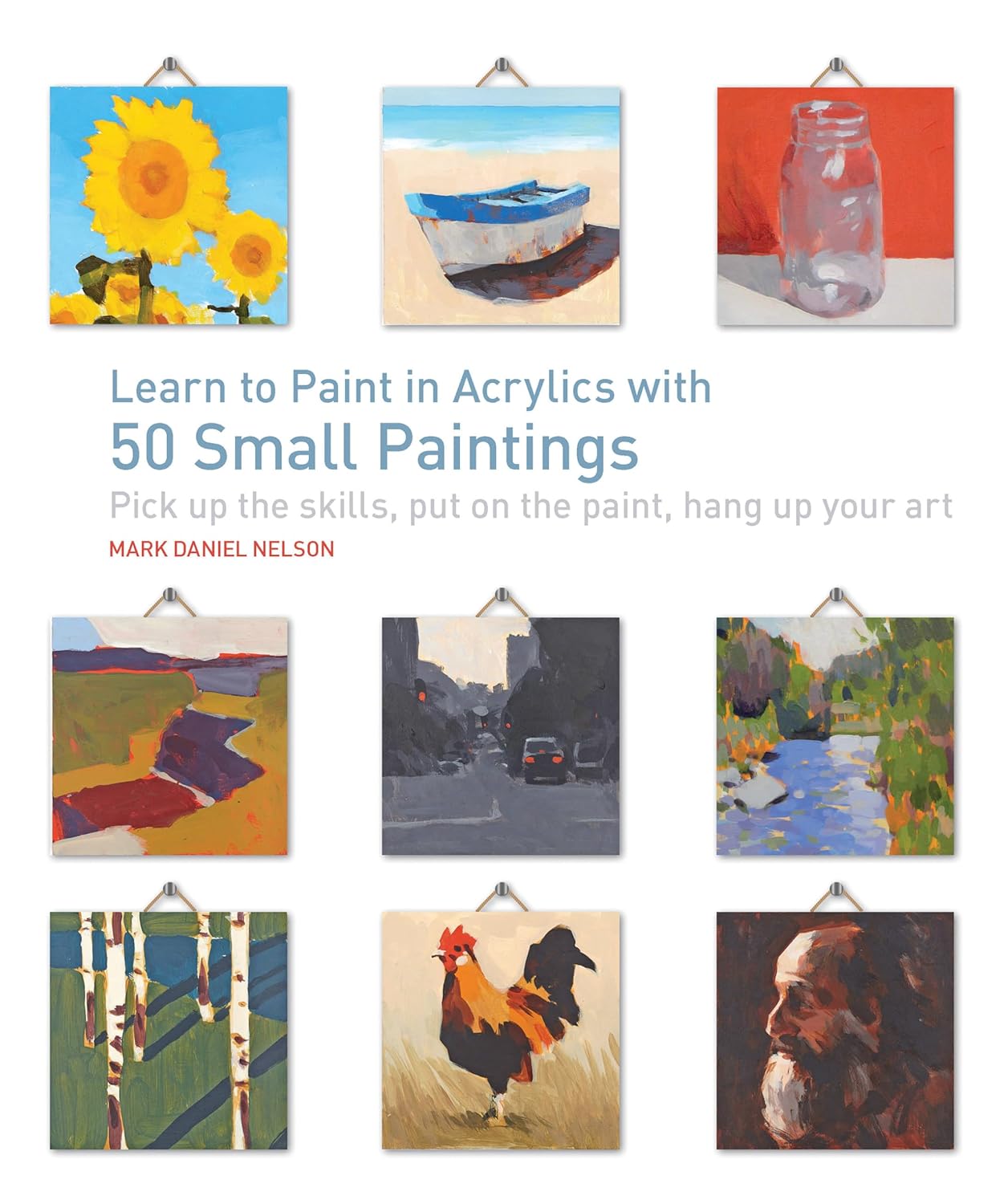
The subtitle sums up the approach: pick up the skills, put on the paint, hang up your art. Fifty small paintings means fifty chances to finish something, which is the fastest way to build both skill and motivation.
Small formats suit acrylic perfectly because they dry quickly and use little paint.
Best suited for: Beginners who learn best by completing many short projects.
Key features:
- 50 small painting projects
- Paperback
- Skills-first approach
Pros:
- Many finishable lessons
- Builds confidence
- Suits small panels
Cons and limitations:
- Small scale by design
- Less theory than a reference book
Buying consideration: Paint one project per day for two weeks and compare the first and last.
2. Compendium of Acrylic Painting Techniques by Gill Barron — Best for a technique reference

A compendium is a reference you keep coming back to. This paperback gathers acrylic techniques in one place, useful when a tutorial mentions a method like scumbling, glazing or impasto and you want to see how it works.
Best suited for: Painters who want a reference alongside project-based tutorials.
Key features:
- Technique compendium
- Paperback
Pros:
- Broad coverage
- Useful long-term reference
- Affordable
Cons and limitations:
- Not a guided course
Buying consideration: Use it to look up any technique named in a tutorial you are following.
3. Acrylics: Techniques and Tutorials for the Complete Beginner by Adrian Burrows — Best for complete beginners

Part of the Art Techniques series, this paperback pairs core techniques with tutorials for complete beginners, at the lowest price tier among the general guides here.
Best suited for: Absolute beginners on a budget.
Key features:
- Techniques and tutorials
- Complete beginner focus
- Paperback
Pros:
- Affordable
- Combines theory and practice
Cons and limitations:
- Less depth than larger books
Buying consideration: Pair it with the compendium as you progress.
4. Secrets of Acrylic: Landscapes Start to Finish by Jerry Yarnell — Best for landscape tutorials

Part of the Essential Artist Techniques series, this book walks through landscapes from start to finish. Complete walkthroughs show how decisions build on each other, from sky to foreground.
Best suited for: Landscape painters who want full start-to-finish demonstrations.
Key features:
- Landscapes start to finish
- Paperback
Pros:
- Complete walkthroughs
- Affordable
- Focused subject
Cons and limitations:
- Landscape only
Buying consideration: Practice Tutorial 2 above first; it introduces the same back-to-front layering.
5. Lee Hammond’s Big Book of Acrylic Painting — Best for many subjects

The subtitle promises fast, easy techniques for painting your favorite subjects. A broad subject range keeps practice varied, and Lee Hammond is a widely published instructional author.
Best suited for: Beginners who want variety across subjects in one book.
Key features:
- Many subjects
- Fast, easy techniques
- Paperback
Pros:
- Broad range
- Accessible approach
Cons and limitations:
- Less depth per subject
Buying consideration: Pick subjects you love first; motivation keeps you painting.
6. Sea and Sky in Acrylics by Dave White — Best for seascapes and skies

Focused on techniques and inspiration for sea and sky, this paperback suits painters drawn to waves, clouds and coastal light, natural follow-ons to Tutorial 1 above.
Best suited for: Painters who love seascapes and dramatic skies.
Key features:
- Sea and sky techniques
- Inspiration
- Paperback
Pros:
- Focused subject
- Builds on blending skills
Cons and limitations:
- Narrow subject
Buying consideration: Practice skies on small panels before attempting large seascapes.
7. The Complete Acrylic Painting Guide for Beginners by Leonard Koe — Best for supplies and mistakes help

This guide covers essential techniques, choosing the right supplies, avoiding common mistakes and creating first paintings, per its title. It was in the premium price tier when checked.
Best suited for: Beginners who also want guidance on what to buy.
Key features:
- Techniques, supplies and mistakes
- First paintings
- Paperback
Pros:
- All-in-one overview
- Supplies guidance
Cons and limitations:
- Premium price tier at check
- Newer title
Buying consideration: Check edition and price on the listing, since prices can vary.
Buying Guide: How to Choose Acrylic Tutorials
Format
Step-by-step projects build confidence. Technique references build understanding. Many learners use both.
Subject
Choose tutorials on subjects you enjoy. Landscapes, florals, seascapes and abstracts each teach different skills.
Skill level
Start slightly below your comfort level to build quick wins, then step up.
Length of lessons
Short lessons fit busy schedules and suit acrylic’s fast drying.
Supplies list
Check that the tutorial uses supplies you have or can easily get.
Acrylic Tips That Make Every Tutorial Easier
- Keep paint moist: mist your palette or use a stay-wet palette.
- Work in layers: let each layer dry; acrylic is forgiving when you build up.
- Mix enough paint: matching a dried color later is hard.
- Expect color shift: many acrylics dry slightly darker.
- Wash brushes promptly: dried acrylic ruins bristles.
- Use retarder when blending matters: a few drops of slow-drying medium buy extra minutes for skies and soft transitions.
- Tone your surface: a thin wash of color on the panel removes the stark white and makes values easier to judge.
- Step back often: view the painting from across the room every few minutes; problems with shapes and values show up at a distance.
Acrylic also works beyond canvas. If you want to try a new surface, see whether you can use acrylic paint on glass jars and how to prep them.
Common Mistakes to Avoid
- Overworking drying paint. It drags and streaks. Let it dry and layer.
- Using too much water. Very thin acrylic can lose adhesion and look patchy.
- Skipping value contrast. Paintings look flat without darks and lights.
- Only following tutorials. Repaint each lesson your own way.
- Leaving brushes to dry with paint. Clean them immediately.
- Starting too large. Big canvases take more paint and time; small panels let you finish and learn faster.
- Judging a painting while wet. Acrylic often dries a little darker, so wait before deciding a color is wrong.
FAQs
What is the easiest acrylic painting for beginners?
A sunset gradient or simple layered landscape. Both teach blending and layering in under an hour.
How do I blend acrylic paint before it dries?
Mist the surface, work quickly with a slightly damp brush, and blend in one direction. Retarder medium can extend working time.
Are acrylic painting books better than videos?
Books are easy to review and explain principles; videos show movement and timing. Many learners use both.
How long does acrylic paint take to dry?
Thin layers are touch-dry in minutes; thick layers take longer.
Can beginners learn acrylic painting from tutorials alone?
Yes, with regular practice. Repeating tutorials and varying them builds real skill.
What surface should I use for acrylic tutorials?
Canvas panels or heavy acrylic paper around 8 x 10 inches are ideal.
Final Recommendation
Start with the five tutorials above. When you want a structured path, choose Learn to Paint in Acrylics with 50 Small Paintings, and keep the Compendium of Acrylic Painting Techniques on hand as a reference. Adrian Burrows’ Acrylics is the budget start, Jerry Yarnell covers landscapes, Lee Hammond offers variety, Dave White focuses on sea and sky, and Leonard Koe’s guide adds supplies advice for brand-new painters.