PaintingProGuide is reader-supported. When you buy through links on this page we may earn an affiliate commission at no extra cost to you.
The best oil painting classes online are not the ones with the slickest trailer. They are the ones that match how you learn, give you a clear sequence of skills, and show the instructor’s palette, brush and canvas closely enough that you can actually copy what they do. Oil painting is a hands-on craft with a materials side, fat over lean, drying times, solvents, that a good class explains and a bad one skips.
This guide answers the real question first: which kinds of online oil painting classes exist, who each format suits, how to judge a class before paying, and how to structure your own learning path. Then, because a video course works best alongside a book you can keep open on the table, we cover six oil painting books that pair well with online lessons.
Quick answer: Most beginners do best with a self-paced, project-based video course that starts with materials and value studies, paired with a structured book such as The Oil Painting Course You’ve Always Wanted. If you want feedback, choose a live online workshop with critiques. For classical skills, an atelier-style program is the deepest option. Keep The Encyclopedia of Oil Painting Techniques nearby as a reference between lessons.
Our Top Picks at a Glance
- Self-paced video courses — Best for beginners on a flexible schedule
- Live online workshops — Best for feedback and accountability
- Atelier-style online programs — Best for classical realism
- Free video tutorials — Best for trying oils before committing
- The Oil Painting Course You’ve Always Wanted (book) — Best book to pair with any class
- Realistic Oil Painting by Jan Matěják (book) — Best book for layered realism
Types of Online Oil Painting Classes Compared
| Format | Best For | Feedback | Structure | Typical Cost Level |
|---|---|---|---|---|
| Self-paced video course | Beginners, busy schedules | Little or none; some community forums | Lesson sequence | Low to moderate |
| Subscription platform | Exploring many teachers | Varies | Many short courses | Monthly or yearly fee |
| Live online workshop | Feedback, motivation | Live critique | Scheduled sessions | Moderate to high |
| Atelier-style program | Classical realism | Structured critiques | Long curriculum | High |
| Free video tutorials | Trying oils, single techniques | None | Unstructured | Free |
How We Approached This Guide
We have not enrolled in or reviewed specific paid online courses for this article, so we do not rank individual courses. Instead, we explain the class formats and the criteria that separate good classes from weak ones. The books below were chosen from Amazon listing details checked in October 2026, based on how well each title’s stated scope fits learners taking online classes, and how widely each is reviewed by Amazon buyers.
- Clear curriculum: a stated sequence from materials to finished paintings.
- Camera quality: close views of the palette and brush, not only the canvas.
- Materials teaching: safety, solvents, mediums and fat over lean.
- Feedback options: critiques, community or none.
- Instructor portfolio: work you would want to make yourself.
The Main Formats in Detail
Self-paced video courses
Recorded lessons you can watch and rewatch on your own schedule. Popular course marketplaces and creative-learning platforms such as Udemy, Skillshare and Domestika host many oil painting courses, and individual artists often sell their own. The strength is flexibility and repetition; you can pause a demo on the exact stroke you need. The weakness is that nobody tells you what is wrong with your painting.
Look for courses that begin with materials and simple value studies rather than jumping to a finished landscape. A good course will also list the exact paints, brushes and surfaces used, so you can copy results more closely.
Live online workshops
Scheduled sessions over video call, often in small groups. Many working painters run these alongside in-person workshops. You paint along, and the instructor reviews work during or after the session. This is the closest online equivalent to a classroom, and the accountability of a fixed time helps many adults actually paint every week.
Atelier-style online programs
Long, structured curricula based on classical training: drawing, value, form, then limited-palette painting and master copies. These are demanding and suit painters aiming for realism. Expect assignments and critiques, and a commitment of months rather than weeks.
Free video tutorials
Free tutorials on video platforms are an excellent way to try oil painting before spending money. Wet-on-wet landscape painting, popularized on television by Bob Ross, remains a common entry point. Free content is rarely sequenced, so use it to sample, then commit to a structured course.
How to Judge an Online Oil Painting Class Before Paying
- Watch the preview lessons. Can you see the palette and the brush loading clearly?
- Check the syllabus. Does it cover materials, values, color mixing and edges, not just finished projects?
- Look at student results shared publicly by the course or community, if available.
- Confirm the materials list and that it fits your budget.
- Check feedback options. Is there a community, critique or Q&A?
- Read the refund policy for paid courses.
Setting Up a Home Studio for Online Classes
Online learning adds one piece of equipment that in-person students do not need: a screen you can see while painting. Position a laptop or tablet at eye level beside the easel, not in front of it, so you can glance between the demo and your canvas without bending. A cheap tablet stand or a stack of books works.
- Lighting: a daylight-balanced lamp aimed at the canvas from the side keeps colors consistent from session to session.
- Screen glare: angle the screen away from windows; you need to read subtle color shifts in the demo.
- Ventilation: open a window or run a fan, especially if your course uses mineral spirits.
- Protected surfaces: a drop cloth under the easel and a tray for the laptop keep paint off electronics.
- A webcam or phone mount: for live workshops, you will need to show your canvas for critique.
Keep the same setup for every lesson. When the light, palette position and screen stay put, you can focus on the painting instead of rearranging the room. It also makes progress easier to judge, because each week’s study is painted under the same conditions as the last.
A Suggested Online Learning Path
| Stage | Focus | Class Type |
|---|---|---|
| Weeks 1-4 | Materials, brush handling, value scale | Self-paced beginner course |
| Weeks 5-8 | Color mixing, simple still life | Project-based course |
| Weeks 9-12 | Landscape basics, alla prima | Free tutorials plus course modules |
| Months 4-6 | Feedback and refinement | Live workshop with critiques |
| Months 6+ | Specialization | Atelier program or subject-specific course |
Books That Pair Well With Online Classes
A book complements video in two ways: it explains the principles a short lesson skips, and it is faster to consult mid-painting than scrubbing through a video. These six titles cover beginner projects, structured courses and technique references.
| Product | Best For | Key Spec | Key Strength | Price Tier |
|---|---|---|---|---|
| The Oil Painting Course You’ve Always Wanted | Structured self-study | Paperback, guided lessons | Course-style sequence | $$ |
| The Beginner’s Guide to Oil Painting | Still life beginners | Paperback, still life projects | Simple projects to learn basics | $$ |
| Easy Oil Painting | Small, quick projects | Paperback, 9 step-by-step projects | Small 4-inch square format | $$ |
| Realistic Oil Painting | Realism | Paperback; underpainting, layered and direct methods | Contemporary realism guide | $$ |
| The Encyclopedia of Oil Painting Techniques | Reference | Paperback, visual directory | Look up any technique | $$ |
| How To Oil Paint For Beginners | Basic overview | Paperback | Techniques and color theory intro | $ |
1. The Oil Painting Course You’ve Always Wanted by Kathleen Lochen Staiger — Best for pairing with any class

Staiger’s book is organized as guided lessons for beginners and experienced artists, so it works like a printed course. If your online class jumps around, this book fills in the sequence; if your class is structured, it reinforces each step with a second explanation.
Best suited for: Self-taught painters who want a reliable learning sequence.
Key features:
- Paperback
- Guided lessons
- For beginners and experienced artists
- Course structure
Pros:
- Clear progression
- Good companion to video
- Useful for review
Cons and limitations:
- Requires commitment
- One teacher’s approach
- Less useful as a quick lookup
Buying consideration: Match each book lesson to a video lesson on the same topic and paint both exercises.
2. The Beginner’s Guide to Oil Painting by Craig Stephens — Best for still life beginners

As its subtitle says, Stephens’ book uses simple still life projects to help you master the basics. Still life is an ideal subject for online learners: you control the light, the objects do not move, and you can set up the same arrangement the instructor uses.
Best suited for: Beginners who prefer learning through small, complete projects.
Key features:
- Paperback
- Simple still life projects
- Focus on basics
- Beginner level
Pros:
- Project-based
- Controllable subject matter
- Good confidence builder
Cons and limitations:
- Still life focus only
- Less on landscapes
- Beginner scope
Buying consideration: Set up a still life with one light source to the side; it makes form and shadow easier to read.
3. Easy Oil Painting by Estelle Day — Best for small, quick projects

Easy Oil Painting offers 9 step-by-step projects of simple still life subjects, designed for 4-inch square canvases according to the title. Small formats are perfect for beginners: they use little paint, dry faster and can be finished in a single session.
Best suited for: Beginners who want quick wins and small daily paintings.
Key features:
- Paperback (Design Originals)
- 9 step-by-step projects
- Small 4-inch square format
- Simple still life subjects
Pros:
- Fast, finishable projects
- Low paint use
- Builds a daily habit
Cons and limitations:
- Small format limits complexity
- Only nine projects
- Still life only
Buying consideration: Paint each project twice: once following the book, once with your own color choices.
4. Realistic Oil Painting by Jan Matěják — Best for layered realism
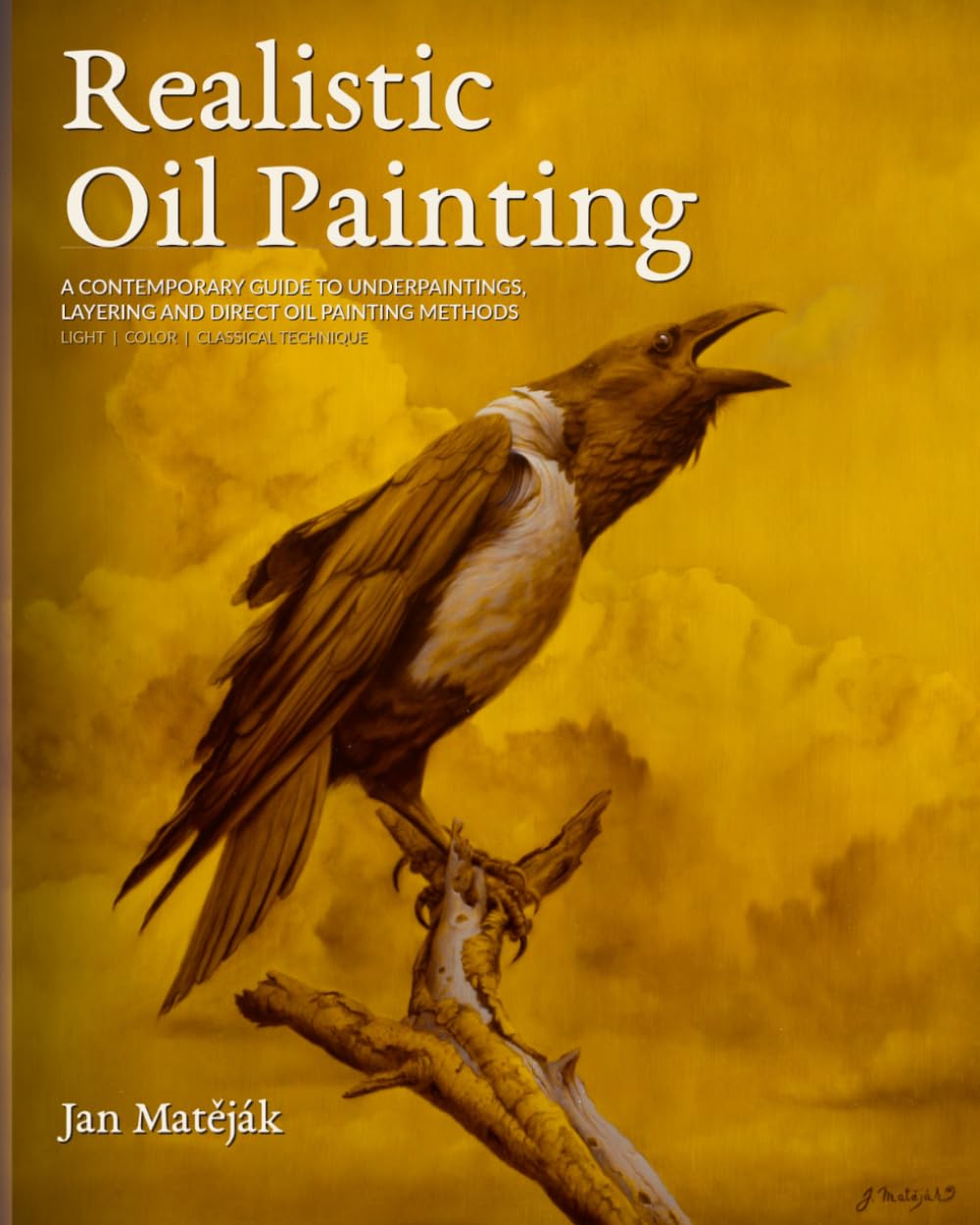
Matěják’s book is described as a contemporary guide to realistic oil painting, covering underpaintings, the layered technique and the direct painting method. That combination is useful for online learners who have tried alla prima and want to understand indirect, layered painting.
Best suited for: Intermediate painters moving toward realism.
Key features:
- Paperback
- Underpainting coverage
- Layered technique and direct method
- Contemporary realism focus
Pros:
- Explains both layered and direct methods
- Good bridge to atelier-style study
- Modern approach
Cons and limitations:
- Higher price tier
- Not for absolute beginners
- Realism focus
Buying consideration: Pair this with a course on value studies; layered realism depends on a solid underpainting.
5. The Encyclopedia of Oil Painting Techniques by Jeremy Galton — Best for a reference between lessons
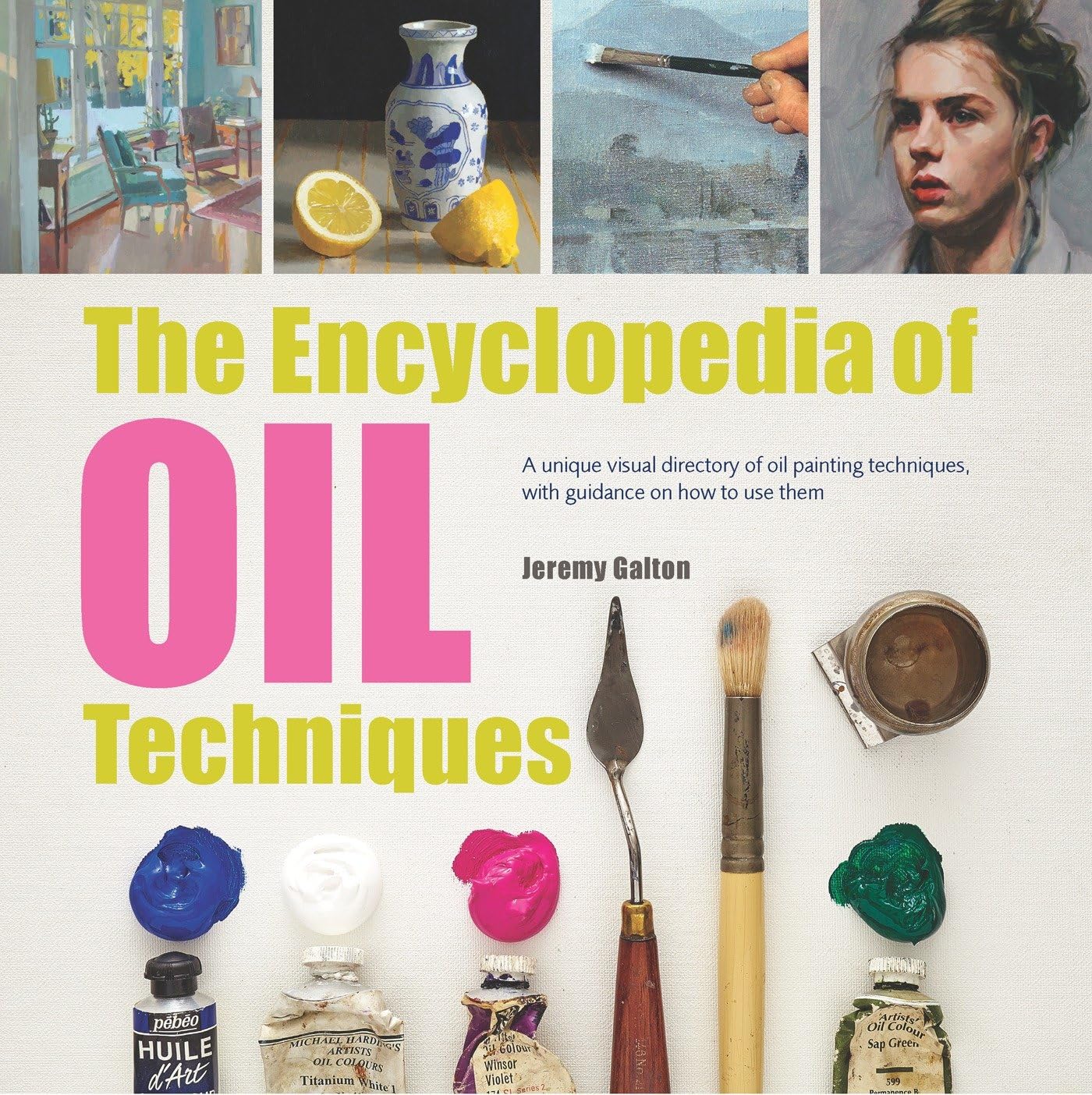
Galton’s encyclopedia is a visual directory of oil painting techniques with guidance on using them. When an online instructor mentions scumbling or glazing in passing, this is where you look it up.
Best suited for: All levels, as a desk reference.
Key features:
- Paperback
- Visual directory of techniques
- Guidance for each method
- Lowest price tier here
Pros:
- Fast lookup
- Broad coverage
- Works with any class
Cons and limitations:
- Not a course
- Breadth over depth
- Edition variations exist
Buying consideration: Keep sticky notes on the techniques your course uses most.
6. How To Oil Paint For Beginners by Pave Press — Best for a basic overview

This beginner title covers artists’ painting techniques, different ways to paint and color theory, according to its subtitle. It is a low-cost primer to read before starting an online course so the vocabulary is familiar.
Best suited for: Complete beginners who want an overview before a class.
Key features:
- Paperback
- Painting techniques overview
- Color theory introduction
- Beginner level
Pros:
- Low price tier
- Quick introduction
- Covers vocabulary
Cons and limitations:
- Less-established publisher
- Overview depth only
- Few details in the listing
Buying consideration: Read it in the week before your course begins to get more from the first lessons.
Buying Guide: What to Look For in Online Oil Painting Classes
Instructor work you admire
You will learn to paint like your teacher, at least at first. Choose someone whose finished paintings match your goals.
Materials and safety coverage
A good course explains solvents, ventilation, mediums and cleanup, and offers solvent-free options. Skipping this is a red flag.
Fundamentals before projects
Look for lessons on value, color temperature and edges. Project-only courses can produce one nice painting without teaching transferable skills.
If a course starts with a large finished landscape on day one, pair it with fundamentals elsewhere.
Camera and audio quality
You need to see the palette, the brush and the canvas up close, and hear explanations clearly. Watch preview lessons first.
Feedback route
Decide whether you need critiques. If so, choose live workshops or programs with critique options.
Time commitment
Match the course length to your real schedule. Finishing a short course beats abandoning a long one.
Practice Projects Between Lessons
Short projects keep skills moving between classes. Our oil seashell painting guide is a good still life exercise in form and highlights. The fog painting tutorial trains soft edges and value control, and painting grass in oil builds brushwork for landscapes.
Common Mistakes to Avoid
- Collecting courses instead of finishing one. Complete a course before buying the next.
- Watching without painting. Paint along, even if the result is rough.
- Using different materials than the instructor. Results will not match; copy the list where you can.
- Skipping fundamentals. Value and color lessons pay off in every painting.
- Never getting feedback. Join a community or book a critique occasionally.
- Ignoring ventilation. Online learners often paint in small rooms; open a window.
FAQs
Can you learn oil painting online?
Yes. Many painters learn successfully through online classes, especially when they combine structured courses, regular practice and occasional feedback.
What is the best online oil painting class for beginners?
A self-paced course that starts with materials, value studies and simple still life is usually best. Pair it with a structured book for review.
Are free oil painting tutorials enough?
They are great for trying oils and learning single techniques, but most lack a sequence. A structured course helps you progress faster.
How long does it take to learn oil painting online?
With regular practice, many beginners paint convincing simple subjects within a few months. Mastery takes years, as with any medium.
Do I need expensive supplies for an online oil painting class?
No. Student-grade paints, a few brushes, canvas panels and a palette are enough to start. Follow the course materials list where possible.
Should I take a live or recorded class?
Recorded classes offer flexibility; live classes offer feedback and accountability. Many painters start recorded and add live workshops later.
Final Recommendation
Start with a self-paced, fundamentals-first video course and pair it with Staiger’s The Oil Painting Course You’ve Always Wanted for structure. Add a live workshop once you want feedback, and consider an atelier-style program if classical realism is your goal. Keep Galton’s Encyclopedia of Oil Painting Techniques on the table as a reference, use Stephens’ or Day’s books for small still life projects, and move to Matěják’s Realistic Oil Painting when you are ready for layered realism.