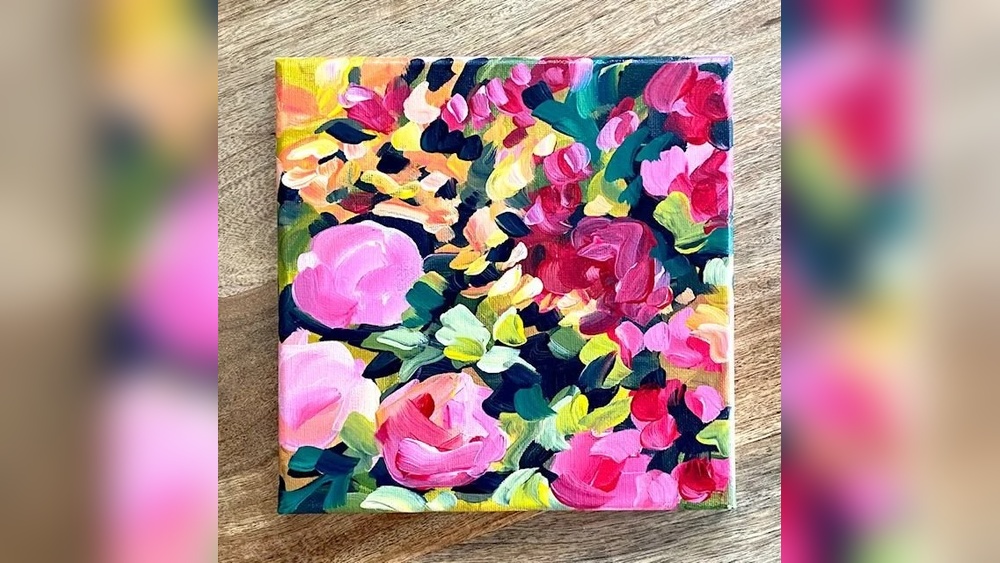
Quick answer: Loose floral acrylic painting means suggesting flowers with a few confident brushstrokes instead of drawing every petal. Thin your acrylics to a creamy, flowing consistency, block in each bloom as a simple shape with a large brush, vary edges between soft and sharp, and stop before you add detail everywhere. Working on a damp surface or with a slow-drying medium gives you the extra open time that loose, blended petals need.
Loose florals look effortless, which is exactly why they are hard. A painting that seems to have taken ten minutes often hides a lot of decisions: which petals to leave out, where to let colors bleed, and when to put the brush down. The good news is that those decisions can be learned, and acrylic paint is a forgiving medium for practicing them because you can paint over anything that does not work.
This guide breaks loose floral acrylic painting into clear stages. You will learn how to set up your paint so it flows, how to build a flower from shapes rather than outlines, and how to handle the fast drying time that trips up many acrylic painters chasing a soft look.
What “Loose” Actually Means in Floral Painting
Loose painting is about suggestion. Rather than rendering every petal edge and vein, you give the viewer enough information to recognize a rose or a tulip, and their brain fills in the rest. A loose floral typically has:
- Large, visible brushstrokes that each describe a petal or a group of petals.
- Lost and found edges, where some outlines are crisp and others melt into the background.
- Limited detail, usually concentrated at the focal flower’s center.
- Color moving freely, sometimes spilling past the flower’s form.
- Negative space that lets the painting breathe.
Tight painting is not wrong; it is just a different goal. Loose florals aim for energy and atmosphere over botanical accuracy.
Why Acrylic Is Tricky for Loose Work (and How to Fix It)
Acrylic paint dries quickly because it relies on water evaporating from a polymer emulsion. Fast drying is helpful when you want to layer, but loose florals often rely on soft blends between colors, and those blends need wet paint. Three adjustments solve most of the problem:
- Thin the paint. Creamy, fluid paint moves more freely and blends more easily than stiff paint straight from a heavy body tube.
- Extend drying time. A slow-drying or retarder medium mixed into the paint, according to the label’s ratio, gives you more working time.
- Keep the surface damp. Misting the canvas lightly with a spray bottle, or wetting the paper first, keeps paint workable longer.
Paint quality plays a part as well. Highly pigmented paints stay vivid when thinned with water or medium, while some budget paints turn weak and streaky. If you are unsure where your current set falls, our breakdown of acrylic paint brands by pigment strength and flow is a useful reference.
Fluid acrylics are particularly well suited to loose florals because they flow like heavy cream right out of the bottle. If you want to understand how fluid paint behaves before buying, our Daler-Rowney fluid acrylic paint review describes one widely available line.
Materials for Loose Floral Acrylic Painting
| Item | Recommended type | Why |
|---|---|---|
| Paint | Soft body or fluid acrylics, or heavy body thinned with medium | Flows easily for one-stroke petals |
| Brushes | Large round (size 10 to 14), filbert (size 8 to 12), small rigger | Round for petals, filbert for leaves, rigger for stems |
| Surface | Canvas board, primed panel or heavy mixed-media paper | Smooth surfaces let strokes glide |
| Medium | Glazing or slow-dry medium | Adds transparency and open time |
| Spray bottle | Fine mist | Keeps paint and palette moist |
| Stay-wet palette | Sealed tray with damp sponge and membrane paper | Stops paint drying on the palette |
| Paper towels | Lint-free | Control water in the brush and lift paint |
The brush matters more than usual. A large round with a fine point can make a broad petal stroke when pressed and a fine line when lifted, which is the core move of loose florals. Soft synthetic brushes designed for acrylic hold more fluid paint than stiff bristle brushes.
Choosing a Color Palette for Loose Florals
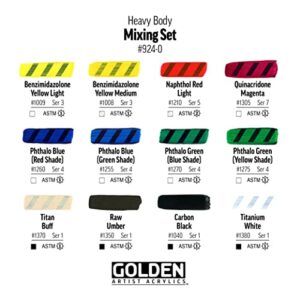
Clean color is the backbone of a fresh floral. Mixing too many pigments together creates mud, and muddy color reads as tired. A limited palette helps.
A Simple Starter Palette
- Titanium white
- A warm red (such as a cadmium red hue)
- A cool pink-red (such as quinacridone magenta)
- A lemon or cool yellow
- A blue (ultramarine works well)
- A green or a yellow and blue you can mix into green
- Payne’s gray or a dark you can mix from complements
Transparent pigments, such as quinacridones and phthalos, keep their glow when thinned and layered. Opaque pigments, such as cadmiums and titanium white, cover well and are good for final highlights. Mixing a little white into every color can make the painting look chalky, so add white sparingly and only where you want opacity or pastel tints.
Color Harmony Ideas
- Analogous: pinks, magentas and violets with soft green leaves.
- Complementary: orange blooms against a blue-violet background.
- Monochrome: one hue in many values, for an elegant, calm piece.
Step-by-Step: Painting a Loose Floral in Acrylic
This sequence works for most flowers, from peonies to poppies. A simple bouquet of three blooms is a good first project.
Step 1: Study the Flower’s Basic Shape
Before painting, look at your reference and identify the overall shape of each bloom. A rose head is roughly a ball, a tulip is a cup, a daisy is a flat disk, and a lily is a star. Lightly sketch these shapes with a watercolor pencil or a thinned paint line, keeping it minimal. You are planning placement, not drawing petals.
Step 2: Plan the Composition
Group flowers in odd numbers and vary their sizes. Place the largest bloom slightly off center as the focal point. Let at least one stem or leaf run off the edge of the canvas, which makes the arrangement feel like it continues beyond the frame.
Step 3: Paint a Soft Background Wash
Thin one or two light colors with water or medium and brush them loosely across the background, letting them blend wet into each other. Leave some areas lighter. While this layer is still damp, you can drop color into the flower areas so their edges blur softly into the background.
Step 4: Block in Each Bloom With Big Strokes
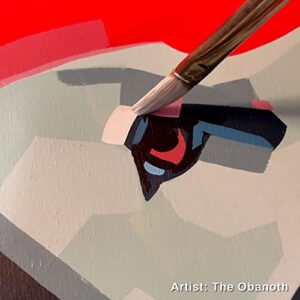
Load a large round brush with a mid-value color for the flower. Press the brush down so the belly spreads, then lift as you pull, forming a petal shape in one movement. Work from the center outward, placing petals in a loose ring. Do not fill the entire shape solidly. Gaps where the background shows through give the flower lightness.
Turn the brush as you stroke to create curved petals, and vary pressure for thick and thin edges. Each stroke should do one job; resist dabbing over it.
Step 5: Add Depth While Paint Is Wet
While the first strokes are still damp, drop a darker version of the flower color near the center and at the base of petals, where shadows sit. Let it bleed slightly. This creates a soft gradient that suggests form without hard lines.
Step 6: Paint Leaves and Stems Loosely
Use a filbert for leaves. Press, pull and lift in one stroke, angling the brush to create a pointed tip. Vary leaf greens by mixing in a bit of blue for cool shadows and yellow for warm highlights. Use a rigger brush for thin stems, moving quickly so the line looks lively rather than stiff.
Step 7: Sharpen a Few Edges
Once the first layers are dry, decide where you want crisp definition. Typically this is the edge of the focal bloom where it meets a contrasting background, or the very center of the flower. Use a smaller brush and slightly thicker paint to define a few petal edges. Leave most edges soft.
Step 8: Add Highlights and Accents
Add a few light strokes with thicker, more opaque paint on the petals nearest the light source. A handful of tiny dots or flicks of a contrasting color, such as yellow stamens or splatters of the flower color, can add energy. Stop while the painting still feels fresh.
Loose vs. Tight: A Quick Comparison
| Aspect | Loose floral | Tight or botanical floral |
|---|---|---|
| Brushwork | Large, visible strokes | Small, blended strokes |
| Edges | Mix of soft and sharp | Mostly crisp |
| Detail | Concentrated at focal point | Even across the painting |
| Time | Often faster per piece | Usually slower |
| Brush size | Larger than feels comfortable | Small to medium |
| Goal | Mood, movement, light | Accuracy, realism |
Exercises to Loosen Up Your Brushwork
Looseness is a habit, and habits come from repetition. These short drills build it faster than finished paintings do.
- Single-stroke petals: fill a page with petals made in one movement each. No corrections allowed.
- Timed flowers: paint a bloom in five minutes, then three, then one. Time pressure forces you to leave out detail.
- Big brush only: paint an entire flower using a brush that feels too large. You physically cannot fuss.
- Stand up: paint at an easel with your arm extended. Movement from the shoulder creates freer marks than movement from the wrist.
- Hold the brush far back: gripping the end of the handle reduces control in a useful way.
- Squint at the reference: squinting simplifies shapes into masses of light and dark.
Common Mistakes in Loose Floral Acrylic Painting
Overworking
The most common problem. Every extra stroke on a petal reduces freshness. Set a rule: one stroke per petal, two at most.
Outlining Everything
Drawing a dark line around each petal makes flowers look like coloring book pages. Let value changes, not outlines, separate shapes.
Too Much Detail Everywhere
When every flower has the same level of detail, nothing stands out. Detail the focal bloom and let the others become simpler as they move away.
Muddy Color
Rinse your brush often, change your water when it turns cloudy, and avoid mixing more than two or three pigments in one stroke.
Paint Too Thick or Too Dry
Stiff paint drags and leaves broken strokes. If your brush skips, add a few drops of water or medium to your paint and mist the surface.
Tips for Different Flowers
| Flower | Basic shape | Loose approach |
|---|---|---|
| Rose | Ball or cup | Dark spiral center, broad C-shaped strokes outward |
| Peony | Large ruffled ball | Many overlapping strokes, soft edges, strong center shadow |
| Tulip | Cup or egg | Three to five long petal strokes, sharp tip edges |
| Poppy | Shallow bowl | Wide crinkled petals, dark center dots |
| Daisy | Flat disk | Quick radiating strokes, yellow center dabbed last |
| Hydrangea | Dome of small florets | Dabbed clusters of color, suggest only a few florets in detail |
Finishing and Protecting Your Painting
Let the painting dry fully, ideally a few days if you used thicker accents. If you want a uniform sheen, apply an isolation coat (a clear acrylic gel medium thinned with water) followed by a varnish. Gloss varnish deepens darks and makes colors look richer; satin and matte varnishes reduce glare. Paintings on paper can be framed under glass instead of varnished.
FAQs
Can you paint loose florals with heavy body acrylic?
Yes, but thin it first with a fluid or glazing medium so it flows. Straight from the tube, heavy body paint drags and makes one-stroke petals difficult.
How do I keep acrylics wet longer for blending petals?
Use a slow-drying medium, mist your surface and palette with water, and work on a stay-wet palette. Painting in a cool, humid room also slows drying.
What brush is best for loose floral acrylic painting?
A large round brush with a sharp point is the most versatile, because pressure changes create both broad petals and fine lines. A filbert for leaves and a rigger for stems complete a basic set.
Should I sketch before painting loose flowers?
A light, minimal sketch of bloom placement is helpful. Avoid drawing petal outlines, since you will feel compelled to fill them in tightly.
Why do my loose florals look messy instead of loose?
Usually because there is no clear focal point or value structure. Loose paintings still need a strong light-dark plan and one area of detail to anchor the eye.
How long does it take to learn loose floral painting?
It varies by person, but regular short practice sessions with timed exercises tend to build looseness faster than occasional long paintings.
Final Thoughts
Loose floral acrylic painting rewards confidence over control. Thin your paint so it flows, use bigger brushes than feel natural, place each petal stroke once, and save your detail for a single focal point. Everything else can stay suggested.
Because loose florals depend so much on how paint flows and how pure the colors stay when thinned, your paint choice has a visible effect on the result. Our guide to the best acrylic paint brands for clean, vibrant color compares fluid and soft body options that suit this style, along with the differences between student and artist-grade pigments.