
PaintingProGuide is reader-supported. When you buy through links on this page we may earn an affiliate commission at no extra cost to you.
Resin is heavy, it self-levels, and it cures into a rigid, glossy shell. Those three facts decide which canvas works. A thin stretched canvas sags in the middle under a flood coat, so resin pools toward the center and cures thicker there than at the edges. A flimsy paper-core panel can bow as resin cures. The best canvas for resin art is therefore a rigid, flat support: canvas panels with an MDF core for small pieces, or stretched canvas that you brace from behind before pouring. The surface should be primed and sealed so resin sits on top rather than soaking into the fibers.
Quick answer: For most small resin pieces, the Simetufy 12-pack of 8×10 cotton panels on MDF is the best choice: MDF instead of recycled paper, so the panel stays flat under a resin coat. For a larger bulk supply on the same idea, the BAKEYBA 40-pack of triple-primed 8×10 boards gives you plenty of pieces to experiment with. If you want stretched canvas for wall-ready resin art in several sizes, the GOTIDEAL 14-piece stretched set works, as long as you support the back during the pour.
One honest note before the picks: our product data for this query contained only canvas boards and stretched canvas, not wood resin panels or cradled boards, which many resin artists prefer for heavy pours. The canvas products below work well for resin when used correctly, and we explain how.
What Resin Needs From a Canvas
Rigidity
Resin is far heavier than paint. A flood coat on a 12×12 stretched canvas can make the center dip enough that resin flows inward. Rigid MDF panels avoid this entirely. If you use stretched canvas, wedge a piece of cardboard, foam board or a cut-to-size board into the back so the canvas is supported across its whole area.
A flat, level surface
Resin self-levels to whatever the surface is doing. Work on a level table, check with a spirit level, and use a panel that is not warped.
Sealing the surface
Raw or lightly primed canvas can absorb resin and trap air, which rises as bubbles. A coat of acrylic gesso or a thin seal coat of resin first reduces this. Paintings underneath resin should be completely dry.
Edges
Resin runs off the edges unless you dam them with tape. Panels have thin edges that are easy to tape; stretched canvas edges can be coated for a wrapped look.
Backing and hanging
Cured resin adds weight. Stretched canvas hangs on its frame; panels need a frame or hanging hardware glued to the back.
Heat and timing
Resin cures by chemical reaction, and most systems are sensitive to room temperature. Follow the resin maker’s guidance on mixing ratio, temperature and cure time; that matters more than any canvas choice.
Our Top Picks at a Glance
- Simetufy 12 Pack 8×10 Canvas Boards, MDF Core — Best overall canvas for resin art
- BAKEYBA 40 Pack 8×10 Canvas Boards, Triple Primed — Best bulk boards for practice pours
- FIXSMITH 2 Pack 8×10 Canvas Boards, MDF — Best small trial pack
- GOTIDEAL 14-Piece Stretched Canvas Set — Best stretched canvas for wall pieces
- CONDA 12 Pack 8×10 Canvas Panels, 4 mm — Best panels listed for pouring
- GOTIDEAL 10 Pack 8×10 Canvas Boards — Best heavily primed boards
- ESRICH 5 Pack 8×10 Canvas Boards — Best budget starter boards
| Product | Best For | Key Spec | Key Strength | Price Tier |
|---|---|---|---|---|
| Simetufy 12 Pack | Small resin pieces | 12 x 8×10, 100% cotton, MDF core, acid-free | Rigid, flat support | $ |
| BAKEYBA 40 Pack | Practice and series | 40 x 8×10, cotton, triple gesso primed | Large count | $$ |
| FIXSMITH 2 Pack | Trial pieces | 2 x 8×10, triple primed, acid-free MDF | MDF in a small pack | $ |
| GOTIDEAL 14-Piece Stretched | Wall-ready pieces | Sizes 4×4 to 11×14, cotton on wood frame | Hangs without frame | $$ |
| CONDA 12 Pack | Pours on panels | 12 x 8×10, 4 mm thick, cotton, acid-free gesso | Pouring listed | $ |
| GOTIDEAL 10 Pack | Smooth surface | 10 x 8×10, 10 oz acid-free gesso | Heavy priming | $ |
| ESRICH 5 Pack | Budget start | 5 x 8×10, cotton, board core | Lowest upfront cost | $ |
How We Chose
We chose these canvases from the Amazon listing details and specifications checked in October 2026, by how well each product’s core material, rigidity, priming and format suit resin, and by how widely each product is reviewed by Amazon buyers. We have not poured resin on these surfaces. Core materials and priming are reported as listed; where a listing does not specify the core, we say so.
- Rigid core: MDF panels ranked above unspecified board cores.
- Priming: acid-free gesso, ideally triple primed.
- Flatness: listings stating warp resistance.
- Format: panels for flat pours, stretched canvas for wall pieces.
- Pack size for practice, since resin has a learning curve.
Best Canvas for Resin Art Reviewed
1. Simetufy 12 Pack 8×10 Canvas Boards, MDF Core — Best for small resin pieces

Simetufy’s panels are 100 percent cotton, acid-free and primed with acrylic, glued to a sturdy MDF core. The listing specifically contrasts MDF with recycled paper and says the panels will not curl, bend or warp.
For resin, MDF is the important detail. It stays flat under the weight of a flood coat and does not soften if a little resin seeps around the edge. An 8×10 panel is a comfortable size to learn on: big enough to see how resin flows, small enough that a mistake costs little.
Panels this thin are also easy to dam with tape around the edges or to mount in a frame once cured.
Best suited for: Resin artists making small pieces, coasters-style panels and practice pours.
Key features:
- 12 panels at 8×10
- 100% cotton, acid-free
- Acrylic primed
- MDF board core
Pros:
- Rigid and flat
- Low cost per panel
- Easy edge taping
Cons and limitations:
- Single size
- Needs framing or hanging hardware
Buying consideration: Seal the panel with a thin coat of gesso or a seal coat before your main pour to reduce bubbles.
2. BAKEYBA 40 Pack 8×10 Canvas Boards, Triple Primed — Best for practice pours and series

BAKEYBA’s bulk pack includes forty 8×10 canvas boards in 100 percent cotton, triple gesso primed for a smooth finish that the listing says resists cracking. The boards are acid-free and ready to use.
Resin rewards practice. Color mixing, cell effects, layering and doming all take repetitions, and forty boards let you work through a series without rationing. The triple priming gives a smooth, sealed surface.
The listing does not state the core material, so check flatness before each pour and support boards on a level surface.
Best suited for: Resin artists who want lots of boards for practice and series work.
Key features:
- 40 boards at 8×10
- 100% cotton
- Triple gesso primed
- Acid-free
Pros:
- Very large count
- Smooth primed surface
- Low cost per board
Cons and limitations:
- Core material not stated
- Single size
Buying consideration: Pour on a level table and check each board with a small level before mixing resin.
3. FIXSMITH 2 Pack 8×10 Canvas Boards, MDF — Best for trial pieces

FIXSMITH’s two-pack uses unwashed 100 percent cotton, triple primed with acid-free gesso, glued over acid-free MDF boards. The listing says the boards will not bend or curl even with heavy paint application.
A two-pack is a low-commitment way to try resin over a painting before buying in bulk. MDF gives the same flatness as the Simetufy boards.
Best suited for: First-time resin artists testing a technique.
Key features:
- 2 boards at 8×10
- Unwashed 100% cotton
- Triple primed, acid-free
- Acid-free MDF core
Pros:
- MDF rigidity
- Small trial pack
- Very low upfront cost
Cons and limitations:
- Only two boards
Buying consideration: Use one board to test and the second for your real piece.
4. GOTIDEAL 14-Piece Stretched Canvas Set — Best for wall-ready resin pieces
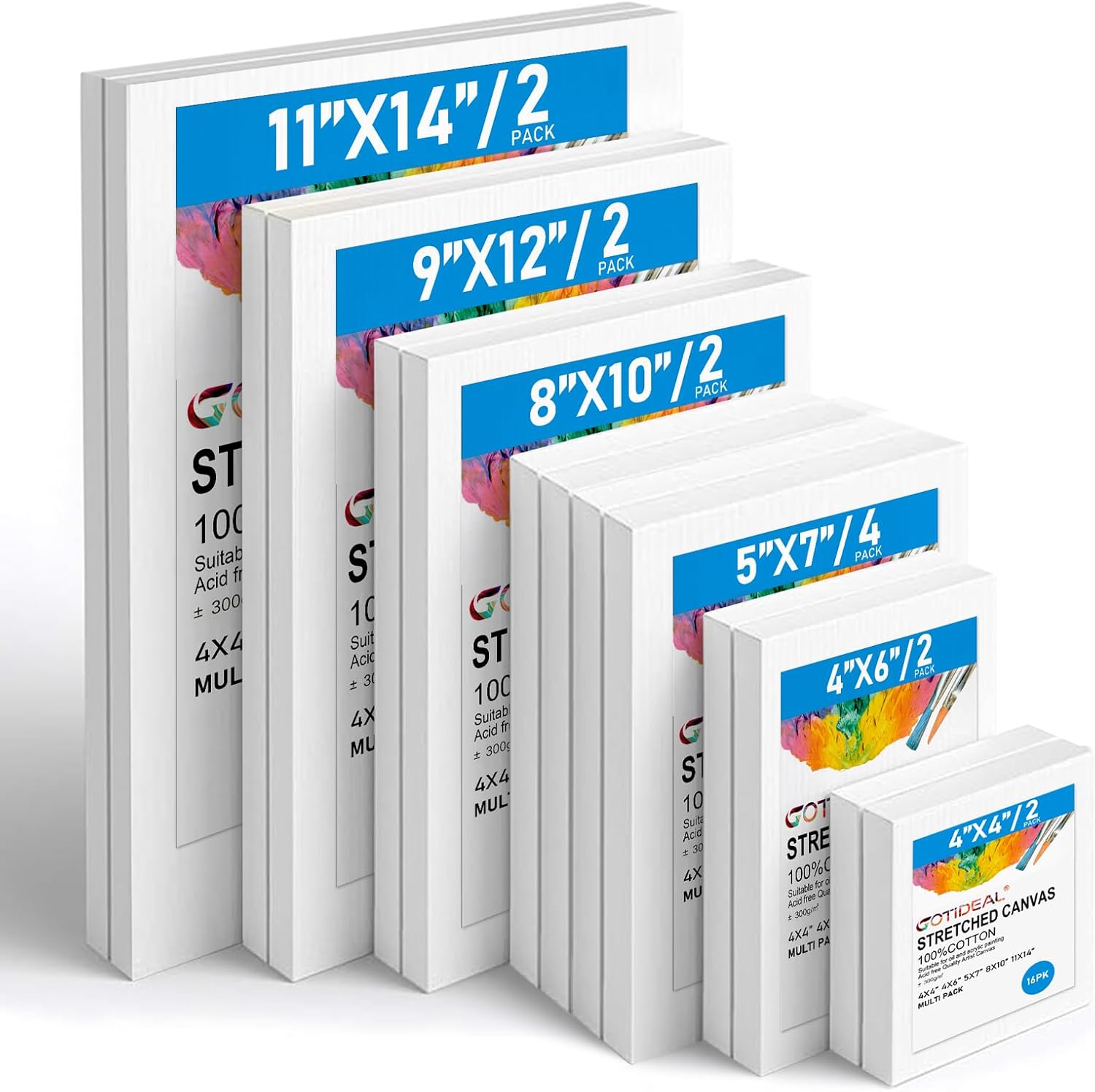
GOTIDEAL’s stretched set includes canvases at 4×4, 5×7, 8×10 and 11×14 (two each), plus four more 5x7s, in 100 percent cotton with a medium grain, primed with acid-free acrylic gesso and nailed to a wood frame.
Stretched canvas is the right choice when you want resin art that hangs without a frame and shows glossy, resin-coated edges. The catch is sag. Before pouring, cut a piece of cardboard or foam board to fit inside the back of the frame so it presses against the canvas and supports it.
The small sizes, 4×4 and 5×7, sag the least and are a good place to learn.
Best suited for: Resin artists who want stretched pieces with coated edges for hanging.
Key features:
- 14 stretched canvases, 4×4 to 11×14
- 100% cotton, medium grain
- Acid-free acrylic gesso
- Wood frames
Pros:
- Wall-ready
- Several sizes
- Coated edges possible
Cons and limitations:
- Needs back support to prevent sag
- Medium grain may show through thin resin
Buying consideration: Support the back with a snug insert and tape the underside of the frame to catch drips.
5. CONDA 12 Pack 8×10 Canvas Panels, 4 mm — Best for pours on panels

CONDA’s panels are 100 percent cotton, primed with acid-free acrylic gesso, 4 mm thick and vacuum packed. The listing names acrylic, pouring, watercolor and oil and says the panels are not easily deformed or warped.
Pouring is listed directly, which suggests the maker expects fluid media. The 4 mm thickness gives a bit more rigidity than very thin boards.
Best suited for: Artists combining acrylic pours with a resin topcoat.
Key features:
- 12 panels at 8×10
- 4 mm thick
- 100% cotton
- Acid-free acrylic gesso
- Vacuum packed
Pros:
- Pouring listed
- Thicker panel
- Mid-size pack
Cons and limitations:
- Core material not specified
Buying consideration: Let acrylic pours dry completely, often several days, before adding resin.
6. GOTIDEAL 10 Pack 8×10 Canvas Boards — Best for a heavily primed surface
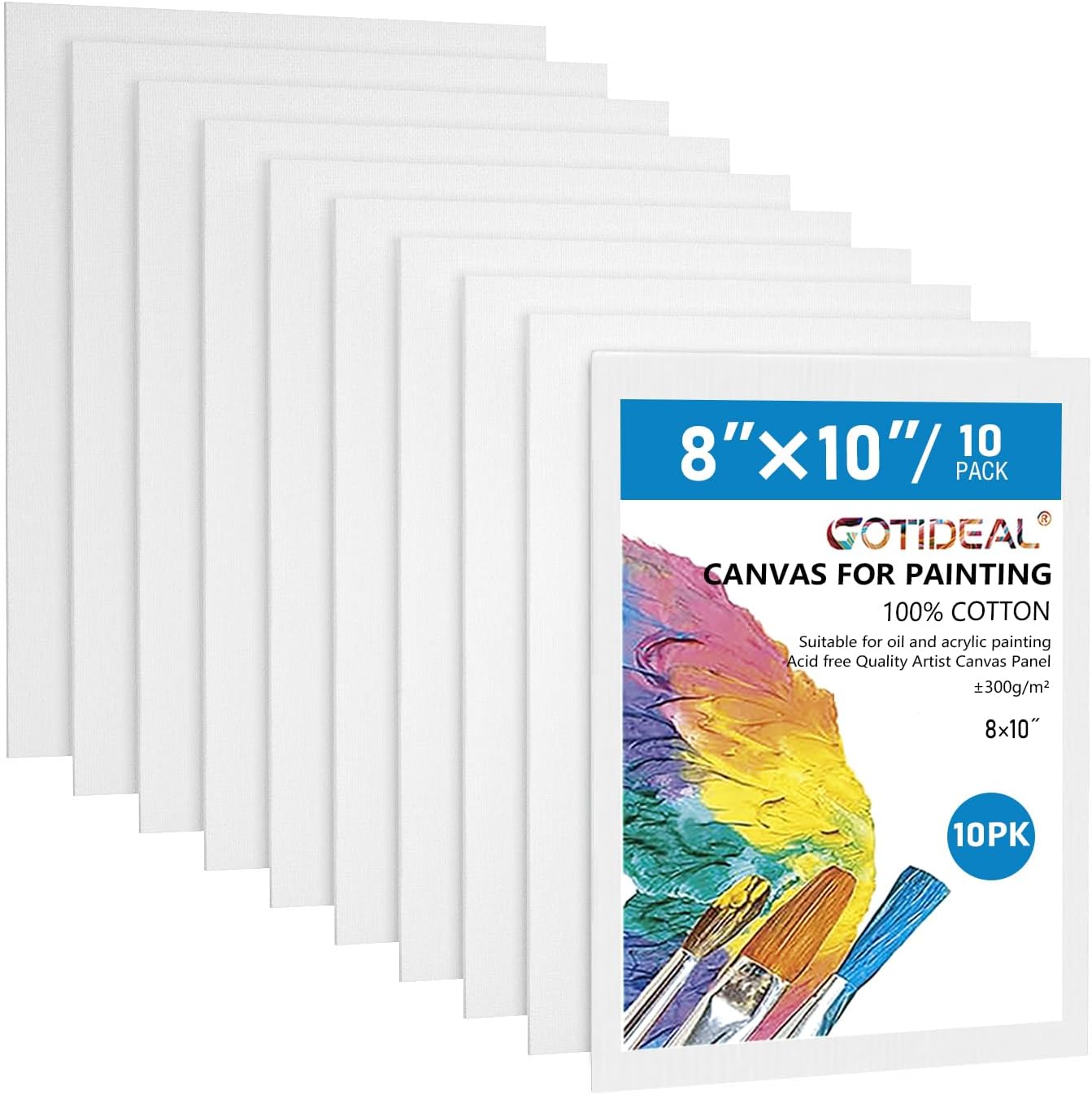
GOTIDEAL’s board pack contains ten 8×10 panels primed with 10 oz of acid-free acrylic gesso, according to the listing. The cotton has a medium grain and the boards suit oil, watercolor, acrylic, pastel, tempera and gouache.
Heavy priming helps with resin because a well-sealed surface absorbs less and traps less air.
Best suited for: Artists who want a well-sealed board for resin over paint.
Key features:
- 10 boards at 8×10
- 10 oz acid-free gesso
- 100% cotton, medium grain
Pros:
- Heavily primed
- Low price tier
- Versatile
Cons and limitations:
- Core not specified
- Medium grain texture
Buying consideration: Sand lightly between extra gesso coats if you want glass-smooth results.
7. ESRICH 5 Pack 8×10 Canvas Boards — Best for a budget start

ESRICH’s five-pack uses pure cotton canvas with a non-toxic, acid-free primer over a sturdy board core that the listing says resists deformation, and names pouring among its uses.
It is the least expensive way to try resin on canvas, though the core type is not specified.
Best suited for: Beginners trying resin for the first time.
Key features:
- 5 boards at 8×10
- Pure cotton
- Acid-free primer
- Board core
Pros:
- Lowest upfront cost
- Pouring listed
Cons and limitations:
- Core type not stated
- Small pack
Buying consideration: Test one board with a thin coat before a full pour.
How to Prepare Canvas for Resin
- Finish and fully dry any painting underneath. Acrylic should cure for at least a day or longer for thick layers.
- Add a coat of gesso or a thin seal coat of resin to reduce bubbles.
- Support stretched canvas from behind with a snug insert.
- Tape the edges if you want clean sides, or plan to coat them.
- Raise the piece on cups or a stand so drips fall away, and cover the table.
- Level the piece with a spirit level.
- Mix and pour according to the resin maker’s instructions, then cover against dust while it cures.
Popular Resin Techniques on Canvas
Clear coat over a painting
A single flood coat of clear resin over a finished acrylic painting gives a deep, glass-like finish and intensifies colors. This is the simplest resin technique and a good first project on a small MDF panel.
Ocean and geode pours
Tinted resins are poured in bands and pushed with a heat tool to create waves, lacing and cells. These pours use a lot of resin and run off the edges, so rigid panels raised on cups work best.
Layered resin
Thin layers of resin with painted or collaged elements between them create depth. Each layer needs to cure before the next, so plan for several days.
Buying Guide: How to Choose Canvas for Resin
Choose rigidity
MDF-core panels are the easiest canvas for resin. Stretched canvas needs back support.
Check priming
Well-primed or triple-primed canvas absorbs less resin and traps fewer bubbles.
Size
Start small. Larger pieces need more resin, more leveling care and more support.
Display plan
Panels need frames or hangers; stretched canvas hangs on its frame.
Quantity
Buy enough for practice; resin techniques take repetitions.
Consider alternatives
For heavy pours and large works, many resin artists use wood panels or cradled boards. Canvas works well for small to medium pieces.
Related Canvas Projects
Resin pairs well with bold designs. For ideas, see our guides to painting a multi-canvas wall art set, painting a quote on canvas and creating all-black canvas art, which looks striking under a glossy resin coat.
Common Mistakes to Avoid
- Pouring resin on unsupported stretched canvas and getting a pooled center.
- Pouring on a surface that is not level.
- Coating a painting that is not fully dry.
- Skipping a seal coat and fighting bubbles.
- Forgetting to protect the table and the underside of the canvas.
- Working in a cold room where resin cures poorly.
FAQs
Can you put resin on canvas?
Yes. Rigid canvas panels work best; stretched canvas needs support from behind.
How do I stop canvas sagging under resin?
Insert a snug piece of cardboard or foam board inside the frame against the back of the canvas.
Do I need to seal canvas before resin?
A coat of gesso or a thin seal coat of resin reduces absorption and bubbles.
Is canvas board or wood better for resin?
Wood panels are more rigid for heavy pours; MDF-core canvas boards are a good option for small pieces.
Can I pour resin over acrylic paint?
Yes, once the acrylic is completely dry.
How do I get resin on the canvas edges?
Let resin flow over the sides and spread it with a gloved finger or spreader, or tape edges for clean sides.
Final Recommendation
For small resin pieces, the Simetufy MDF-core boards are the most reliable canvas choice, with FIXSMITH’s MDF two-pack as a trial. Choose BAKEYBA’s 40-pack for plenty of practice boards and CONDA or GOTIDEAL’s heavily primed boards as alternatives. For wall-ready resin art with glossy edges, use the GOTIDEAL stretched set and support the back of each canvas before you pour. ESRICH’s five-pack is the cheapest way to start.





2 Comments