
PaintingProGuide is reader-supported. When you buy through links on this page we may earn an affiliate commission at no extra cost to you.
Old Holland vs Michael Harding is a comparison between two of the most respected premium oil paint makers in the world, and both are excellent. Old Holland is a Dutch maker with roots going back to the 1600s, known for densely pigmented, stiff-bodied paint and an extensive range of historic and unusual colors. Michael Harding is a British brand founded by a working painter, known for intensely pigmented, buttery paint and a carefully curated range that includes some rare and historic pigments.
The right choice depends less on “which is better” and more on how you paint: the body you prefer straight from the tube, which specific colors you need, how much you want to spend per tube, and how easy each brand is to buy in the US. This guide breaks those differences down so you can choose with confidence, or decide which colors to buy from each.
Quick answer: Choose Old Holland if you want a stiff, heavily loaded paint that holds knife marks and impasto, and you value an unusually broad range of historic colors. Choose Michael Harding if you prefer a smoother, more buttery paint that brushes out easily while still delivering very strong color. Many professionals mix brands, buying each maker’s standout colors rather than committing to one. To try both on Amazon, the Old Holland Classic Oil Introductory Box Set and the Michael Harding Introductory Oil Paint Set are the most direct way to compare them side by side.
Our Top Picks at a Glance
- Old Holland Classic Oil Colours — Best for stiff body, impasto and historic color range
- Michael Harding Artist Oil Colours — Best for buttery handling and strong tinting color
Old Holland vs Michael Harding at a Glance
| Factor | Old Holland | Michael Harding |
|---|---|---|
| Origin | Netherlands; company history traces to 1664 | United Kingdom; founded in the early 1980s by painter Michael Harding |
| Typical body | Stiff, dense, often described as heavy | Buttery, smooth, slightly softer |
| Pigment load | Very high; known for strong saturation | Very high; known for strong tinting strength |
| Color range | Very large, with many historic and unusual colors | Curated range, including several rare and historic pigments |
| Fillers | Brand emphasizes pigment-rich formulation | Brand emphasizes minimal or no fillers |
| Price position | Premium; some colors among the most expensive available | Premium; generally slightly below Old Holland for comparable colors |
| US availability | Specialist art retailers; selection can vary | Specialist art retailers; widely stocked by major online shops |
| Best suited to | Impasto, knife work, painters who like to control oil content | Alla prima, blending, painters who want paint ready to use |
| Product | Best For | Key Spec | Key Strength | Price Tier |
|---|---|---|---|---|
| Old Holland Classic Oil Colours | Impasto and historic palettes | Stiff body, very high pigment load | Huge color range | $$$ |
| Michael Harding Artist Oil Colours | Blending and alla prima | Buttery body, strong tinting | Clean, intense mixes | $$$ |
How We Chose
We did not paint with these paints for this comparison. The Amazon sets and tubes linked later on this page were chosen from listing details checked in October 2026, not from studio use. Our comparison is based on each brand’s published information and well-established characteristics widely reported by painters and retailers. Exact color counts, prices and formulations change over time, so check current color charts before buying.
- Handling: body straight from the tube and how it brushes, blends and holds marks.
- Pigment strength: saturation and tinting strength in mixtures.
- Color range: breadth of the line and availability of single-pigment and historic colors.
- Transparency of information: pigment codes, lightfastness and oil content on labels.
- Value: price relative to how far the paint stretches in mixtures.
- Availability: how easy it is to find colors in the US.
Old Holland: Dense, Traditional and Vast
Old Holland Classic Colours is one of the oldest names in artists’ oil paint. The company traces its history to 1664 in the Netherlands and positions itself as a maker of traditional, pigment-rich oil colors ground in linseed oil. Painters most often describe Old Holland as stiff and dense: it can feel almost like clay compared with student paint, and some colors are notably firmer than others.
That stiffness is a feature for some painters. It holds palette knife marks and impasto beautifully, and it lets you decide how much oil or medium to add rather than starting with a loose paste. For alla prima painters who like paint to flow off the brush, it can feel like hard work without a little medium.
The range is a major draw. Old Holland offers a very large selection, including many historic, mineral and unusual colors that are hard to find elsewhere, and a number of convenience mixtures with distinctive names. That breadth makes it popular with painters building a specific historical palette or looking for a hue no other brand makes.
Old Holland strengths
- Very high pigment load and rich saturation
- Stiff body ideal for impasto and knife painting
- One of the broadest color ranges on the market
- Long heritage and traditional manufacture
Old Holland limitations
- Among the most expensive oil paints, especially for cadmiums, cobalts and rare pigments
- Stiffness may require medium for fluid brushwork
- Body varies noticeably from color to color
- Selection at US retailers can be patchy
Michael Harding: Buttery, Intense and Curated
Michael Harding founded his company as a painter making paint for himself, and the brand has built a reputation for intensely pigmented, buttery oil colors. The brand emphasizes high pigment content with minimal or no fillers, and many painters notice how strongly its colors tint mixtures: a little goes a long way.
The body is typically softer and smoother than Old Holland, ready to use from the tube for blending and alla prima work, while still holding brushmarks well. The range is curated rather than exhaustive, but it includes several distinctive and historic pigments, and the core palette covers everything most painters need.
Michael Harding strengths
- Very strong tinting strength; paint stretches far in mixtures
- Smooth, buttery handling straight from the tube
- Clean, intense color with clear pigment information
- Widely stocked by major US online art retailers
Michael Harding limitations
- Premium pricing, though often slightly below Old Holland
- Smaller range than Old Holland
- Softer body may need a stiffening medium for heavy impasto
Head-to-Head Comparison
Handling and body
This is the clearest difference. Old Holland tends to be stiff and dense; Michael Harding tends to be buttery and smooth. If you paint thick, sculptural passages with a knife, Old Holland’s body is a natural fit. If you push paint around with soft brushes and blend wet-in-wet, Michael Harding usually feels easier.
Pigment strength and value
Both brands are pigment-rich. Harding’s colors are often described as having especially high tinting strength, which can offset price because you use less. Old Holland’s saturation is equally impressive, and its dense paste also means you get a lot of pigment per tube.
Color range
Old Holland wins on breadth. If you need an unusual historic color, it is more likely to have it. Michael Harding’s range is smaller but carefully chosen, and it includes some notable specialty pigments.
Consistency between colors
Because each pigment behaves differently in oil, every brand has some variation. Old Holland is often noted for larger differences in stiffness between colors. Harding is generally perceived as more uniform in feel across the range.
Drying
Drying time depends on pigment and oil more than brand. Earth colors and those containing lead or cobalt usually dry faster; some cadmiums and blacks dry more slowly. Check each brand’s technical information for specific colors if drying time matters to your process.
Price
Both are premium. Prices vary by series, with cadmium, cobalt and rare mineral pigments costing the most. Compare the specific colors you need rather than general brand pricing.
What You Are Actually Paying For in Premium Oil Paint
The jump from student oils to brands like Old Holland and Michael Harding is mostly about pigment. Student paints often use less pigment, more fillers such as extenders and stabilizers, and cheaper “hue” substitutes for costly pigments like cadmium and cobalt. Premium makers use more pigment per tube and, in most colors, the genuine pigment named on the label.
That has practical effects at the easel. Colors hold their intensity when mixed with white instead of turning chalky. Transparent pigments stay clear in glazes. Thin layers still cover. And because each tube holds more color, you often use less paint than you expect, which narrows the real cost gap.
Oil choice matters as well. Linseed oil is the traditional binder and dries to a strong, flexible film, though it can yellow slightly over time, particularly in whites kept away from light. Some makers grind certain whites and pale colors in other oils, such as safflower or poppy, to reduce yellowing. Check each brand’s labels or technical sheets if this matters for your work.
Finally, you are paying for consistency and information: batch-to-batch reliability, clear pigment codes and lightfastness ratings. For painters selling work or exhibiting, that transparency is a big part of the value.
Whites and Earths: Where Differences Show Most
If you only test two colors when comparing brands, make them a white and an earth. White is the color you use most, and its body affects every mixture on your palette. A stiff white makes all your tints stiffer; a soft white makes them looser. Try both brands’ titanium white and see which feels right with your brushes and medium.
Earth colors such as yellow ochre, raw sienna and burnt umber are inexpensive pigments, so the price difference between premium brands is smaller here. They also reveal handling differences clearly because earths are usually heavily loaded. Many painters find that this is where they first develop a brand preference.
Blues and reds are where tinting strength shows. A tiny amount of a strong ultramarine or alizarin replacement can overpower a pile of white, so mix cautiously with any premium paint until you learn its strength.
Getting the Most From Premium Tubes
Squeeze out small amounts at first, especially of expensive colors; premium paint goes further than student paint. Keep tube threads clean and caps tight so paint does not dry at the neck. Store tubes at room temperature away from heat. If a tube seems oily when you first open it, knead it gently before squeezing so the oil and pigment remix. And keep notes on which brand you used for each color in a painting, which helps with touch-ups and consistent results across a series.
Mediums and Grounds That Suit Each Brand
Premium paint deserves a surface and medium that let it perform. Because Old Holland is stiff, a small amount of a fluid medium, such as a linseed-based painting medium or a solvent-free alkyd medium, loosens it for brushwork without diluting its strength. Add medium a little at a time, and remember the fat-over-lean rule: each layer should be equal to or slightly more flexible (more oil) than the one beneath it.
Michael Harding’s buttery body usually needs no medium for alla prima work. If you want to build heavier texture, a gel or impasto medium will stiffen it while keeping color intensity. For glazes with either brand, a dedicated glazing medium improves flow and transparency.
Grounds matter too. A smooth, oil-primed linen or a gessoed panel shows off saturated color and fine detail. A slightly absorbent acrylic gesso ground drinks a little oil from the first layer, which can make paint feel stiffer and drier at first; tone it with a thin wash before painting if you notice drag. Whatever ground you use, keep it consistent when comparing brands so you are judging the paint and not the surface.
Verdict by Use Case
- Impasto and palette knife painting: Old Holland.
- Alla prima and wet-in-wet blending: Michael Harding.
- Building a historic or unusual palette: Old Holland for its range.
- Painters who want maximum tinting per dollar: Michael Harding.
- Glazing: either; choose transparent single-pigment colors and use a glazing medium.
- Students stepping up from student grade: Michael Harding’s handling is usually easier to adapt to.
Old Holland and Michael Harding Sets on Amazon
Comparing these two brands is easiest with paint on your own palette. Below are Old Holland and Michael Harding listings available on Amazon, chosen from listing details checked in October 2026 for how well each format lets you judge the brand: sets for a full test, and a single white for a low-cost trial. We have not painted with these specific products.
| Product | Best For | Key Spec | Price Tier |
|---|---|---|---|
| Old Holland Classic Oil Introductory Box Set (10 x 40ml) | A full working palette in Old Holland | Ten 40ml tubes | $$$ |
| Old Holland Classic Oil Intro Set (6 x 18ml) | Sampling Old Holland before a bigger purchase | Six 18ml tubes | $$$ |
| Old Holland Classic Oil Titanium White (40ml) | Testing the brand with the color you use most | Single 40ml tube | $$ |
| Michael Harding Introductory Oil Paint Set (Six 40ml Tubes) | A balanced starter palette in Michael Harding | Six 40ml tubes | $$$ |
| Michael Harding Plein Air Painter Set (Ten 40ml Tubes) | Painting outdoors with one brand | Ten 40ml tubes | $$$ |
| Michael Harding Desert Oil Paint Set (Ten 40ml Tubes) | Warm, earthy palettes | Ten 40ml tubes, earth-led | $$$ |
Price tiers: $ under $15, $$ $15 to $40, $$$ over $40, based on listing prices checked in October 2026. Prices change often, so confirm on Amazon.
1. Old Holland Classic Oil Introductory Box Set (10 x 40ml) — Best for a full working palette in Old Holland

This is the most practical way to judge Old Holland at a usable scale. Ten tubes at 40ml each give you enough paint to work through several canvases, so you can see how the stiff, dense body behaves under a knife, in impasto passages and when mixed with medium.
The listing describes it as an introductory box of ten Classic Oil Colors. It is a serious outlay, but it is often a cleaner comparison than buying a single tube, because you experience the brand across a spread of pigments rather than one color.
Best suited for: Painters who already work in oil and want to commit properly to testing Old Holland handling across a whole painting.
Key features:
- Ten Old Holland Classic Oil Colors
- 40ml (1.35 oz) tubes
- Presented as an introductory box set
Pros:
- Tube size large enough for real paintings, not just swatches
- Shows the brand across several pigments at once
- Box keeps the set organized
Limitations:
- High up-front cost compared with single tubes
- You do not choose the colors yourself
- Listing does not detail every color in the box
Buying consideration: Check the color list on the current listing against the palette you already use; if most colors duplicate tubes you own, single tubes may be better value.
2. Old Holland Classic Oil Intro Set (6 x 18ml) — Best for sampling Old Holland before a bigger purchase

Smaller tubes make this the lighter-commitment route into Old Holland. Six 18ml tubes are enough to feel the heavy, stiff consistency the brand is known for and to compare it directly against a tube of Michael Harding on the same palette.
It suits a study or a few small panels rather than large work. Think of it as a tasting set: if you love the body, move to 40ml single colors.
Best suited for: Curious painters who want to try Old Holland handling on small studies without paying for a full-size set.
Key features:
- Six Old Holland Classic Oil Colours
- 18ml tubes
- Listed as crack resistant
Pros:
- Lower entry cost than the 10-tube box
- Easy to compare tube-for-tube with another brand
- Compact enough for a travel kit
Limitations:
- 18ml runs out quickly on larger canvases
- Cost per ml is higher than 40ml tubes
- Preselected colors
Buying consideration: Use the set for side-by-side tests with the Michael Harding introductory set below before investing in full-size colors.
3. Old Holland Classic Oil Titanium White (40ml) — Best for testing the brand with the color you use most

White is the color most painters burn through fastest, and it is where differences in body and opacity show most clearly, as the whites section above explains. A single 40ml tube of Old Holland Titanium White is an inexpensive way to feel the brand in your own mixes.
The listing states that only cold-pressed linseed oil is used, with no artificial driers, and describes the colors as heavily pigmented with excellent covering power.
Best suited for: Painters who want to swap one key color into an existing palette and judge the difference in everyday mixing.
Key features:
- 40ml tube of Titanium White
- Cold-pressed linseed oil binder, no artificial driers (per listing)
- Described as heavily pigmented with strong covering
Pros:
- Lowest-cost way to try Old Holland
- White reveals body and opacity quickly
- Fits into any existing palette
Limitations:
- One color tells you less than a set
- Stiff white may need medium for smooth passages
- Larger sizes are better value if you like it
Buying consideration: If the stiffness suits you, the same white comes in a 225ml size on Amazon, which lowers the cost per ml for heavy users.
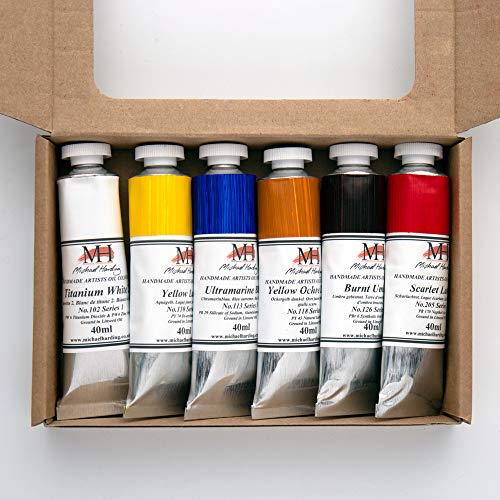
4. Michael Harding Introductory Oil Paint Set (Six 40ml Tubes) — Best for a balanced starter palette in Michael Harding

This set gives you a genuinely usable limited palette rather than a random sampler. The listing names the six colors: Titanium White No. 2, Yellow Lake, Ultramarine Blue, Yellow Ochre Deep, Burnt Umber and Scarlet Lake.
That spread covers a warm and cool bias, an earth, a transparent yellow and a strong blue, which is enough to paint full studies and to feel the buttery, brushable body the brand is known for.
Best suited for: Painters who want to try Michael Harding on complete paintings with a ready-made limited palette.
Key features:
- Six 40ml tubes
- Includes Titanium White No. 2, Yellow Lake, Ultramarine Blue, Yellow Ochre Deep, Burnt Umber and Scarlet Lake
- Listed as fade resistant
Pros:
- Colors listed clearly, so no guesswork
- Full-size tubes for real work
- Makes a coherent limited palette
Limitations:
- Premium cost for six colors
- No true green or violet in the set
- May duplicate colors you already own
Buying consideration: Pair it with the Old Holland intro set above to compare body and tinting strength color for color, especially the whites and umbers.
5. Michael Harding Plein Air Painter Set (Ten 40ml Tubes) — Best for painting outdoors with one brand

A ten-color set assembled around outdoor painting. At 40ml per tube it carries enough paint for a season of small to mid-size field studies.
The listing gives limited detail on the individual colors, so check the current color list before buying. The buttery body described for the brand tends to suit quick, direct alla prima work outside.
Best suited for: Landscape and plein air painters who want a ready-made outdoor palette from Michael Harding.
Key features:
- Ten 40ml tubes
- Colors grouped for plein air painting
- Single boxed set
Pros:
- Broader palette than the six-tube introductory set
- Tube size suits regular outdoor sessions
- One purchase for a complete field kit
Limitations:
- High total cost
- Color list not detailed in the listing data we checked
- Ten full tubes add weight to a field bag
Buying consideration: If you mainly paint indoors, the six-tube introductory set is a cheaper way to judge the brand.
6. Michael Harding Desert Oil Paint Set (Ten 40ml Tubes) — Best for warm, earthy palettes

The Desert set leans into earths, and the listing says it includes rich, earthy colors and Warm White. That makes it a natural match for landscape, figure and still life painters who build mostly from ochres, siennas and umbers.
The listing also describes the paint as high in pigment with great coverage and a buttery, easy-to-manipulate texture, which matches the brand profile in the comparison above.
Best suited for: Painters whose work is built on earth colors and warm light, and who want a themed set rather than a general one.
Key features:
- Ten 40ml tubes
- Earth-focused palette with Warm White (per listing)
- Described as high-pigment, buttery and fade resistant
Pros:
- Cohesive palette for warm subjects
- Shows how the brand handles earths, where differences are often obvious
- Full-size tubes
Limitations:
- Limited for cool or high-chroma work
- Premium price
- Themed sets may overlap colors you own
Buying consideration: Earth colors are relatively inexpensive pigments, so compare the set price with buying three or four single earth tubes you actually need.
A practical approach is to buy one Old Holland item and one Michael Harding item of similar size, then paint the same small study with each. Body, tinting strength and drying are far easier to judge side by side than from descriptions.
Buying Guide: Choosing Between Premium Oil Paint Brands
Read the pigment codes
Labels list pigment index codes such as PB29 (ultramarine) or PW6 (titanium white). Comparing codes tells you whether two colors are truly the same pigment or a different mixture with a similar name.
Check lightfastness ratings
Premium brands publish lightfastness information. Choose highly lightfast colors for work you intend to sell or exhibit.
Buy single colors, not sets
At this level, sets are rarely the best value. Choose the colors you actually use, and test a few tubes from each brand before switching entirely.
Match body to technique
Stiff paint suits impasto; buttery paint suits blending. You can adjust either with mediums, but starting close to your preferred consistency saves time.
Mix brands freely
Artist-grade oils from different makers are generally compatible. Many painters use one brand’s white, another’s earths and another’s blues. Test any new combination on a scrap panel.
Consider tube sizes
Both brands offer larger tubes for whites and frequently used colors, which lowers cost per milliliter.
Building a Starter Palette From Either Brand
A limited palette is the best way to evaluate premium paint without spending a fortune. Try titanium white, a warm yellow, a cool red, ultramarine blue, yellow ochre and burnt umber. Paint the same small study with each brand and compare how the paint handles, how far a dab of blue tints your white and how the colors look once dry. Projects with subtle values, such as painting fog in oil or painting a seashell in oil, reveal differences in tinting strength and handling quickly. A landscape detail like painting grass in oil shows how each brand holds brushmarks.
Common Mistakes to Avoid
- Assuming two colors with the same name use the same pigment across brands.
- Buying a full premium set instead of testing a few key colors.
- Adding too much medium to stiff paint and losing its body and strength.
- Using premium paint for underpaintings where student grade would do.
- Ignoring drying differences between pigments in layered work.
- Comparing brands on tube price alone rather than how far the paint goes.
FAQs
Is Old Holland better than Michael Harding?
Neither is better overall. Old Holland is stiffer with a broader range; Michael Harding is more buttery with very strong tinting strength. Choose based on handling and the colors you need.
Why is Old Holland paint so expensive?
High pigment content, traditional manufacture and expensive pigments contribute to the cost. Prices vary widely by color series.
Is Michael Harding paint worth the price?
For many painters, yes. Its strong tinting strength means a little paint goes far, which offsets the premium price.
Can I mix Old Holland and Michael Harding paints?
Generally yes. Artist-grade oils from different makers are compatible. Test new combinations on a scrap surface.
Which brand is better for beginners?
Most beginners do well with a good student or mid-range artist paint first. When stepping up, Michael Harding’s buttery handling is usually easier to adapt to.
Do these paints need medium?
Not necessarily. Michael Harding is usable from the tube. Old Holland can benefit from a little medium for fluid brushwork.
Final Recommendation
If you love thick paint, knife work and an enormous range of historic colors, Old Holland is the brand to explore. If you want intense color that brushes out smoothly from the tube and stretches far in mixtures, Michael Harding is the more versatile everyday choice. The smartest approach for many painters is to buy a few tubes of each in your most-used colors, paint the same study with both, and let your own handling preferences decide.




