Quick answer: To paint snow with acrylic paint, never use pure white everywhere. Paint shadowed snow in cool blue-violet tints (white with a little ultramarine and a touch of alizarin), sunlit snow in warm off-white (white with a touch of yellow ochre or cadmium yellow), and save pure white for small highlights. Shape drifts with soft edges, add blue cast shadows that follow the surface contours, and finish with a few sparkles and falling flakes spattered from a toothbrush.
Snow looks white, so most beginners paint it white. The result is flat and chalky, like paper rather than a landscape. Real snow is a reflective surface that picks up the colors of the sky and the light, which means it is full of blues, violets, pinks and golds.
This guide covers how to paint snow with acrylic paint from color mixing to final sparkle: drifts, snow on trees, snowy rooftops, falling snow, and a full step-by-step winter landscape. It also explains the most common mistakes and how to correct them.
Why Snow Is Full of Color
Snow reflects most of the light that hits it. On a clear day:
- Sunlit snow reflects warm sunlight, so it looks slightly yellow, cream or peach, especially in early morning and late afternoon.
- Shadowed snow is lit only by the blue sky, so it looks distinctly blue or blue-violet.
- Snow near warm objects may reflect a bit of their color, such as orange near a lit window.
On overcast days, contrast is much lower. Snow looks gray-white with subtle cool shadows and little warm light. Deciding the weather first tells you how much warm-cool contrast to use.
Supplies for Painting Snow
| Item | Recommendation |
|---|---|
| White | Titanium white; you will use a lot |
| Cool tints | Ultramarine blue, phthalo blue, alizarin crimson or dioxazine purple |
| Warm tints | Yellow ochre, cadmium yellow light, cadmium orange (tiny amounts) |
| Darks | Burnt umber, burnt sienna, Payne’s gray (optional) for trees and rocks |
| Brushes | 1-inch flat, size 6 and 10 filberts, fan brush, liner, small round |
| Palette knife | For crisp snow edges and highlights |
| Toothbrush | For falling snow and sparkle |
Because snow scenes are mostly white mixtures, the quality of your white matters. A strong, opaque titanium white covers in fewer coats and keeps tints clean, while weaker whites can look gray and translucent over darker underlayers. Our guide to acrylic paint brands with opaque, clean whites compares options.
Mixing Snow Colors
| Snow area | Mix |
|---|---|
| Light shadow | White + a touch of ultramarine |
| Deep shadow | White + ultramarine + a little alizarin or purple |
| Sunlit snow | White + a tiny touch of yellow ochre or cadmium yellow |
| Sunset snow | White + a touch of cadmium orange or alizarin |
| Overcast snow | White + a little ultramarine + a little burnt umber |
| Highlights / sparkle | Pure titanium white |
Mix these before you start. Keeping warm and cool snow piles separate on your palette helps prevent everything blending into the same pale gray.
How to Paint Snow With Acrylics: Step-by-Step Winter Landscape
This demonstration paints a sunny winter scene with distant trees, a snowy field and a foreground drift on a 12×16-inch canvas, with light from the right.
Step 1: Paint the Sky
Paint a clear winter sky: deeper blue at the top, fading to a pale, warm tone near the horizon. Let it dry.
Step 2: Distant Tree Line
Paint distant trees as soft, bluish-gray shapes, lighter and cooler than you think they should be. Atmospheric perspective is strong in clear winter air.
Step 3: Block In the Snowfield With Shadow Color
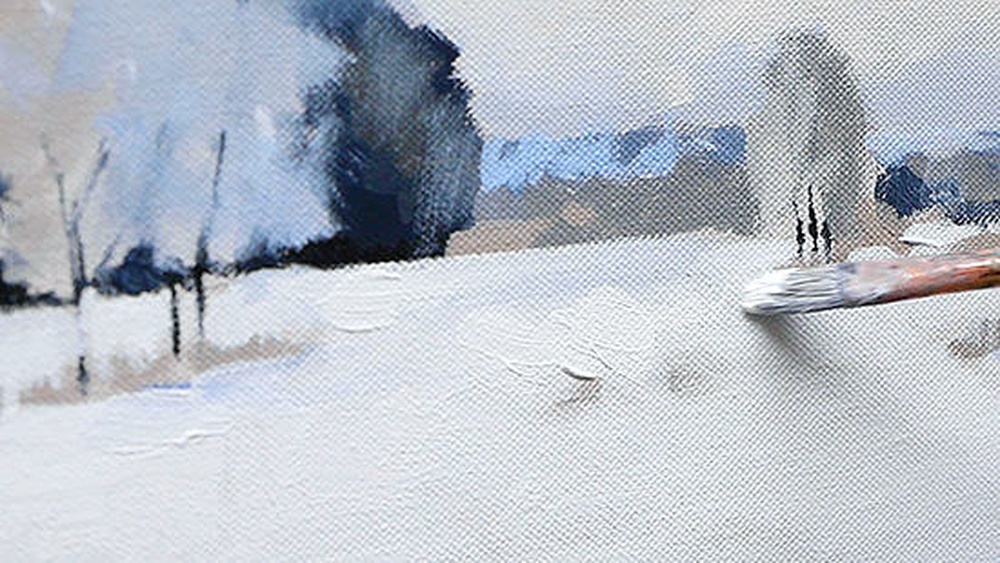
Paint the entire snow-covered ground in a light shadow blue. This sounds counterintuitive, but starting with the cool mid-tone gives you a base to add both deeper shadows and warm light on top.
Step 4: Add Sunlit Areas
With warm off-white, paint the areas that face the light: the tops and right-facing slopes of drifts and the open field in sunlight. Use horizontal or gently curving strokes that follow the ground.
Step 5: Paint Deep Shadows
With the deep shadow mix, paint the shadowed sides of drifts, hollows and the cast shadows of trees. Cast shadows should follow the contours of the snow surface, curving up and over drifts rather than lying flat.
Step 6: Foreground Trees
Paint a few bare trees or pines in dark browns and greens. Add snow on the top surfaces of branches with a small brush or knife, warm on the lit side and cool on the shadow side.
Step 7: Soften Transitions
Blend the edges between light and shadow areas where the snow surface curves gently. Keep edges sharper where drifts have defined crests.
Step 8: Add Texture and Sparkle
Using a toothbrush or stiff brush, spatter a few tiny dots of pure white on the sunlit snow to suggest sparkle. Add a few tiny blue-gray dots in shadow areas for texture. Keep it subtle.
Step 9: Final Highlights
Place the brightest pure white on the crests of drifts and the tops of snow on branches nearest the light. These final touches give the painting its glow.
Painting Snow Drifts
Drifts are smooth, wind-shaped forms. Treat them like soft, rounded hills:
- Paint the drift shape in mid-tone blue.
- Add warm light on the side facing the sun, blending softly over the rounded top.
- Paint a crisp crest line where wind has sculpted a sharp edge.
- Darken the hollow under the crest, which often holds the deepest blue shadow.
- Add reflected light, a slightly lighter blue, at the bottom of shadow areas.
A palette knife is excellent for drift crests. Load a thin ridge of warm white on the knife edge and pull it along the top of the drift for a crisp, sculpted edge.
Footprints, Tracks and Texture in Snow
Small surface details make a snowfield feel real and give scale. Footprints and sled tracks are shallow depressions: paint the side nearest the light in cool shadow blue and the far inner edge in a lighter, warmer tone. Tracks shrink and narrow as they recede. Wind-rippled snow shows gentle parallel ridges, each with a light side and a soft shadow. Near trees and rocks, snow often forms shallow wells where wind scoured around the base, so paint a slightly darker blue ring around trunks.
Snow on Trees, Rooftops and Fences
- Trees: snow sits on top of branches, thicker on horizontal branches and thinner or absent on vertical ones. Paint the branch first, then add snow on its upper surface only.
- Rooftops: snow forms a thick, rounded layer with a soft overhang at the eaves. Paint the edge thick and rounded, with a cool shadow underneath.
- Fences: snow caps each post and rail. Include small drifts around the base of posts where wind piles snow.
- Rocks: snow caps rounded tops while dark rock shows on steep sides.
How to Paint Falling Snow
- Finish and dry the painting completely.
- Thin titanium white slightly with water so it spatters well.
- Dip an old toothbrush, tap off excess paint, and test on scrap paper.
- Run your thumb across the bristles to spatter flakes over the painting. Hold the brush farther away for smaller flakes.
- Add a few larger flakes in the foreground with the tip of a round brush or a dotting tool.
- Mask areas, such as the sky, with paper if you want flakes only in certain zones.
For a gentle snowfall, use fewer, smaller flakes. For a blizzard, add more flakes, slant them with short streaks and reduce contrast in the distance with a thin white glaze. Acrylic inks with dropper caps can also produce controlled, crisp dots; our Daler-Rowney acrylic ink review covers how inks perform for fine detail.
How to Paint Snow With Acrylics for Beginners: Simple Exercise
Paint three small snow mounds on a 5×7 panel:
- Paint a blue sky.
- Paint three rounded mounds in light blue.
- Add warm white on one side of each mound.
- Add deeper blue on the other side and underneath.
- Paint a dark tree trunk and its blue cast shadow across the mounds.
This exercise teaches the essential warm-light, cool-shadow principle in less than 30 minutes. Repeat it with overcast lighting, using only cool grays and almost no warm light, and compare the two panels side by side. Seeing how much the mood changes with the same shapes is one of the fastest ways to understand how snow color depends on the light rather than on the snow itself.
Snow at Different Times of Day
The same field of snow can look completely different depending on when you paint it. Choosing a time of day before mixing colors keeps the whole painting consistent.
| Time / weather | Lit snow | Shadowed snow | Contrast |
|---|---|---|---|
| Clear midday | Near-white, slightly warm | Clear sky blue | High |
| Early morning | Pale gold or peach | Cool blue-violet | Moderate to high |
| Sunset | Pink, orange or rose | Deep violet | High, very colorful |
| Overcast | Soft gray-white | Slightly darker gray-blue | Low |
| Moonlight | Pale blue-gray | Deep blue | Moderate, mostly cool |
Snowy Scenes With Lights and Cabins
A lit cabin or village at dusk is one of the most popular winter subjects. The warm glow of windows contrasts beautifully with cool blue snow. Paint the snow in deep blues and violets first, then add windows in warm yellow-orange. Around each window, glaze a soft warm halo onto the surrounding snow, and paint warm light falling on the snow directly below or in front of each window as an elongated patch. That warm-cool contrast is what makes these scenes feel cozy. Smoke from a chimney, painted in soft gray against a darker sky, adds a final sense of life.
Painting Snow Leopard Fur With Acrylics
Snow leopard fur uses many of the same color ideas as snow. The fur is not pure white; it is a soft gray-cream with cool blue-gray shadows and warmer highlights. Paint the base in a light warm gray, add darker rosette markings with a small round brush using broken, soft-edged shapes, and then flick fine hair strokes with a liner in lighter and darker tones following the direction of fur growth. Keep the rosettes slightly blurred and integrated into the fur rather than crisp spots.
Common Mistakes When Painting Snow
- Pure white everywhere. Snow needs warm and cool variations.
- Gray shadows mixed from black. Snow shadows are blue or violet.
- Flat cast shadows. Shadows should curve over drifts and follow the surface.
- Snow on the underside of branches. Snow sits on top surfaces.
- Too much sparkle. Glitter-like spatter everywhere looks artificial.
- Hard edges everywhere. Most snow transitions are soft, with crisp edges only at drift crests.
- Uniform falling flakes. Vary size and density.
Related Reading
FAQs
How do you paint snow in acrylics?
Mix warm and cool versions of white: blue-violet for shadows and warm off-white for sunlit areas. Paint the shadow color first, add the light areas on top, and save pure white for small highlights.
What color should snow shadows be?
Snow shadows are usually blue or blue-violet, because shadowed snow reflects the blue sky. Mix white with ultramarine and a touch of alizarin or purple.
How do I paint snow with acrylics for beginners?
Start with a small exercise: paint rounded snow mounds in light blue, add warm white on one side and darker blue on the other, then paint a tree with a blue cast shadow.
How do I make painted snow sparkle?
Spatter a few tiny dots of pure titanium white onto sunlit snow with a toothbrush, and add a few individual highlights with a fine brush. Keep the effect subtle.
How do I paint falling snow?
Once the painting is dry, spatter thinned white paint with an old toothbrush, then add a few larger flakes in the foreground with a round brush or dotting tool.
Should snow be painted with a brush or a palette knife?
Both work. Brushes are best for soft, rounded snowfields and drifts, while a palette knife creates crisp crests and thick snow on branches and roofs.
Final Thoughts
Painting snow with acrylic paint is a lesson in seeing color where you expect white. Warm light, cool shadows, soft transitions, crisp crests and restrained sparkle are what turn a white surface into a convincing winter scene.
Snow paintings use more white than any other subject, so the paint you choose has an outsized effect. Compare options in our guide to the best acrylic paints for winter landscapes.